
Free worksheet and solutions · OCR A A Level · H556
Proportionality Ratios and Scaling Physics Worksheet
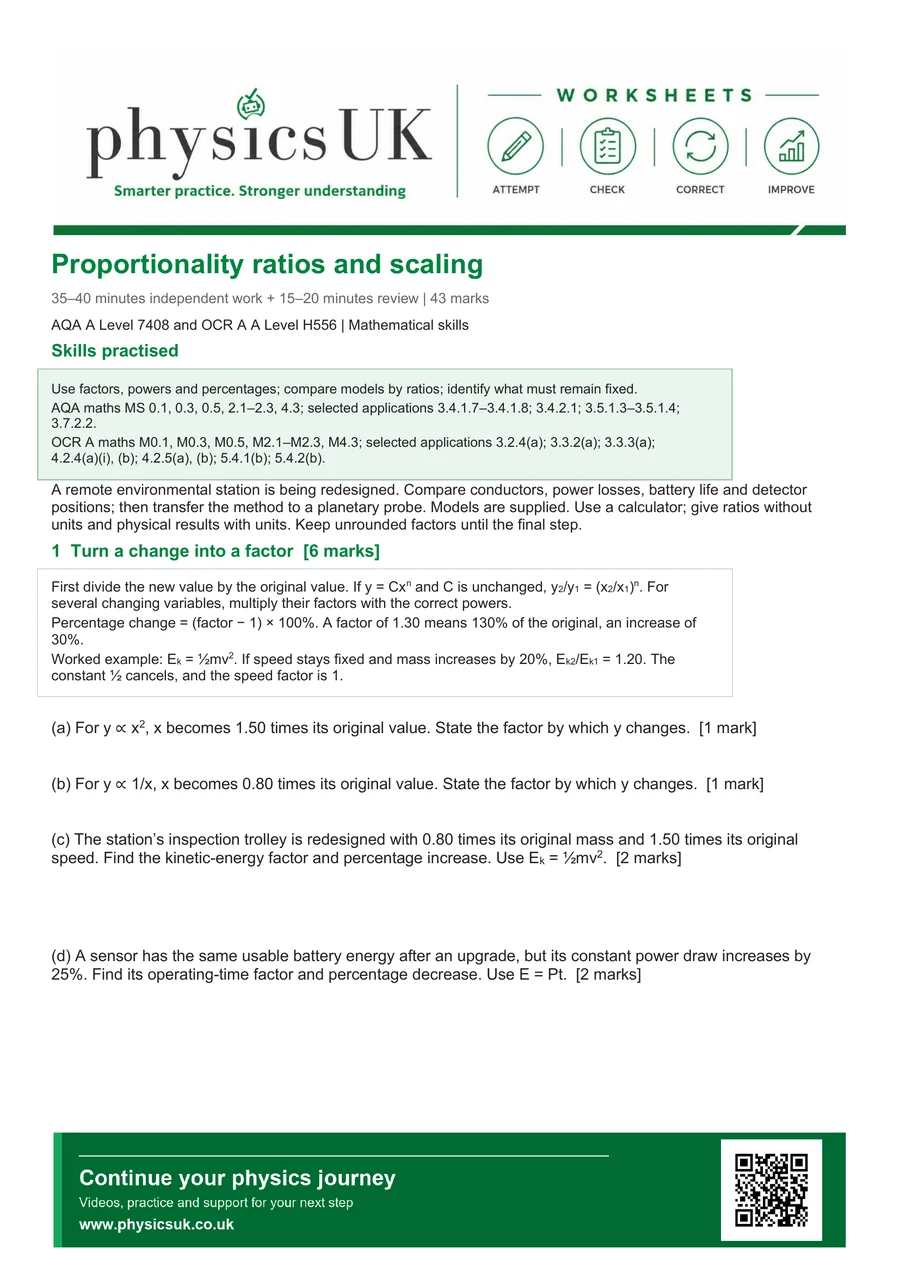
A-level physics proportionality worksheet with worked answers: ratios, scaling, percentage changes and inverse-square laws through applied design problems.
What is covered
Questions and skills covered
The worksheet contains 6 pages of printable questions. A separate 6-page solutions PDF makes it easy to mark, review or share answers after the activity.
- Factors and percentage changes
- Simultaneous changes in mass, speed, length and diameter
- Resistance and mass ratios for circular conductors
- Constant-current and constant-voltage heating comparisons
- Combined battery-energy and power ratios
- Testing a supplied inverse-square detector model
- Selecting a design against mass, loss and time constraints
- Planetary field-strength ratios using radius plus altitude
About this activity
Remote environmental station redesign: conductor geometry, mass and heating, optical detector positioning, battery runtime, then transfer to a planetary probe.
Before you start
Powers and square roots; Resistance, density, energy and power models; Interpreting a supplied inverse-square model
Specification fit
This shared PDF includes the applicable boards’ references and a board-neutral footer. Choose an eligible course below and check the scope before assigning it.
- AQA A Level 7408 · Mathematical skills · 3.4.1.7, 3.4.1.8, 3.4.2.1, 3.5.1.3, 3.5.1.4, 3.7.2.2
- OCR A A Level H556 · Mathematical skills · 3.2.4(a), 3.3.2(a), 3.3.3(a), 4.2.4(a)(i), 4.2.4(b), 4.2.5(a), 4.2.5(b), 5.4.1(b), 5.4.2(b)
OCR A A Level Physics Worksheets
H556 · 3.2.4(a), 3.3.2(a), 3.3.3(a), 4.2.4(a)(i), 4.2.4(b), 4.2.5(a), 4.2.5(b), 5.4.1(b), 5.4.2(b)
Choose the correct pathway: Guided mathematical skills with selected kinetic-energy, conductor geometry, electrical power, operating-time and gravitational-field applications. The optical detector model is supplied as a mathematical application; no nuclear-physics or complete topic-coverage claim. Entire pair is A-level only. No AS or GCSE route or required-practical tag has been approved.
Classroom use
Use the worksheet for class practice, homework, intervention, cover work or revision. Keep the PhysicsUK attribution intact when sharing copies with pupils.
Choose targeted follow-up practice
Use the diagnostic map to choose one or two worksheets. Keep your qualification and tier, and follow each PDF’s printed replacement instructions. The diagnostic score is not a grade prediction.