
GCSE Physics · A Level Physics · Revision guide
How to revise Physics: the best ways to improve at GCSE and A Level
Stop measuring revision by pages read or hours spent. The useful question is: what can you not yet do, and what will you do next to fix it?
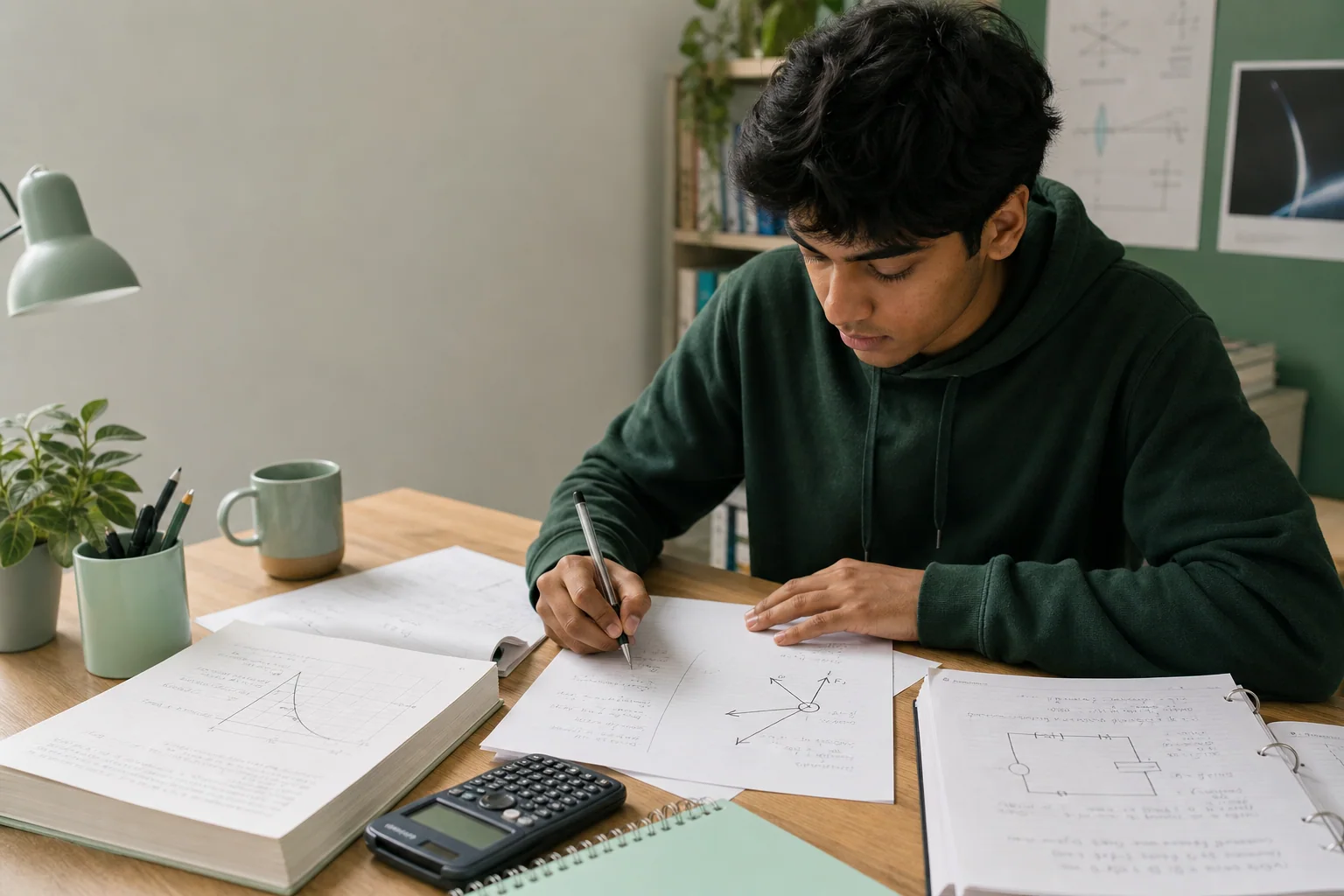
1. Start here
What is the best way to revise Physics?
The best way to revise Physics is to repeat a short cycle: diagnose a precise weakness, retrieve the relevant knowledge from memory, apply it to a question, get feedback, correct the cause of the mistake and revisit it later. This combines active recall with problem solving and stops revision becoming a tour of things you already know. Good revision is not about doing the most work; it is about repeatedly identifying what you cannot yet do and fixing it.
- DiagnoseFind one precise gap.
- RetrieveRecall before looking.
- ApplyAttempt a fresh question.
- FeedbackCompare with good evidence.
- CorrectFix the reason, not just the answer.
- RevisitCheck again after a delay.
Physics needs several skills at the same time. A pupil may know the facts but choose the wrong equation; calculate accurately but omit the unit; or understand the idea but fail to build a clear written explanation. That is why a single label such as “good at electricity” tells you very little.
Why these methods? A major review rated practice testing and distributed practice as high-utility learning techniques across a broad range of learners and tasks. The review did not say that every form of testing, spacing or interleaving works equally well, so the practical details below matter. Read Dunlosky and colleagues’ 2013 review.
2. Diagnose
Find your weaknesses first
Start Physics revision with evidence, not a favourite topic. Use the specification, recent tests and short diagnostic questions to locate precise things you cannot yet recall, explain or apply.
A topic checklist is useful, but “red, amber, green” can become guesswork if it is based on confidence. Test each judgement. Can you state the definition without notes? Can you select the relationship in an unlabelled question? Can you explain the result? Can you still do it a week later?
This does not tell you what to practise next.
Each label suggests a specific retrieval or application task.
For AQA GCSE Physics and Combined Science, AQA A Level Physics or OCR A Level Physics A, keep the correct specification open while you build the list. A question bank tells you what has been asked; the specification tells you what may be assessed.
3. Retrieve
Use active recall for the things Physics requires you to remember
Active recall means trying to produce an answer before seeing it. It is especially useful for equations, definitions, laws, units, practical knowledge and key relationships.
Rereading can make a page feel familiar, but recognition is not the same task as producing an answer in an exam. Close the book, answer, then check. If you cannot retrieve it accurately, you have found useful work.
| What to retrieve | A stronger prompt | Check after answering |
|---|---|---|
| Equation | Write the relationship for electrical power. | Name every symbol, give the usual SI units and state when it applies. |
| Definition | Define electromotive force. | Compare meaning and precision, not just one remembered keyword. |
| Relationship | How does resistance affect current at constant potential difference? | Explain the physical relationship as well as writing an equation. |
| Practical | How would you measure the resistivity of a wire? | Include measurements, controls, graph or calculation, uncertainty and safety where relevant. |
Flashcards are useful when the prompt demands a real response. A card that says “read this equation” is passive; a card that asks you to recall, interpret and apply it is active. Short A Level Physics MCQ practice can also expose misconceptions, but follow it with questions that require working and explanation.
Retrieval is not merely a way to measure memory. In a well-known experiment, repeated testing improved delayed recall more than repeated studying once items had been learned. The material was vocabulary rather than school Physics, so it supports the retrieval principle rather than proving a particular Physics routine. Read Karpicke and Roediger’s study in Science.
4. Apply
Solve Physics problems independently
Move from worked examples to unsupported questions. Examples can teach a method, but improvement is demonstrated when you can choose and carry out that method without copying the steps.
If a topic is new, study one good worked example and explain why each step is there. Then cover it and try a similar problem. Reduce the support until you can complete a fresh question alone. Guidance on science teaching recommends worked examples, fading and alternating examples with problems rather than leaving novices to guess a method indefinitely. See the EEF secondary science guidance.
- Identify quantities.Write what is given and what the question wants, using symbols where helpful.
- Convert units.Deal with prefixes, minutes, centimetres, electronvolts or other conversions before substitution.
- Choose the Physics.Select the model, principle or relationship; do not start by hunting for any equation containing the same letters.
- Rearrange.Make the required quantity the subject before inserting numbers when that keeps the algebra clearer.
- Calculate.Show substitution and keep enough figures during intermediate steps.
- Add the unit.Make sure the unit belongs to the quantity you calculated.
- Sense-check.Check sign, direction, order of magnitude, limiting behaviour and physical plausibility.
For more deliberate calculation practice, use A Level Physics problem-solving questions or the free PhysicsUK Solve preview. Keep all working visible: a wrong final number can still reveal a correct model, or expose exactly where the method failed.
5. Select
Practise choosing the Physics
Mix question types so that you must decide which Physics applies. Twenty nearly identical questions can improve execution while hiding a weakness in method selection.
A worksheet headed “kinetic energy calculations” has already made the hardest decision for you. Real papers move between energy, momentum, circuits, graphs and practical data without announcing the technique. Once you can complete a blocked set accurately, mix it with previously learned material.
Blocked practice
Useful for learning one method
Complete a small set of potential-divider questions while the method is new. Concentrate on the circuit model and the algebra.
Interleaved practice
Useful for learning when to use it
Mix potential dividers with internal resistance, power and resistivity so each question requires a choice before a calculation.
In an undergraduate Physics study, interleaved homework improved memory and problem-solving performance and appeared to give learners more practice in strategy selection. It is promising evidence, not a guarantee that every shuffled worksheet helps every GCSE or A Level pupil; mix questions after the underlying methods have been taught. Read the open-access physics study.
6. Feedback and correction
Mark and diagnose mistakes
A score says how the attempt went; a diagnosis says what to do next. Mark while the reasoning is still visible, then classify the cause of every lost mark before writing a correction.
Knowledge
A fact, definition, equation or unit was not recalled.
Conceptual Physics
The physical model or causal idea was wrong or incomplete.
Equation selection
The mathematics may be sound, but the chosen relationship does not fit.
Maths
Rearranging, substitution, standard form, graphs or calculator work failed.
Units
A conversion, prefix, derived unit or final unit was missing or wrong.
Written communication
The answer did not state the link, comparison or conclusion clearly enough.
Practical or data
The method, variable, uncertainty, graph or evaluation was weak.
Careless
A sign, copied value, instruction or arithmetic slip occurred despite secure understanding.
“Careless” should be the last category, not the automatic one. If the same “careless” unit error happens repeatedly, it is a habit that needs a deliberate check. If you chose the wrong equation because you misread the situation, that is a Physics-selection error, not a calculator mistake.
A useful correction has three parts
- State the cause: “I treated terminal potential difference as the emf.”
- Write the corrected reasoning: “The lost volts across the internal resistance must be subtracted.”
- Set a later check: “In three days, attempt one internal-resistance graph question and one calculation without notes.”
Mark schemes are evidence, but they are not always teaching explanations. If you cannot see why your answer failed, compare a worked solution, ask your teacher, or use formative feedback. Research finds that feedback effects vary considerably with the information given; feedback is not a single uniformly effective treatment. Read the 2020 feedback meta-analysis.
7. Space the check
Revisit mistakes later
Do not retire a weakness because you answered correctly immediately after reading the solution. Reattempt it after a delay, preferably with a different question that tests the same idea.
Immediately after feedback, the method is still in working memory and the question is familiar. A later attempt asks whether you can retrieve and transfer the learning. There is no perfect fixed spacing schedule for every pupil and every topic. A practical approach is to revisit a new correction after a few days, then again after a longer gap if it remains fragile.
Keep the revisit small: one definition, one calculation and one explanation can be enough. Correct answers move to a longer interval; repeated errors return to diagnosis. This is distributed practice in a usable form, not a demand to rebuild your entire timetable around an app.
8. Explain
Practise written Physics explanations
Strong Physics explanations connect a cause to a consequence. Practise calculations and written answers every week; being comfortable with formulae does not automatically produce clear reasoning.
Build a chain rather than a pile of keywords. A useful rehearsal frame is:
For example: Because the resistance increases while the supply potential difference is constant, the current decreases. Therefore the power transferred by the component decreases, so less energy is transferred each second. The linking words are scaffolding, not mandatory exam vocabulary. The Physics on each side of them must be correct.
After writing, underline the cause, the link and the requested conclusion. If one is absent, edit the answer. Use A Level Physics QWC practice questions or the free written-explanation practice to make this a normal part of revision.
9. Represent
Draw diagrams even when the question does not ask for one
A quick, labelled diagram can turn words into a model you can reason with. Draw it before choosing equations when direction, geometry, components, paths or energy levels matter.
- Force diagrams: isolate one object, draw forces from the object and label direction and type.
- Fields: show direction, relative spacing and the source; do not confuse a field line with a particle path.
- Circuits: redraw an awkward arrangement and mark known current and potential difference information.
- Rays: add the normal, directions and relevant angles.
- Vectors: choose a scale or resolve components consistently.
- Waves: mark equilibrium, amplitude, wavelength and phase points where relevant.
- Energy-level diagrams: show permitted levels and label the direction of transitions.
The diagram is working, not artwork. It should reduce ambiguity. If it adds assumptions the question did not make, it can lead you in the wrong direction, so label only what the physics supports.
10. Methods and data
Revise practical Physics properly
Revise practicals as decisions, measurements and evidence—not as scripts to memorise. You need to explain why a method works, how data should be treated and whether the conclusion is justified.
Method
What will you measure, with what instrument, over what range, and how often?
Variables
Identify independent, dependent and control variables, then say how controls are maintained.
Graphs
Choose axes, scales and units; use a best-fit line and connect gradient or intercept to the Physics.
Uncertainty
Read instruments realistically, repeat where useful and distinguish uncertainty from a mistake.
Limitations
Name a limitation specific to the method and explain its effect on the result.
Improvements
Give an actionable change and explain how it addresses the named limitation.
A vague improvement such as “use better equipment” rarely shows enough thinking. Say what would be changed, what would be measured more precisely and why that matters. Official specifications make clear that practical work includes planning, variables, data presentation, graphs, uncertainty and evaluation: see AQA GCSE Physics practical assessment, AQA A Level Physics practical assessment and the OCR A H556 specification.
11. Build towards the exam
Use past papers at the right time
Past papers are valuable, but a full timed paper is not always the best first step. Match the format to your stage of revision, then spend serious time analysing the attempt.
Topic questions
Learn and check one area with support available. Diagnose specific gaps without the noise of a complete paper.
Mixed questions and sections
Practise selecting Physics across topics and build stamina in manageable blocks.
Full timed papers
Rehearse timing, question choice, checking and concentration under realistic conditions.
After every paper, separate “I lost five marks” into causes. Which topic? Which skill? Was it a knowledge gap, equation choice, maths, unit, explanation, practical skill or instruction error? Correct it, find one fresh follow-up question and schedule a later revisit. Avoid memorising a mark-scheme phrase without understanding when it applies.
Use your exam board for the authoritative documents and current assessment information: AQA GCSE Physics 8463, AQA A Level Physics 7408 and OCR A Level Physics A H556.
12. Make passive work active
What are the worst ways to revise Physics?
The weakest revision methods are the ones that never require you to retrieve, choose, apply or correct. They are not useless, but they are poor as the whole session.
| Activity | Its limitation | Turn it into active revision |
|---|---|---|
| Rereading notes | Familiarity can hide weak recall and application. | Read briefly, close the notes, retrieve the key points, then answer a question. |
| Excessive highlighting | Selecting large amounts of text does not show that you can use it. | Highlight only a small set of relationships, then convert them into prompts or questions. |
| Watching videos without practice | A clear explanation can feel like your own understanding while the presenter is doing the thinking. | Pause before each step, predict what comes next, then solve a fresh problem afterwards. |
| Copying worked examples | Copying rehearses transcription more than independent problem solving. | Explain each decision, cover the solution and reproduce it, then try an unsupported variant. |
| Questions without proper marking | You can repeat the same misconception or never discover missing marking points. | Mark promptly, classify the error, correct the reasoning and schedule a later check. |
| Only revising favourite topics | Confidence grows where it is already high while examinable gaps remain. | Use specifications and diagnostic results to allocate more time to precise weaknesses. |
13. A session you can use today
A practical 30-minute Physics revision session
In 30 minutes, include retrieval, a known weakness, independent questions, diagnosis and a planned revisit. The timings below are a starting structure, not a rule.
Retrieval
From memory, write two equations, one definition and one diagram from a previous topic.
Revisit a weakness
Reattempt one item from your error log without looking at the old solution.
Problem solving
Complete two or three exam-style questions independently. Include at least one that makes you choose the method.
Mark and diagnose
Use the solution or feedback, then label the cause of every lost mark.
Correct and plan
Write the corrected reasoning and record the exact task to revisit, with a date.
If the marking reveals a substantial misconception, stop. It is better to correct one important idea than rush through another question to complete the timetable.
14. Adjust the emphasis
How should GCSE and A Level Physics revision differ?
The revision cycle is the same at both levels, but A Level Physics demands more multi-step reasoning, mathematical application, precision, uncertainty and combination of topics.
| Revision need | GCSE Physics | A Level Physics |
|---|---|---|
| Course map | Know whether you study separate Physics or Combined Science, your tier where applicable, and your board. | Track AS/first-year knowledge as well as later content, paper structure and any option route. |
| Mathematics | Build secure substitution, rearranging, graphs, ratios, standard form and unit conversion. | Add more algebraic manipulation, logarithms, trigonometry, radians, gradients, uncertainty and multi-stage modelling. |
| Problem selection | Move from topic questions to mixed GCSE contexts. | Expect more synoptic questions and unfamiliar situations that combine ideas from different modules. |
| Written answers | Use precise scientific terms and connected cause-and-effect explanations. | Increase the precision of assumptions, comparisons, models and chains of reasoning. |
| Practicals | Revise required practical knowledge, variables, graphs, errors and improvements. | Develop deeper analysis of uncertainties, gradients, intercepts, method design and evaluation alongside the practical endorsement. |
Use A Level Physics revision resources for both OCR A H556 and AQA 7408. GCSE pupils can start from the AQA GCSE Physics and Combined Science hub and move into the board- and topic-specific pages.
15. Live resource comparison
What are the best Physics revision websites?
There is no single best Physics revision website for every job. Use official exam-board sites for authoritative course documents, broad libraries for notes and past papers, video sites for explanation, problem platforms for difficult application, and assessment tools for feedback and next steps.
Disclosure: this article is published by PhysicsUK, so this is not an independent ranking. The comparison is based on publicly visible official pages checked on . Features, access and prices can change.
| Website | Best used for | How to use it actively |
|---|---|---|
| AQA and OCR | Official specifications, assessment information, past papers, mark schemes and examiner materials. | Build your checklist from the current specification, then use official questions to check coverage and exam language. |
| Physics & Maths Tutor (PMT) | A broad revision library with notes, factsheets, videos and questions from past papers organised by topic across many boards. | Use a short note to repair a gap, attempt a topic pack without support, then mark and log the specific error. |
| Isaac Science | Free interactive Physics problem solving from GCSE through A Level and beyond, with questions at varying difficulty. | Use it to stretch method selection and perseverance once the core idea is secure; keep a full written solution beside the online answer. |
| A Level Physics Online | Video explanations organised by board and topic, plus practical videos, worked solutions and other free or premium resources. | Pause and predict, reproduce the derivation or example from memory, then complete an unrelated question away from the video. |
| Save My Exams | Structured exam-board resources including revision notes, exam questions, flashcards and past papers, with access depending on the resource and plan. | Use the structure to locate a gap, but close the notes before retrieval and question practice. |
| PhysicsUK Publisher of this guide | Original course-matched assessment, marking, specific weakness identification and targeted follow-up for AQA GCSE, AQA A Level and OCR A. | Attempt PhysicsUK Exam Studio, PhysicsUK Solve, QWC or MCQs, act on the feedback, then revisit the gap. |
PhysicsUK is deliberately different: it is assessment-focused. PMT is a sensible place to find a large bank of resources. PhysicsUK is designed to collect evidence from what you can do, mark the attempt, identify the gap and make the next practice more useful—not simply give you another summary of a topic you already recognise. For a detailed feature comparison, read PhysicsUK vs Physics & Maths Tutor.
Stop reading. Start doing.
Don’t just practise more questions—find out what to practise next.
Choose your actual course, attempt one original question and see how PhysicsUK turns the working into feedback and a next step. The public demonstration needs no account or payment card.
Sources and editorial method
What this guide is based on
The revision advice combines classroom and examining experience with learning-science reviews, Physics research and current official product or specification pages. Competitor descriptions were checked against the providers’ own websites rather than copied from comparison articles.
Learning and feedback research
- Dunlosky et al. (2013), review of ten learning techniques.
- Karpicke & Roediger (2008), retrieval and long-term retention.
- Samani & Pan (2021), interleaved practice in undergraduate Physics.
- Wisniewski, Zierer & Hattie (2020), meta-analysis of educational feedback.
- US Institute of Education Sciences, organising instruction and study.
Official course and resource checks
Questions
Frequently asked questions
What is the best way to revise Physics?
Use a repeated cycle: diagnose a specific weakness, retrieve the relevant knowledge from memory, apply it to an unfamiliar question, get feedback, correct the cause of the mistake and revisit it later. This combines recall with the calculation, explanation, practical and problem-solving skills Physics exams actually assess.
Are past papers good for Physics revision?
Yes, when used at the right time. Begin with topic questions, move to mixed paper sections, then use complete timed papers near the exam. Mark every attempt and classify why each mark was lost; completing papers without correcting the weaknesses wastes much of their value.
How many hours should I revise Physics?
There is no reliable universal number. Start with short, regular sessions that fit your course load and increase them as assessments approach. Judge a session by what you retrieved, attempted, corrected and scheduled to revisit, not by time alone.
How do I remember Physics equations?
Retrieve each equation from memory, name every symbol and unit, state when the relationship applies, and use it in varied calculations. Check your current exam-board specification and formula sheet so you know which relationships must be recalled and which are provided.
How do I improve Physics calculations?
Use the same visible process each time: identify quantities, convert units, choose the physical relationship, rearrange, substitute, calculate, add the unit and sense-check. Then mix problem types so you must choose the method rather than repeat a method supplied by the worksheet heading.
Why do I understand Physics but struggle with exam questions?
Recognising an explanation is easier than selecting and applying Physics independently. Practise without notes, use mixed questions, make your equation choice and reasoning visible, and classify errors. This reveals whether the gap is recall, concept, equation choice, mathematics, units or communication.
What is the best Physics revision website?
The best website depends on the task. Exam-board sites are best for specifications and official papers; Physics & Maths Tutor for a broad question and notes library; Isaac Science for challenging problem solving; A Level Physics Online for videos; Save My Exams for structured resources; and PhysicsUK for assessment, feedback and identifying what to practise next. This comparison is published by PhysicsUK.
How should I revise GCSE Physics?
Use the GCSE Physics specification to find precise gaps, retrieve equations, definitions and units, and practise topic questions before mixed and timed papers. Include calculations, written explanations, required practicals, graphs and circuit, ray, force and energy diagrams.
How should I revise A Level Physics?
At A Level, place more emphasis on multi-step problems, unfamiliar contexts, mathematical modelling, uncertainty, precise explanations and questions that combine topics. Keep first-year content active while learning later material, and use mixed practice so you must select the Physics yourself.
Last reviewed: 2026-08-14 · PhysicsUK is independent and is not affiliated with or endorsed by AQA or OCR.