
Start with the real problem
Why is my child struggling with Physics even though they revise?
A pupil can spend a long time revising without practising the thing an exam requires: choosing and applying Physics independently. Reading notes and watching explanations can make a topic feel familiar, but familiarity may disappear when the book closes and a question presents the idea in an unfamiliar situation.
“I do not get Physics” rarely describes one problem. Look at a recent piece of work and ask where the answer first went wrong. The next step depends on the answer.
They cannot remember the starting fact
Use short retrieval practice for the equation, definition, unit or physical principle before attempting another question.
They know the facts but cannot start
Practise identifying the quantities and deciding which model or relationship applies. Do not show the whole solution immediately.
The mathematics breaks down
Separate the Physics choice from rearranging, standard form, unit conversion, gradients or calculator use, then reconnect the steps.
They understand it but lose explanation marks
Compare their wording with the required chain of reasoning. Ask which link in the explanation is missing rather than memorising a model paragraph.
They panic when the context looks new
Begin with a familiar example, then change one feature at a time. The goal is to recognise the underlying Physics, not the surface story.
They avoid beginning altogether
Make the first task smaller. One question attempted properly is more useful than an ambitious timetable that never gets started.
The improvement cycle
What is the best way to improve at Physics?
Use appropriately difficult questions to expose a precise gap, then give the pupil a chance to act on the feedback. Struggle is useful only when the task remains possible and there is a route forward. Leaving a child stuck for an hour is not productive practice.
- ChooseOne topic and one manageable skill.
- AttemptWork without notes and keep the reasoning visible.
- DiagnoseFind the first missing idea or incorrect step.
- CorrectChange the work while the thinking is still fresh.
- RetryAttempt a related question with less support.
- RevisitCheck the skill again after a few days.
Rapid feedback is useful because a pupil can still remember why they chose each step. It is not valuable merely because it is fast. Feedback needs to identify something specific, explain what should change and leave time for another attempt. The Education Endowment Foundation describes effective feedback in the same practical terms: it should focus on the task and give the learner an opportunity to act on it.
Evidence checked: Read the EEF summary of feedback evidence and its guidance on improving secondary science.
For the pupil-facing version of this method, use PhysicsUK’s detailed guide to how to revise GCSE and A Level Physics.
A manageable starting point
How much Physics revision should my child do?
Several short sessions are usually easier to sustain than one revision marathon. There is no universal number of hours, and the plan must fit around lessons, other subjects, access needs and wellbeing. Start small enough that it actually happens.
Find the gap
Spend 20–25 minutes on retrieval and two or three short questions. Record one precise weakness.
Practise the weak skill
Spend 25–30 minutes on calculations or explanations. Review the feedback and correct the work.
Check it stuck
Return after a delay. Mix the skill with an older topic so the pupil must choose the Physics independently.
Near an assessment, a teacher may recommend more focused work. Complete papers become useful when most individual topics are secure enough to combine. Earlier on, targeted questions usually produce clearer information than repeatedly sitting whole papers.
Match the course
Is the best support different for GCSE and A Level Physics?
The same practice and feedback cycle works at both levels, but the source of difficulty often changes.
GCSE Physics and Combined Science
Secure the core knowledge, equations, units, practical methods, graphs and short written explanations. Pupils also need practice recognising familiar Physics inside unfamiliar contexts.
Explore AQA GCSE Physics support or use the free AQA GCSE Physics worksheets.
A Level Physics
Expect more multi-step mathematics, modelling, uncertainty, precise written reasoning and questions that combine ideas from different topics.
Use the AQA A Level Physics or OCR A Level Physics A course pages. Parents of sixth-form pupils can also read the A Level parent support guide.
If your child is moving from GCSE into sixth form, the free GCSE to A Level Physics transition guides explain the change in mathematics, independence and answer quality.
When human help matters
Does my child need a Physics tutor?
Sometimes, but first identify what a tutor needs to solve. More teaching is not automatically the answer when the pupil mainly needs regular independent practice. Equally, a question platform cannot replace the judgement and relationship of a good teacher or tutor.
Structured independent practice may be enough when...
- the pupil understands lessons but does too few questions;
- feedback arrives too late for regular corrections;
- they need more course-matched calculations and explanations;
- they can work independently once the next task is clear.
Speak to the school or consider a tutor when...
- the same misconception returns after several careful attempts;
- significant teaching or practical work has been missed;
- motivation, confidence or anxiety needs personal support;
- you need advice about predicted grades, access arrangements or school decisions.
A tutor should be able to explain how they diagnose gaps, what the pupil will do between sessions and how progress will be reviewed. PhysicsUK maintains a separate UK Physics tutoring services directory for families who decide that human tuition is the right next step.
Support without taking over
How can I help if I do not understand Physics?
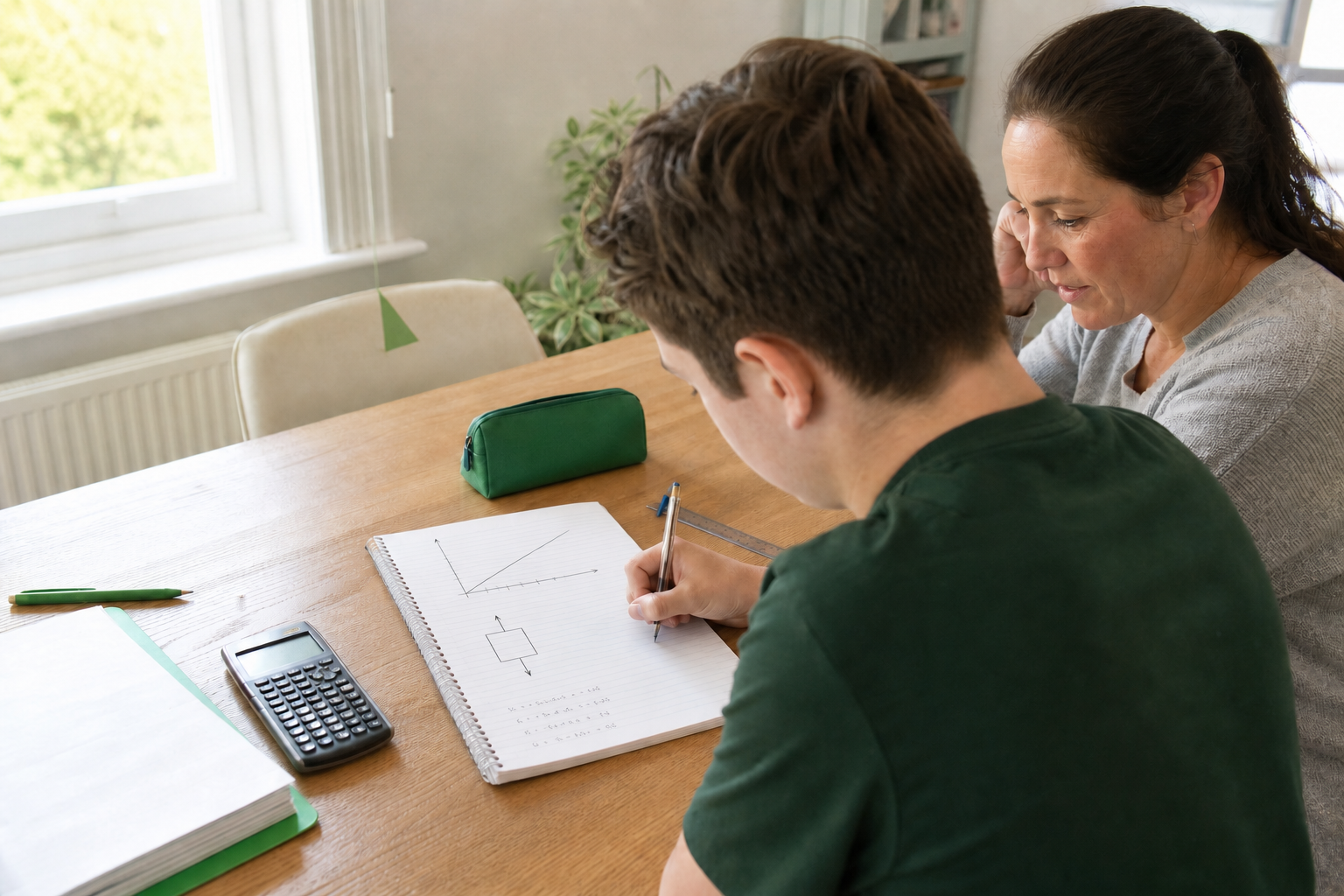
You do not need to check the equations or reteach the lesson. A parent can make good practice easier to begin, protect it from interruptions and ask questions that encourage the pupil to think about their own learning.
Instead of“How many hours did you revise?”
Ask“Which question showed you what to practise next?”
Instead of“What mark did you get?”
Ask“What did you change after reading the feedback?”
Instead of“Why are you still getting this wrong?”
Ask“Where does the method first stop making sense?”
A sensible first conversation
- Ask your child which part of Physics currently feels hardest.
- Check whether their teacher has identified a more precise topic or skill.
- Agree one short session, not an entire revision programme.
- Let them attempt the work without hovering over each step.
- At the end, ask what they will do differently next time.
If revision is causing persistent distress, conflict or avoidance across subjects, speak to the school. The immediate priority may be workload, wellbeing or additional learning support rather than another Physics resource.
Sources and further guidance
- Education Endowment Foundation: Feedback
- Education Endowment Foundation: Improving Secondary Science
- Dunlosky and colleagues: Improving Students’ Learning With Effective Learning Techniques
These sources support the principles of practice, feedback and revisiting. They do not guarantee a particular result for an individual pupil. School staff remain best placed to advise on current attainment and personal needs.
Questions
Frequently asked questions
Why is my child struggling with Physics even though they revise?
They may recognise notes and examples but still find it difficult to select and apply the Physics independently. Short questions attempted without notes can show whether the barrier is recall, a misconception, equation choice, mathematics, units, written explanation or confidence.
How can I help my child with Physics if I do not understand it?
You do not need to teach the subject. Help them protect a short study time, choose one precise area, attempt questions before checking notes, act on feedback and return to the same skill later. Ask what they changed after the feedback rather than testing them yourself.
What is the best way to improve at GCSE Physics?
Use the GCSE specification and recent work to find a precise gap, retrieve the relevant knowledge, attempt course-matched questions, study specific feedback, correct the cause of the mistake and revisit the skill after a delay. Include calculations, explanations, practical skills, graphs and diagrams.
Does my child need a Physics tutor?
A tutor may be worthwhile when the same misunderstanding persists, significant teaching has been missed, starting work requires personal accountability or confidence and anxiety need sensitive human support. A teacher should remain the first contact for school assessments, predicted grades, access arrangements and practical work.
How much Physics revision should my child do?
There is no universal number of hours. Several short, purposeful sessions are often easier to sustain than one long session. Judge the work by what was attempted, corrected and revisited, while balancing other subjects, school advice, access needs and wellbeing.
Are Physics past papers enough for revision?
Past papers are useful once the underlying topics are reasonably secure. Begin with focused topic questions, move to mixed sections and use complete timed papers nearer an exam. Every attempt should be marked and corrected; simply completing more papers can repeat the same mistakes.
What if my child understands Physics in class but cannot answer exam questions?
Following an explanation and producing one independently are different tasks. Practise questions without prompts, make working visible and diagnose where the answer breaks down. Mixed questions are especially useful because the pupil must decide which Physics applies.
How can my child become more confident in Physics?
Use tasks that are challenging but still possible, make progress visible and treat mistakes as information about the next step. Confidence usually becomes more reliable when it is built from successful independent attempts rather than reassurance alone.
Is the best support different for GCSE and A Level Physics?
The same practice and feedback cycle helps at both levels. GCSE pupils often need a secure core of equations, units, practical skills and explanations. A Level pupils need more multi-step mathematics, modelling, precise reasoning and practice combining ideas from different topics.
Does PhysicsUK replace a teacher or tutor?
No. PhysicsUK provides course-matched independent practice and rapid formative feedback. Teachers and tutors remain important for persistent misconceptions, personal explanation, motivation, practical supervision, pastoral support and official judgements.
Last reviewed: 2026-08-31 · PhysicsUK is independent and is not affiliated with or endorsed by AQA or OCR.