
Free worksheet and solutions · OCR A A Level · H556
Using ln and log for A Level Physics Worksheet
A-level ln and log worksheet with answers: learn logarithms, solve exponential equations and interpret graphs through capacitor and radioactive-decay applications.
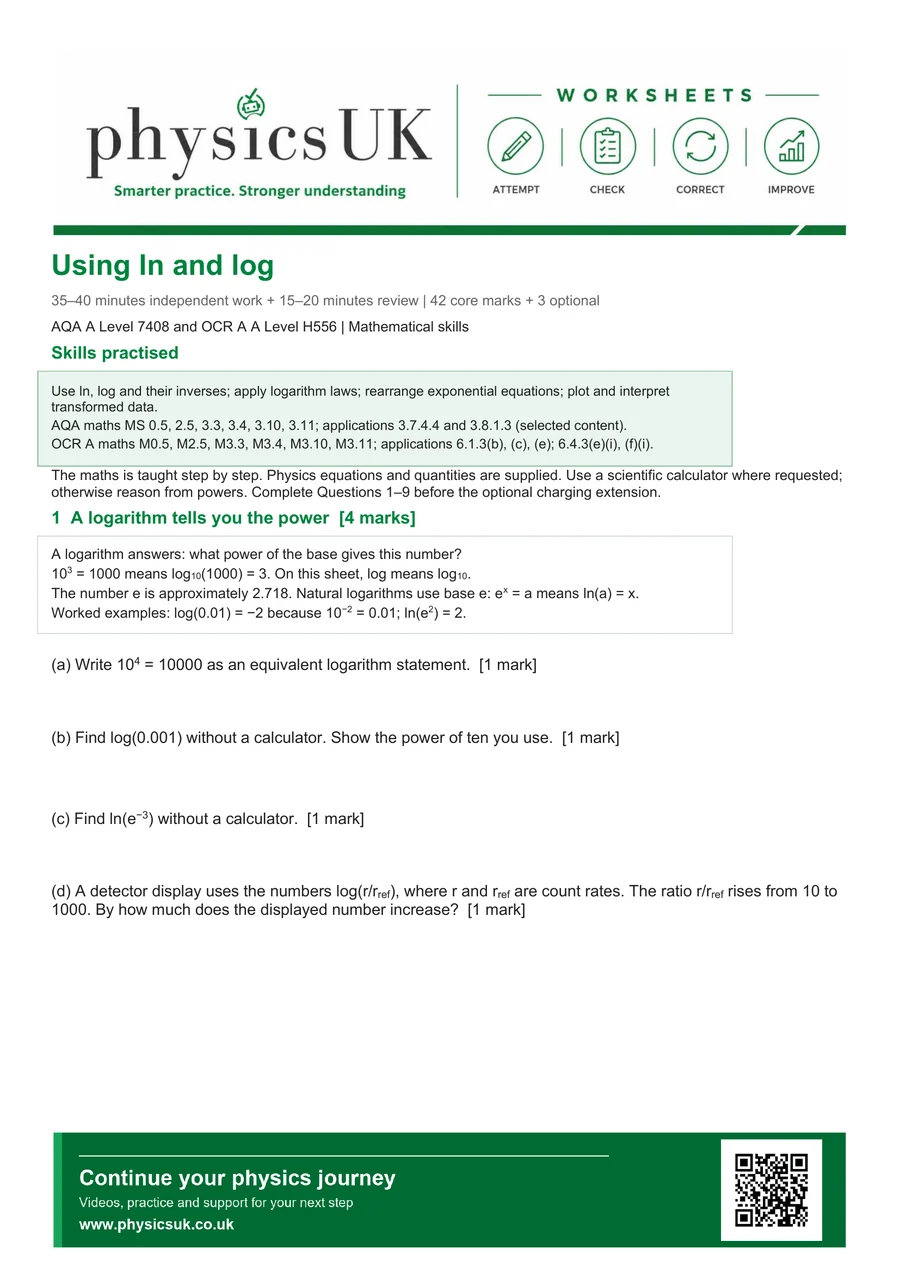
What is covered
Questions and skills covered
The worksheet contains 7 pages of printable questions. A separate 7-page solutions PDF makes it easy to mark, review or share answers after the activity.
- Meaning of base-ten and natural logarithms
- Inverse exponential functions and calculator use
- Product, quotient and power laws
- Rearranging for an unknown exponent
- Capacitor discharge and an optional charging extension
- Background-corrected radioactive count rates, decay constant and half-life
- Plotting ln-normalised data, interpreting gradients and comparing ln with log10
About this activity
A hospital instrumentation team analyses a capacitor timing circuit and background-corrected radioactive reference measurements. Guided fluency leads to exponential equations and logarithmic graphs.
Before you start
A-level learners who can rearrange equations and use a scientific calculator. Physics models are supplied; this is guided maths practice with second-year applications.
Specification fit
This shared PDF includes the applicable boards’ references and a board-neutral footer. Choose an eligible course below and check the scope before assigning it.
- AQA A Level 7408 · Mathematical skills · 3.7.4.4, 3.8.1.3
- OCR A A Level H556 · Mathematical skills · 6.1.3(b), 6.1.3(c), 6.1.3(e), 6.4.3(e)(i), 6.4.3(f)(i)
OCR A A Level Physics Worksheets
H556 · 6.1.3(b), 6.1.3(c), 6.1.3(e), 6.4.3(e)(i), 6.4.3(f)(i)
Choose the correct pathway: Guided mathematical skills with selected second-year capacitor and radioactive-decay applications. Models are supplied. No complete capacitance, radioactivity, required-practical or power-law/log-log coverage claim. Entire pair is A-level, not an AS or GCSE resource.
Classroom use
Use the worksheet for class practice, homework, intervention, cover work or revision. Keep the PhysicsUK attribution intact when sharing copies with pupils.