
Free worksheet and solutions · AQA A Level · 7408
Power Laws and Log Log Graphs Physics Worksheet
A-level physics power laws and log-log graphs worksheet with answers. Find exponents and constants, interpret gradients and test cable-resistance models.
What is covered
Questions and skills covered
The worksheet contains 6 pages of printable questions. A separate 6-page solutions PDF makes it easy to mark, review or share answers after the activity.
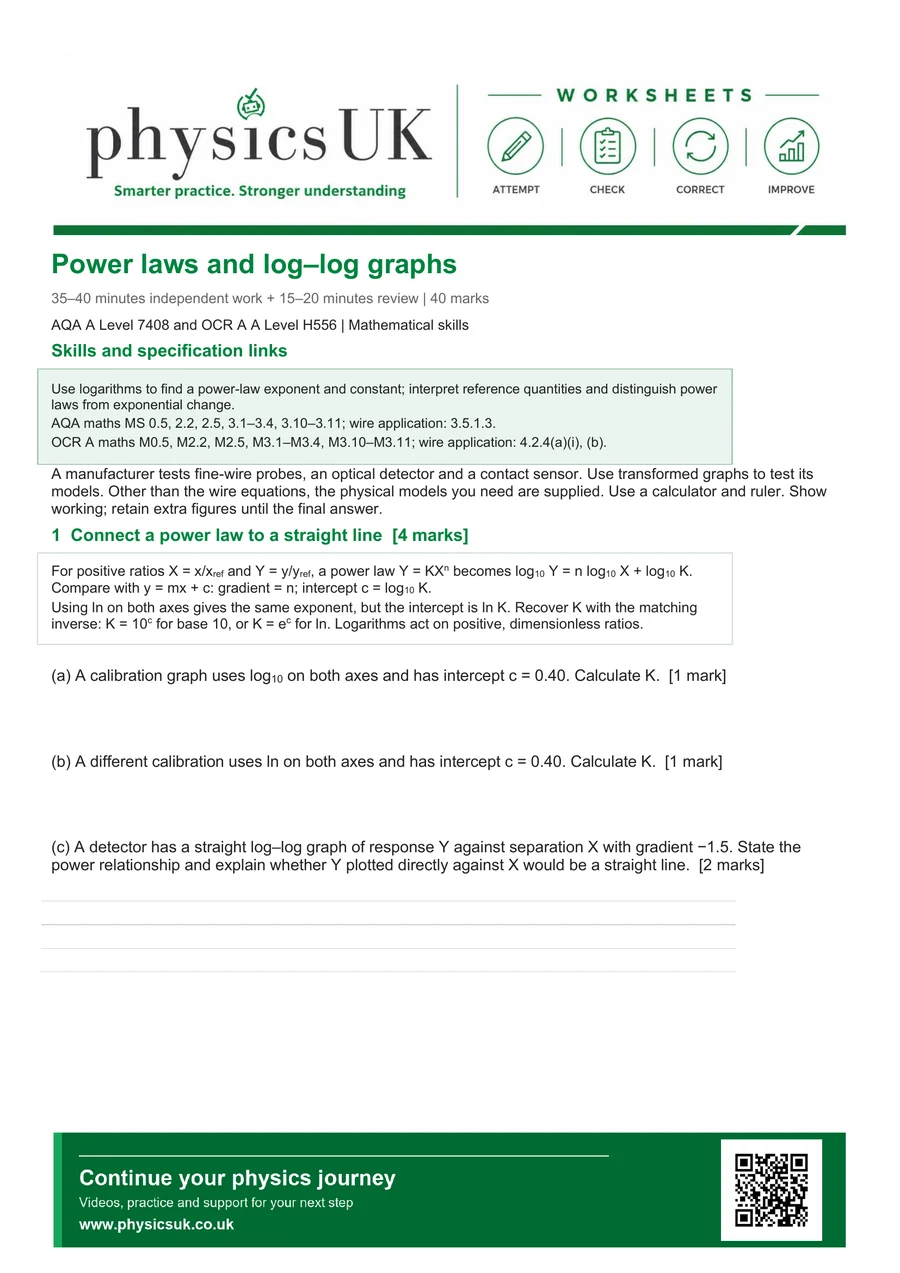
- Connect Y = KXⁿ to transformed straight-line graphs
- Base-10 and natural-log intercept inverses
- Positive dimensionless reference ratios and negative logarithms
- Plot transformed wire data and use a large gradient triangle
- Recover the exponent and dimensionless constant
- Restore an SI physical constant and its units
- Connect resistance and circular cross-sectional area
- Test an inverse-square exponent using an uncertainty interval
- Identify additive-background bias
- Distinguish log–log and semi-log transformations
- Recover an attenuation coefficient in SI units
- Transfer the method to a fractional-power contact-sensor model
- Interpolation, extrapolation and limits of calibration
About this activity
A manufacturer checks fine-wire probe resistance, an optical detector, attenuator response and a contact-sensor calibration.
Before you start
Prior ln and log worksheet or equivalent logarithm fluency; Straight-line gradients, intercepts and positive ratios; Resistance, resistivity and circular area; equations printed in the task
Specification fit
This shared PDF includes the applicable boards’ references and a board-neutral footer. Choose an eligible course below and check the scope before assigning it.
- AQA A Level 7408 · Mathematical skills · 3.5.1.3
- OCR A A Level H556 · Mathematical skills · 4.2.4(a)(i), 4.2.4(b)
AQA A Level Physics Worksheets
7408 · 3.5.1.3
Choose the correct pathway: Guided mathematical skills: power-law transformations, exponents, intercepts, reference quantities and model choice. A resistivity application supports wire-diameter reasoning. Optical detector, attenuator and contact-sensor models are supplied mathematical applications, not complete topic coverage or additional content tags. Shared A-level pair only; no approved AS/GCSE route or required-practical tag.
Classroom use
Use the worksheet for class practice, homework, intervention, cover work or revision. Keep the PhysicsUK attribution intact when sharing copies with pupils.
Choose targeted follow-up practice
Use the diagnostic map to choose one or two worksheets. Keep your qualification and tier, and follow each PDF’s printed replacement instructions. The diagnostic score is not a grade prediction.