
Free worksheet and solutions · OCR A A Level · H556
Gradients Tangents and Areas Physics Worksheet
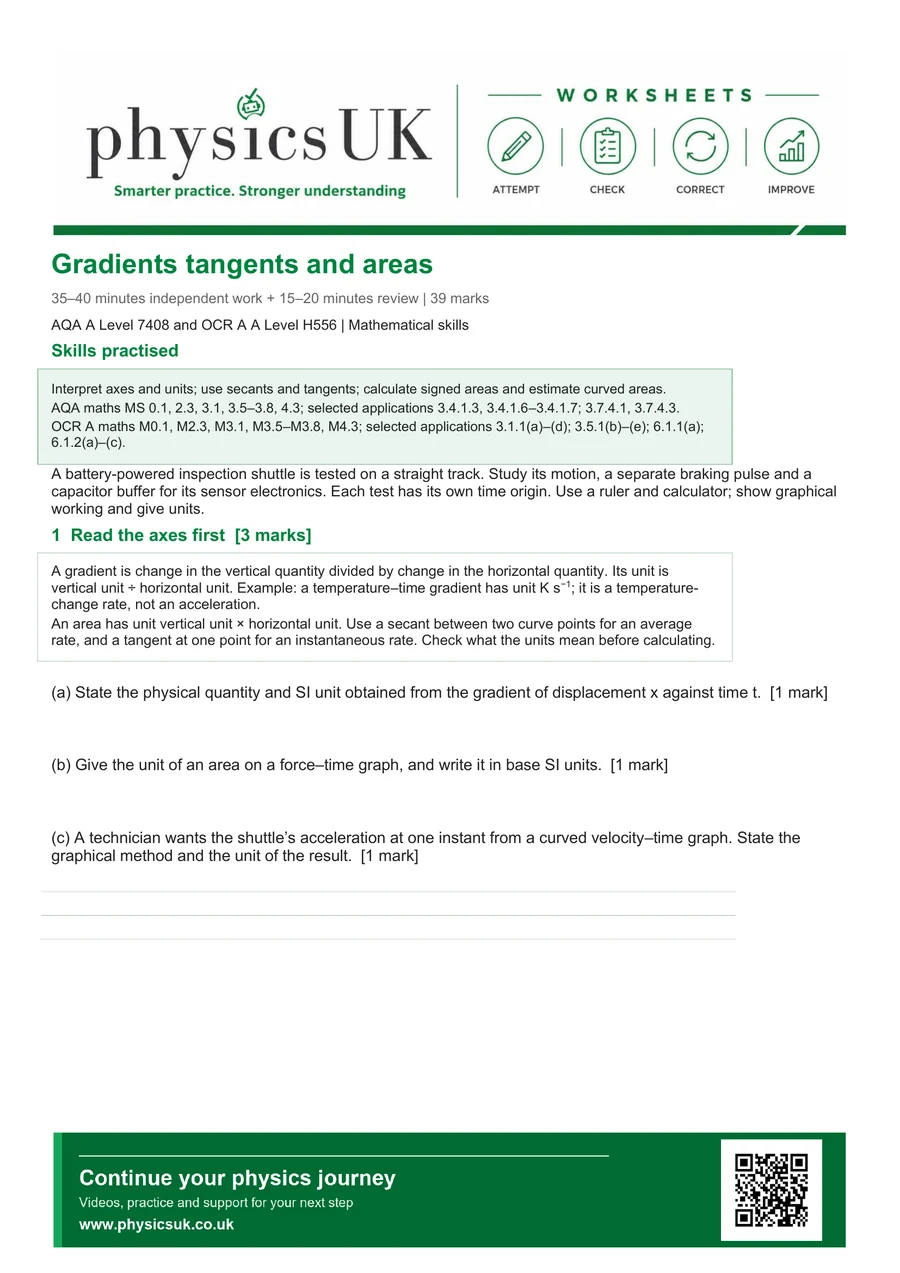
A-level physics graphs worksheet with worked answers: gradients, tangents, signed areas, impulse estimates and capacitor energy in an inspection-shuttle scenario.
What is covered
Questions and skills covered
The worksheet contains 6 pages of printable questions. A separate 6-page solutions PDF makes it easy to mark, review or share answers after the activity.
- Meaning and units of gradients and areas
- Secants and tangents for average and instantaneous velocity
- Signed velocity-time areas, distance and displacement
- Direction, speed and negative acceleration
- Four-trapezium estimate of a resultant-force impulse
- Momentum and velocity changes from a braking pulse
- Stored energy and interval areas on voltage-charge graphs
- Changing gradient and swapping axes for a linear capacitor
- Precise quantity language and checking area interpretations with units
About this activity
Independent inspection-shuttle motion and braking trials, with transfer of graphical methods to the sensor-electronics capacitor buffer.
Before you start
Linear graph scales and geometric areas; Displacement, velocity, acceleration and signed quantities; Momentum and resultant force; The printed constant-C voltage-charge energy interpretation
Specification fit
This shared PDF includes the applicable boards’ references and a board-neutral footer. Choose an eligible course below and check the scope before assigning it.
- AQA A Level 7408 · Mathematical skills · 3.4.1.3, 3.4.1.6, 3.4.1.7, 3.7.4.1, 3.7.4.3
- OCR A A Level H556 · Mathematical skills · 3.1.1(a), 3.1.1(b), 3.1.1(c), 3.1.1(d), 3.5.1(b), 3.5.1(c), 3.5.1(d), 3.5.1(e), 6.1.1(a), 6.1.2(a), 6.1.2(b), 6.1.2(c)
OCR A A Level Physics Worksheets
H556 · 3.1.1(a), 3.1.1(b), 3.1.1(c), 3.1.1(d), 3.5.1(b), 3.5.1(c), 3.5.1(d), 3.5.1(e), 6.1.1(a), 6.1.2(a), 6.1.2(b), 6.1.2(c)
Choose the correct pathway: Guided mathematical skills using selected motion, resultant-impulse and constant-capacitance energy applications. Each shuttle trial has a separate time origin. The capacitor buffer is for sensor electronics, not the complete traction-energy store. A-level only; no AS or GCSE route, required-practical tag, complete topic-coverage claim, SUVAT lesson or field-content claim.
Classroom use
Use the worksheet for class practice, homework, intervention, cover work or revision. Keep the PhysicsUK attribution intact when sharing copies with pupils.
Choose targeted follow-up practice
Use the diagnostic map to choose one or two worksheets. Keep your qualification and tier, and follow each PDF’s printed replacement instructions. The diagnostic score is not a grade prediction.