

When is the Harvest Moon in the UK?
The 2026 Harvest Moon reaches its full phase at 5:49pm BST on Saturday 26 September, according to Royal Observatory Greenwich. For a UK observer, the useful plan is to watch for moonrise around dusk, not to expect the Moon to appear at precisely 5:49pm.
Look towards an open eastern horizon. Trees, hills and nearby buildings can hide the Moon even after its calculated rise time. A park with a clear view can work well; you do not need to travel to a remote dark-sky site to see a bright full Moon.
Check a local moonrise forecast and the weather before setting off. The full phase happens at one instant worldwide, but moonrise depends on where you are. There is no single rise time that is correct for London, Edinburgh and Belfast.
You will not miss a sudden transformation if you arrive a few minutes late. The Moon changes phase gradually, and it looks almost full on the evenings either side too. NASA's September guide also points out Saturn near the full Moon; a current sky map will help you tell the planet from nearby stars.
Why does the Moon look orange?
Moonlight starts as sunlight. The Moon's surface reflects some of that light towards Earth. It is not producing the visible light that makes its disc shine.
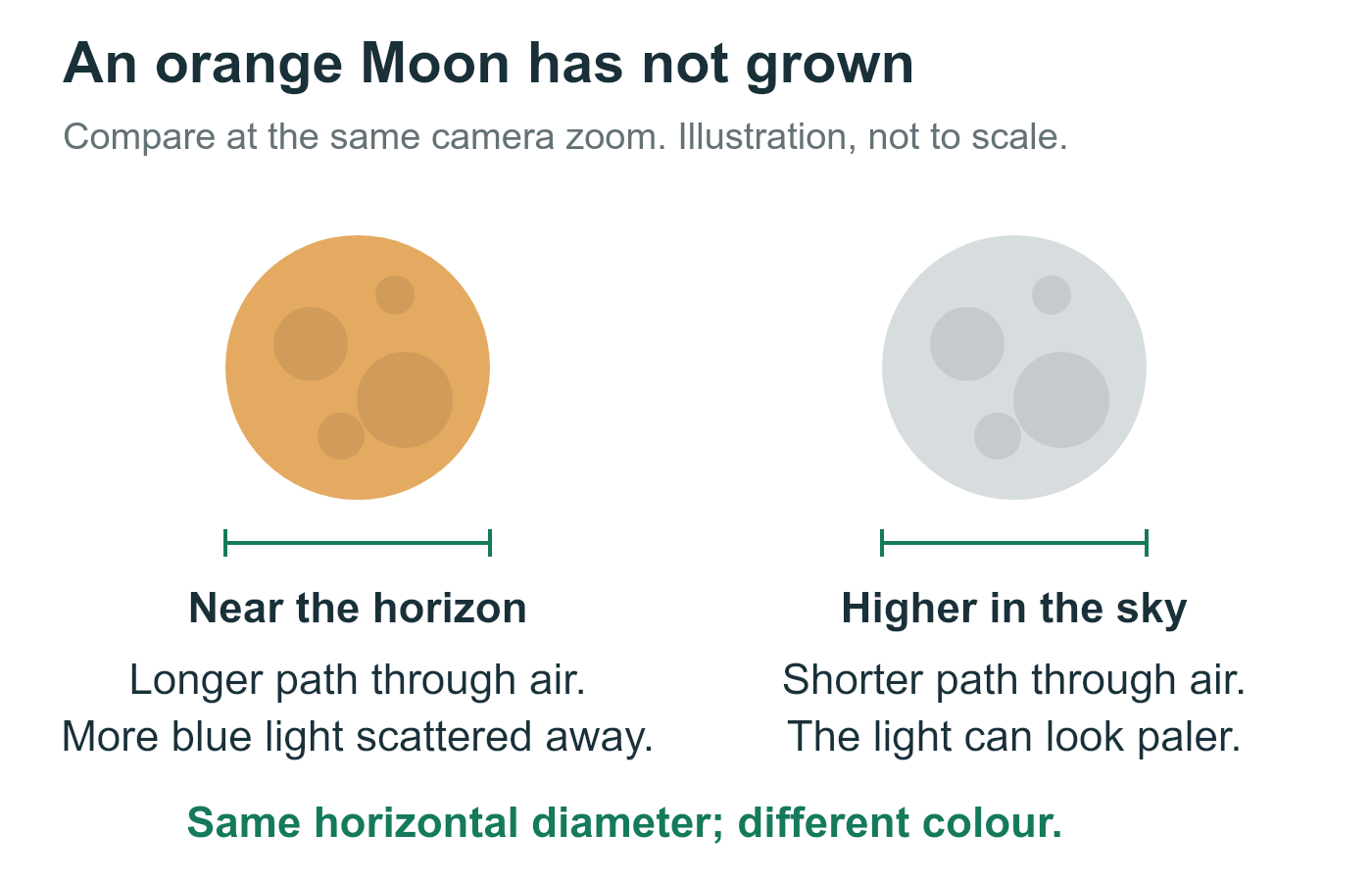
When the Moon is low, its light takes a longer path through our atmosphere than when it is high overhead. Shorter-wavelength blue light is scattered out of the direct beam more strongly than longer-wavelength red light. The light reaching your eyes can therefore look warmer: yellow, orange or reddish.
That is not the lunar surface changing colour. It is the light changing on its journey to you. The same broad idea helps explain red sunsets, although haze, dust and clouds can make individual evenings look quite different.
Do not confuse this with the August lunar eclipse. During an eclipse, Earth blocks direct sunlight from reaching part or all of the Moon. The Harvest Moon on 26 September is not passing through Earth's main shadow.
How to photograph the Harvest Moon and test the illusion
Try a pair of pictures rather than chasing one perfect shot. This turns an attractive view into a useful observation.
Keep the scale fixed
Use the same camera, lens and zoom for a low-Moon photograph and another when it is higher. Keep the original frames; do not crop and enlarge one independently.
Expose for the Moon
Support the camera or phone, focus on the Moon and reduce exposure if the disc is a white blob. Automatic night mode can overexpose it. For a colour comparison, keep white balance fixed too.
Measure across, not up
Compare the horizontal diameter in pixels. It should not show the dramatic growth suggested by the illusion. Low-altitude refraction can squash the vertical diameter, so that is a poorer comparison.
Record the conditions
Note the time, location, cloud and haze. The Moon itself can be viewed without eclipse glasses. Never point binoculars or a telescope at the Sun while setting up before sunset.
Why is it called the Harvest Moon?
Harvest Moon is the traditional name for the full Moon nearest the Northern Hemisphere's autumn equinox. It can fall in September or October. In 2026 it is the September full Moon.
Around this season, the Moon rises only a little later on successive evenings at northern latitudes. Its path makes a shallow angle with the evening horizon, so its daily movement relative to the stars adds a relatively small delay to moonrise. Historically, that supplied useful evening moonlight during harvest.
The name is about timing, not a special orange variety of Moon. It does not mean a lunar eclipse or automatically mean a supermoon. Those terms describe different things.
The physics you already know
Start with the electromagnetic spectrum revision page: visible colours correspond to different wavelengths. Red has a longer wavelength than blue. A change in the mixture of wavelengths reaching your eye can change the colour you see.
The topic of light, lenses and image formation helps with the camera test below. Increasing zoom makes the Moon cover more pixels even if nothing about the Moon has changed. A fair comparison must keep the image scale fixed.
There is also a useful distinction between reflection and refraction. Reflection sends sunlight away from the lunar surface. Refraction changes its direction as it travels through air with changing density. Neither should be confused with scattering light out of the beam.
An astrophysicist has to ask the same question about every observation: is the object changing, or has the atmosphere or instrument changed what we measured? You can practise that reasoning without owning a telescope.
Science ideas to understand
Full phase is not moonrise
5:49pm BST describes the Sun-Earth-Moon geometry. It is not a promise that the Moon will be above your local horizon then.
A Level stretch: why colour and apparent size are different
For molecules much smaller than the wavelength, Rayleigh scattering is strongly wavelength-dependent. Shorter wavelengths scatter more strongly. Large particles and droplets do not follow the same simple wavelength dependence, which is one reason a hazy Moon is not always the same colour.
The apparently enormous horizon Moon is a separate perception effect, called the Moon illusion. There is no single agreed explanation for every aspect of the illusion. Photographs at a fixed image scale do not show the dramatic horizontal enlargement your eyes may suggest.
Atmospheric refraction can actually flatten the low Moon vertically. The Moon's distance also changes over its orbit, giving genuine changes in angular diameter, but that is not the cause of a dramatic apparent shrinkage as it climbs on one evening.
Key words
Quick pupil questions
When is the Harvest Moon 2026 in the UK?
Saturday 26 September. The exact full phase is at 5:49pm BST; look east around dusk and check moonrise for your location.
Why is the Moon orange tonight?
A low Moon can look orange because its light travels through more atmosphere and shorter wavelengths are scattered out of the direct beam more strongly. Haze and clouds affect the colour too.
Is the Harvest Moon a lunar eclipse?
No. Harvest Moon names the full Moon nearest the autumn equinox. The 26 September 2026 full Moon is not a lunar eclipse.
Do I need a telescope to see the Harvest Moon?
No. A clear view towards the eastern horizon is enough to see it rise. Clouds and local obstructions can still hide it.