The spectrum is continuous: the named bands share the same wave nature, but their wavelengths lead to different interactions with matter.
By the end, you should be able to:
Order electromagnetic waves by wavelength and frequency.
Connect uses and hazards to physical interactions.
Higher: explain radio-wave generation and reception.
Before you revise
Diagnostic question
Choose an answer from memory. Your result tells you what to watch for in the guide.
Core revision guide
Learn the model, then use it
The spectrum is continuous: the named bands share the same wave nature, but their wavelengths lead to different interactions with matter.
01
Order, detection and interactions
Scope: 8463 and 8464 · Foundation and Higher
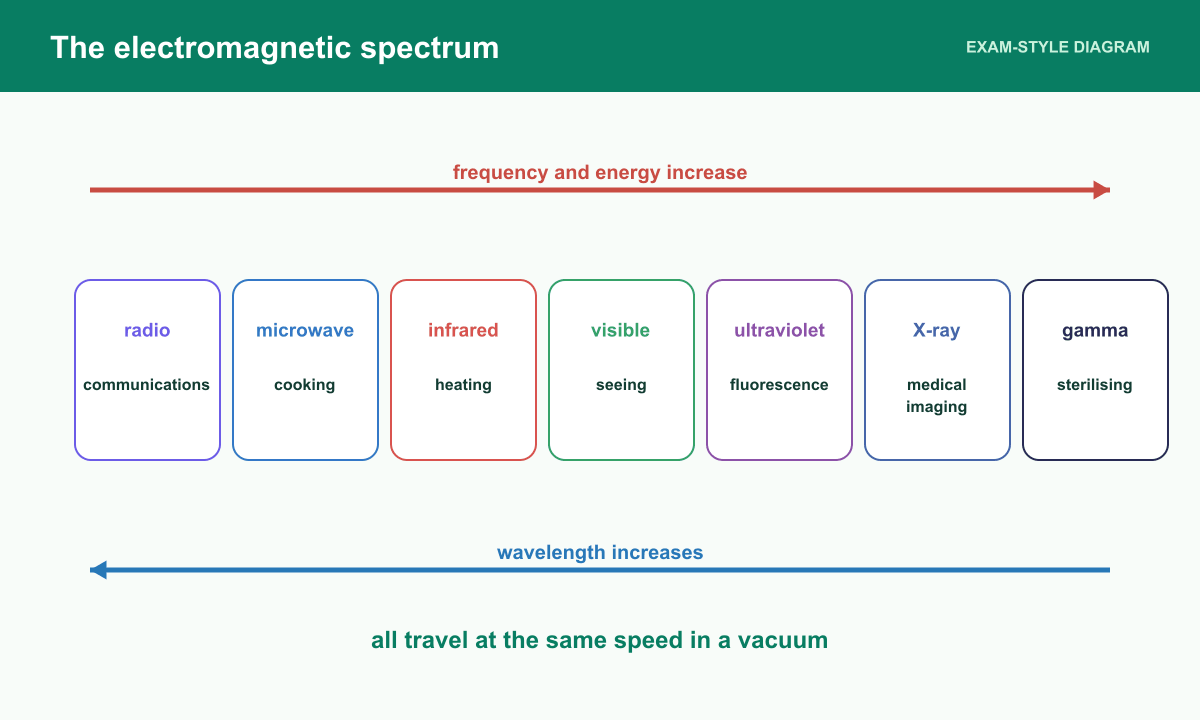
In increasing frequency the bands are radio, microwave, infrared, visible, ultraviolet, X-ray and gamma. Frequency rises while wavelength falls; all have the same speed in vacuum. Eyes detect only visible radiation. Matter can absorb, transmit or reflect different wavelengths differently. Absorption transfers energy into matter; gamma originates from nuclear changes, while electronic transitions can generate/absorb other frequencies.
02
Radio generation and reception
Scope: 8463 and 8464 · Higher only
An oscillating electrical current in a transmitting circuit/aerial generates radio waves. A receiving aerial absorbs waves and can develop an alternating current of the same frequency. The detected electrical signal can then carry information into receiver electronics. Radio waves themselves are electromagnetic rather than sound; a loudspeaker subsequently produces sound.
03
Uses and hazards
Scope: 8463 and 8464 · Foundation and Higher
Radio carries broadcasts; microwaves can carry satellite communication and heat food; infrared suits heaters and thermal cameras; visible light carries information in optical fibres; ultraviolet is used in some lamps but excessive exposure damages skin/eyes. X-rays have differential absorption useful in imaging; gamma can be used in treatments. X-rays and gamma are ionising and can damage DNA. Compare wavelength, penetration/absorption and dose for the stated application rather than saying one band is universally safe.
04
Justify an application
Scope: 8463 and 8464 · Higher only
At Higher, connect a named property to the use. Infrared cameras detect emitted radiation from surfaces rather than literally seeing through every solid. X-ray images arise because different tissues absorb differently; a controlled exposure balances image benefit and dose.
All electromagnetic waves travel at the same speed in a vacuum; frequency and wavelength change across the spectrum.Open the full-size exam diagram
Misconception clinic
Replace the tempting answer
Read each belief, say what is wrong with it, then compare your correction.
Tempting idea: Sound in air at the current’s frequency.
Use instead: The transmitted wave is electromagnetic. Generation and reception use electrical oscillations.
Tempting idea: All objects emit the same infrared intensity.
Use instead: Emission depends on temperature and surface. Displayed colours represent the chosen infrared scale.
Retrieval practice
Quick checks
Worked examples
See the method being built
Apply order, detection and interactions in the worked reasoning, then try the changed-context questions below.
Example 1 · Radio is not sound
Scope: 8463 and 8464 · Foundation and Higher
Why can radio communication cross a vacuum while sound cannot?
Identify radio as an electromagnetic wave.
Identify sound as a mechanical disturbance of matter.
Relate each to a medium requirement.
Show the answer
Radio waves can propagate in vacuum; sound needs particles to transfer vibrations.
Exam precision
Use the physics precisely
Do this: Link the chosen wavelength band to penetration, absorption or detection in the stated application. At Higher connect aerial charge oscillation to the received electrical signal.
Independent practice
Exam-style questions
Write an answer before opening the marking guidance. Then edit the exact phrase or step that would gain the next mark.
1. Higher: explain how a transmitting and receiving aerial use radio waves.
[3 marks]
Scope: 8463 and 8464 · Higher only
Show marking guidance and model answer
Original PhysicsUK mark scheme: Point 1 (1 mark): Oscillations in the transmitter circuit generate radio waves. Point 2 (1 mark): The receiving aerial absorbs radio waves. Point 3 (1 mark): An alternating electrical signal of the same frequency is induced in the receiving circuit. Award each distinct point once. Accept equivalent scientifically correct wording. No half marks.
Oscillations in the transmitter circuit generate radio waves. (1 mark)
The receiving aerial absorbs radio waves. (1 mark)
An alternating electrical signal of the same frequency is induced in the receiving circuit. (1 mark)
Model answer: Electrical oscillations generate radio waves that transfer energy to the receiving aerial, where they can induce an alternating signal of the same frequency.
2. Explain one hazard of X-rays and one way to reduce exposure.
[2 marks]
Scope: 8463 and 8464 · Foundation and Higher
Show marking guidance and model answer
Original PhysicsUK mark scheme: Point 1 (1 mark): X-rays ionise atoms and may damage DNA/cells. Point 2 (1 mark): Use a justified control such as limiting exposure time/dose or appropriate shielding. Award each distinct point once. Accept equivalent scientifically correct wording. No half marks.
X-rays ionise atoms and may damage DNA/cells. (1 mark)
Use a justified control such as limiting exposure time/dose or appropriate shielding. (1 mark)
Model answer: X-rays can damage cells through ionisation. Limit the exposure to the necessary dose and use suitable shielding.
Questions pupils ask
Electromagnetic Spectrum: Uses and Risks FAQs
Does a radio transmitter send its wire electrons to the receiver?
No. Electrical oscillations generate electromagnetic radiation; its arrival induces corresponding oscillations in the receiving circuit.