Sound moves through vibrating matter. Ultrasound and seismic evidence use the travel, reflection and transmission of vibrations to infer hidden boundaries.
AQA 8463GCSE PhysicsHigher
Learn · practise · improve
Start here
The revision snapshot
Sound moves through vibrating matter. Ultrasound and seismic evidence use the travel, reflection and transmission of vibrations to infer hidden boundaries.
By the end, you should be able to:
Explain sound conversion in the ear and hearing limits.
Calculate an ultrasound boundary distance.
Use P- and S-wave evidence to infer a liquid core.
Before you revise
Diagnostic question
Choose an answer from memory. Your result tells you what to watch for in the guide.
Core revision guide
Learn the model, then use it
Sound moves through vibrating matter. Ultrasound and seismic evidence use the travel, reflection and transmission of vibrations to infer hidden boundaries.
01
Ear and hearing limits
Scope: 8463 Physics only · Higher only
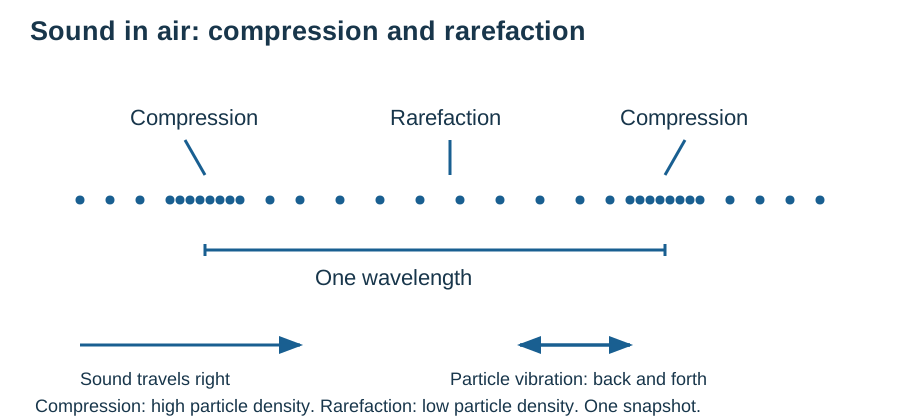
Alternating pressure in air makes the eardrum vibrate. Vibrations transfer through middle-ear bones into inner-ear fluid, where sensory structures convert them to nerve signals. This conversion has a limited frequency response; normal human hearing is roughly 20 Hz to 20 kHz. Ultrasound is above 20 kHz. Larger amplitude gives stronger vibration/loudness; higher frequency gives higher pitch.
02
Ultrasound echo timing
Scope: 8463 Physics only · Higher only
A pulse partly reflects at boundaries between materials. The time records the outward and return journeys: depth d = vt/2. In tissue at 1500 m/s, a 200 microsecond echo gives 1500 × 200 × 10⁻⁶/2 = 0.15 m, a plausible 15 cm depth. An echo time of 0.020 s would imply 15 m, which is unsuitable as an ordinary tissue-depth example.
03
Seismic waves reveal the core
Scope: 8463 Physics only · Higher only
Earthquakes produce longitudinal P waves that travel through solids and liquids and transverse S waves that cannot pass through liquids. Observed S-wave absence and refracted P-wave paths supply evidence for a liquid outer core and hidden internal boundaries. These are conclusions from wave data, not direct photographs of the core.
Read each belief, say what is wrong with it, then compare your correction.
Tempting idea: 0.30 m.
Use instead: 0.30 m is the round-trip distance. 1500 × 0.000200/2 = 0.15 m.
Tempting idea: All waves must stop at every boundary.
Use instead: P waves may transmit and refract. Transmission property connects observation to structure.
Retrieval practice
Quick checks
Worked examples
See the method being built
Apply ear and hearing limits in the worked reasoning, then try the changed-context questions below.
Example 1 · Plausible medical echo
Scope: 8463 Physics only · Higher only
A 200 µs tissue echo travels at 1500 m/s. Find depth.
Convert 200 µs to 0.000200 s.
Find the round-trip distance: 1500 × 0.000200 = 0.30 m.
Halve it and check the body scale.
Show the answer
Depth = 0.15 m = 15 cm, plausible for a tissue boundary.
Exam precision
Use the physics precisely
Do this: Follow the vibration chain or evidence chain requested. For ultrasound echoes use half the travelled distance to locate the reflecting boundary.
Independent practice
Exam-style questions
Write an answer before opening the marking guidance. Then edit the exact phrase or step that would gain the next mark.
1. An ultrasound pulse returns from a tissue boundary after 160 µs. Wave speed is 1500 m/s. Calculate boundary distance.
[3 marks]
Scope: 8463 Physics only · Higher only
Show marking guidance and model answer
Original PhysicsUK mark scheme: Point 1 (1 mark): d = vt/2 because the path is out and back. Point 2 (1 mark): t = 160 × 10⁻⁶ s; d = 1500 × 0.000160/2. Point 3 (1 mark): d = 0.12 m = 12 cm. Award each distinct point once. Accept equivalent scientifically correct wording. No half marks.
d = vt/2 because the path is out and back. (1 mark)
t = 160 × 10⁻⁶ s; d = 1500 × 0.000160/2. (1 mark)
d = 0.12 m = 12 cm. (1 mark)
Model answer: d = vt/2 because the path is out and back. t = 160 × 10⁻⁶ s; d = 1500 × 0.000160/2. d = 0.12 m = 12 cm.
Acceptable answers: Expected result: d = 0.12 m = 12 cm. Accept the unrounded value or a correctly rounded equivalent to two or more significant figures; accept equivalent units if converted correctly. No additional measurement interval is implied.
Marking notes: Method marks remain available after an arithmetic error. Carry an earlier numerical error into a later valid step; award that method point if the unit conversion and physics are correct. A fully correct answer with unit earns all marks unless working is expressly requested.
2. Describe how sound reaches the brain through the ear.
[3 marks]
Scope: 8463 Physics only · Higher only
Show marking guidance and model answer
Original PhysicsUK mark scheme: Point 1 (1 mark): Air pressure variations make the eardrum vibrate. Point 2 (1 mark): Vibration is transmitted through middle-ear structures to inner-ear fluid/sensory cells. Point 3 (1 mark): Sensory structures convert vibration into nerve signals interpreted as sound. Award each distinct point once. Accept equivalent scientifically correct wording. No half marks.
Air pressure variations make the eardrum vibrate. (1 mark)
Vibration is transmitted through middle-ear structures to inner-ear fluid/sensory cells. (1 mark)
Sensory structures convert vibration into nerve signals interpreted as sound. (1 mark)
Model answer: Pressure variations vibrate the eardrum; the vibration reaches the inner ear, whose sensory structures produce nerve signals.
Questions pupils ask
Sound, Ultrasound and the Ear FAQs
Why divide an ultrasound echo distance by two?
The measured delay includes travel to the reflecting boundary and back, so speed times time is twice the one-way depth.