Subsection scope: Refraction ray construction: both courses and tiers. Speed/wavefront explanation: Higher. Reflection practical: Physics only. Diffraction: optional enrichment.
Learn · practise · improve
Start here
The revision snapshot
Separate the ray construction from the cause of refraction. Reflection returns to the original medium; refraction changes speed and usually direction.
By the end, you should be able to:
Construct reflection and refraction rays.
Higher: explain refraction using speed and wavefronts.
Distinguish required wave behaviour from optional diffraction.
Before you revise
Diagnostic question
Choose an answer from memory. Your result tells you what to watch for in the guide.
Core revision guide
Learn the model, then use it
Separate the ray construction from the cause of refraction. Reflection returns to the original medium; refraction changes speed and usually direction.
01
Construct a refraction diagram
Scope: 8463 and 8464 · Foundation and Higher
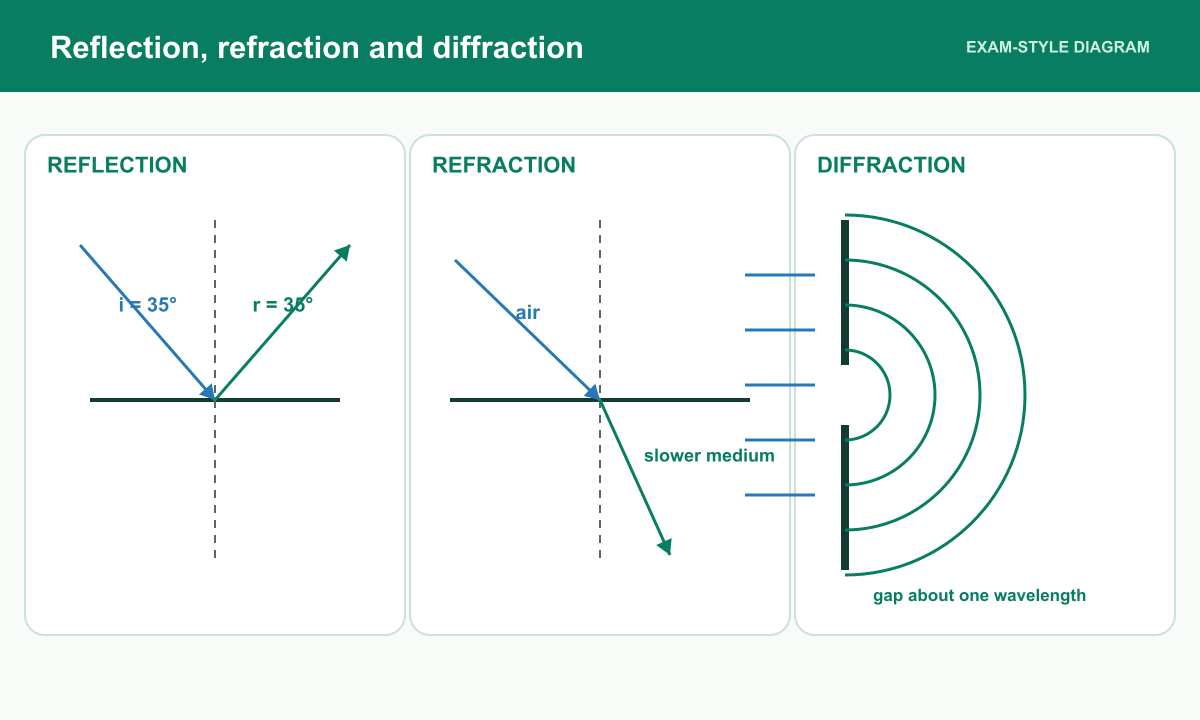
Draw the boundary and a normal at the point of incidence. Measure every angle from the normal. A ray entering slower glass from air bends towards the normal; leaving glass for air it bends away. At normal incidence speed changes but direction does not. Refraction ray construction is common to Physics and Combined Science at both tiers.
02
Explain speed, wavelength and wavefronts
Scope: 8463 and 8464 · Higher only
The source fixes frequency at the boundary. With v = fλ, slower propagation means shorter wavelength. When one side of a wavefront reaches the new medium first, that side slows first and the wavefront pivots, changing travel direction. The speed-based/wavefront explanation is Higher demand.
03
Reflection and optional diffraction
Scope: 8463 Physics only · Foundation and Higher
For a mirror, i = r measured from the normal. Smooth surfaces give orderly specular reflection; rough surfaces scatter because local normals differ, although i = r still holds locally. The reflection practical is Physics only. Diffraction is spreading at a gap or edge; gap size comparable to wavelength gives pronounced spreading. Diffraction is optional enrichment here, not a listed AQA GCSE outcome.
Measure angles from the normal and link greater diffraction to a gap similar in size to the wavelength.Open the full-size exam diagram
Wave speedv = fλm/s, Hz, m
Misconception clinic
Replace the tempting answer
Read each belief, say what is wrong with it, then compare your correction.
Tempting idea: Its direction changes by 90°.
Use instead: Normal incidence gives no bending. Symmetry leaves the direction unchanged.
Tempting idea: It increases.
Use instead: λ = v/f follows the lower speed. Lower v with fixed f means lower λ.
Retrieval practice
Quick checks
Explore the relationship
Wave boundary explorer
Compare the gap width with wavelength to predict how strongly waves diffract.
Model scope: Optional diffraction enrichment
What to notice: use the readout to describe how one variable changes when the other is controlled.
Worked examples
See the method being built
Apply construct a refraction diagram in the worked reasoning, then try the changed-context questions below.
Example 1 · Normal-incidence refraction
Scope: 8463 and 8464 · Higher only
A ray enters a glass block along the normal. Describe the change.
Draw the perpendicular normal.
Keep the ray on that line.
Distinguish speed from direction.
Show the answer
Light slows and its wavelength decreases; frequency and direction stay unchanged.
Exam precision
Use the physics precisely
Do this: Draw a normal at the boundary and measure angles from it. Explain direction changes through wave speed; label optional diffraction separately.
Independent practice
Exam-style questions
Write an answer before opening the marking guidance. Then edit the exact phrase or step that would gain the next mark.
1. Draw/describe a ray entering glass from air at a non-zero angle to the normal.
[3 marks]
Scope: 8463 and 8464 · Foundation and Higher
Show marking guidance and model answer
Original PhysicsUK mark scheme: Point 1 (1 mark): Draw a normal perpendicular to the boundary at incidence. Point 2 (1 mark): Draw the transmitted ray closer to the normal than the incident ray. Point 3 (1 mark): Label the incident and refracted angles from the normal. Award each distinct point once. Accept equivalent scientifically correct wording. No half marks.
Draw a normal perpendicular to the boundary at incidence. (1 mark)
Draw the transmitted ray closer to the normal than the incident ray. (1 mark)
Label the incident and refracted angles from the normal. (1 mark)
Model answer: The incident ray meets a perpendicular normal; the refracted ray in glass makes a smaller angle with it.
Marking notes: For an actual drawing award the stated features individually. Equivalent correctly labelled geometric construction earns credit.
2. Higher: explain why wavelength changes but frequency stays the same on entering slower glass.
[2 marks]
Scope: 8463 and 8464 · Higher only
Show marking guidance and model answer
Original PhysicsUK mark scheme: Point 1 (1 mark): The source still supplies the same number of wave cycles per second. Point 2 (1 mark): v = fλ, so smaller v at fixed f gives a smaller λ. Award each distinct point once. Accept equivalent scientifically correct wording. No half marks.
The source still supplies the same number of wave cycles per second. (1 mark)
v = fλ, so smaller v at fixed f gives a smaller λ. (1 mark)
Model answer: The source fixes frequency. Slower speed at that frequency requires a shorter wavelength.
Questions pupils ask
Reflection, Refraction and Diffraction FAQs
Can refraction happen without visible bending?
Yes. At normal incidence speed and wavelength can change while the direction stays along the normal.