A wave carries a disturbance and energy. The medium oscillates around its position rather than travelling all the way from source to receiver.
By the end, you should be able to:
Distinguish transverse and longitudinal motion.
Calculate wave speed, wavelength and period.
Measure sound speed using distance and arrival delay.
Before you revise
Diagnostic question
Choose an answer from memory. Your result tells you what to watch for in the guide.
Core revision guide
Learn the model, then use it
A wave carries a disturbance and energy. The medium oscillates around its position rather than travelling all the way from source to receiver.
01
Transverse and longitudinal motion
Scope: 8463 and 8464 · Foundation and Higher
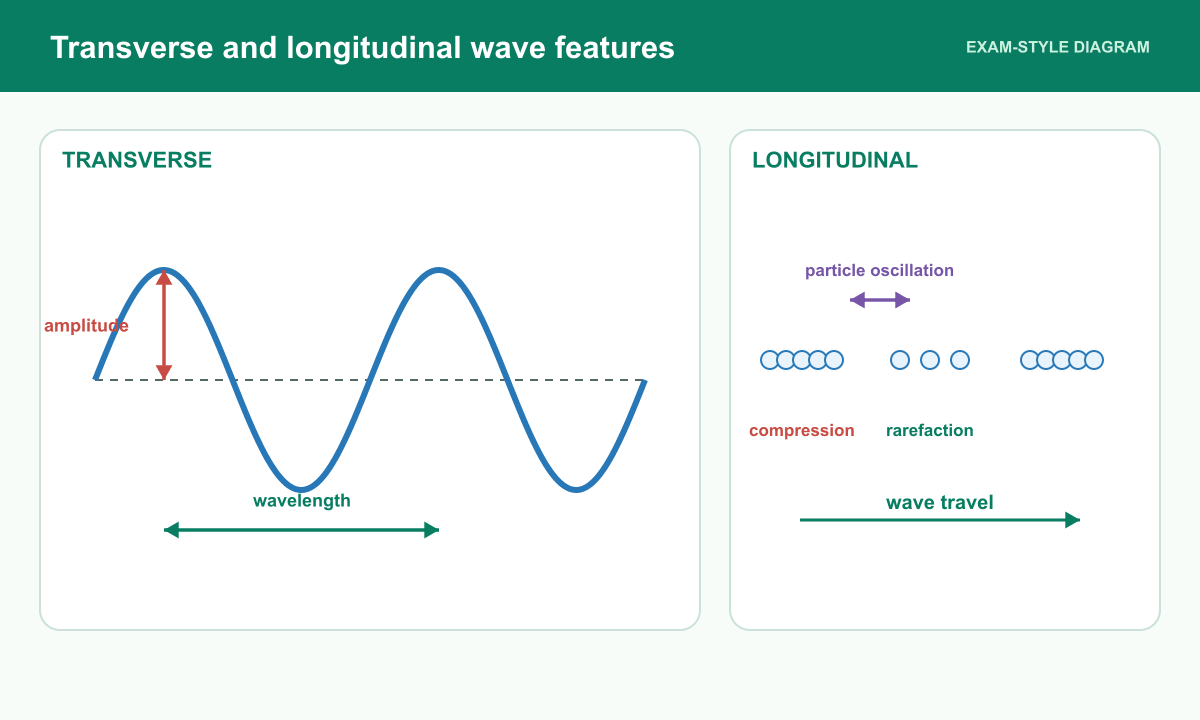
Transverse oscillations are perpendicular to travel direction, as in the GCSE surface-ripple model and electromagnetic waves. Longitudinal oscillations are parallel to travel direction and create compressions and rarefactions, as sound in air does. A floating marker bobbing while a ripple travels demonstrates transfer without net transport of the water.
02
Read the four quantities
Scope: 8463 and 8464 · Foundation and Higher
Amplitude is maximum displacement from equilibrium, not crest-to-trough height. Wavelength λ is distance between adjacent matching points, such as crests or compressions. Frequency f is cycles per second in Hz; period T = 1/f is seconds per cycle. Speed v = fλ is distance travelled by the disturbance per second, not the oscillating particle’s speed.
03
Predict a change at fixed speed
Scope: 8463 and 8464 · Foundation and Higher
If frequency doubles while wave speed stays fixed, wavelength halves. Amplitude is independent of these spacing quantities; increasing amplitude commonly increases energy transfer but does not by itself double speed in the stated medium.
04
Measure sound speed in air
Scope: 8463 and 8464 · Foundation and Higher
Place two microphones a measured distance apart along the direction of sound travel. Connect them to two channels of an oscilloscope or data logger with adequate time resolution. Make a sharp sound on the side of the first microphone away from the second and read the arrival-time difference between matching features in the two traces. Use v = microphone separation/time delay, not the distance from the source. Repeat and average delays; avoid reflected pulses. A larger separation increases the delay, reducing fractional timing uncertainty for the same time resolution. For 1.02 m and a mean delay of 3.0 ms, v = 1.02/0.0030 = 340 m/s. In an echo method, a wall 17 m away gives 34 m of travel; a 0.10 s echo delay also gives 340 m/s. Keep the ripple-tank and solid-wave required-practical methods separate.
Amplitude is measured from equilibrium; particle oscillation is parallel to travel for a longitudinal wave.Open the full-size exam diagram
Wave speedv = fλm/s, Hz, mPeriodT = 1 ÷ fs, Hz
Misconception clinic
Replace the tempting answer
Read each belief, say what is wrong with it, then compare your correction.
Tempting idea: 8 cm.
Use instead: 8 cm is peak-to-trough. Amplitude is displacement from equilibrium.
Tempting idea: 66.7 m/s.
Use instead: This divides f by λ. v = 20 × 0.30 = 6.0.
Retrieval practice
Quick checks
Explore the relationship
Wave equation explorer
Change frequency or wavelength, then calculate wave speed using v = fλ.
Model scope: 8463 and 8464 · Foundation and Higher
What to notice: use the readout to describe how one variable changes when the other is controlled.
Worked examples
See the method being built
Apply transverse and longitudinal motion in the worked reasoning, then try the changed-context questions below.
Example 1 · Wave speed
Scope: 8463 and 8464 · Foundation and Higher
A wave has frequency 25 Hz and wavelength 0.080 m. Find speed.
v = fλ.
v = 25 × 0.080.
Show the answer
2.0 m/s.
Example 2 · Microphone arrival delay
Scope: 8463 and 8464 · Foundation and Higher
Two microphones are 0.85 m apart along the sound path. Their mean arrival delay is 2.5 ms. Find speed.
Use microphone separation, 0.85 m, and convert delay to 0.0025 s.
v = 0.85/0.0025.
Show the answer
340 m/s.
Example 3 · Echo round trip
Scope: 8463 and 8464 · Foundation and Higher
A pulse echoes from a wall 51 m away after 0.30 s. Find speed.
Total travelled distance is 2 × 51 = 102 m.
v = 102/0.30.
Show the answer
340 m/s.
Exam precision
Use the physics precisely
Do this: Identify whether timing measures one-way travel or an echo. Convert milliseconds to seconds and use the distance actually travelled by the sound.
Independent practice
Exam-style questions
Write an answer before opening the marking guidance. Then edit the exact phrase or step that would gain the next mark.
1. A 50 Hz wave has wavelength 0.12 m. Calculate its speed.
[3 marks]
Scope: 8463 and 8464 · Foundation and Higher
Show marking guidance and model answer
Original PhysicsUK mark scheme: Point 1 (1 mark): v = fλ. Point 2 (1 mark): v = 50 × 0.12. Point 3 (1 mark): v = 6.0 m/s. Award each distinct point once. Accept equivalent scientifically correct wording. No half marks.
v = fλ. (1 mark)
v = 50 × 0.12. (1 mark)
v = 6.0 m/s. (1 mark)
Model answer: v = fλ. v = 50 × 0.12. v = 6.0 m/s.
Acceptable answers: Expected result: v = 6.0 m/s. Accept the unrounded value or a correctly rounded equivalent to two or more significant figures; accept equivalent units if converted correctly. No additional measurement interval is implied.
Marking notes: Method marks remain available after an arithmetic error. Carry an earlier numerical error into a later valid step; award that method point if the unit conversion and physics are correct. A fully correct answer with unit earns all marks unless working is expressly requested.
2. Explain evidence that ripples transfer energy without carrying all the water along.
[2 marks]
Scope: 8463 and 8464 · Foundation and Higher
Show marking guidance and model answer
Original PhysicsUK mark scheme: Point 1 (1 mark): A floating marker oscillates near one position while the crest travels. Point 2 (1 mark): The disturbance/energy progresses across the water without the marker following it horizontally. Award each distinct point once. Accept equivalent scientifically correct wording. No half marks.
A floating marker oscillates near one position while the crest travels. (1 mark)
The disturbance/energy progresses across the water without the marker following it horizontally. (1 mark)
Model answer: The marker bobs near a fixed position while crests travel away, showing disturbance and energy transfer without net transport of the water.
3. Two microphones lie 1.20 m apart along a sound path. The mean arrival delay is 3.5 ms. Calculate sound speed.
[3 marks]
Scope: 8463 and 8464 · Foundation and Higher
Show marking guidance and model answer
Original PhysicsUK mark scheme: Point 1 (1 mark): v = distance/time delay. Point 2 (1 mark): v = 1.20/0.0035. Point 3 (1 mark): v = 343 m/s (340 m/s to two significant figures). Award each distinct point once. Accept equivalent scientifically correct wording. No half marks.
v = distance/time delay. (1 mark)
v = 1.20/0.0035. (1 mark)
v = 343 m/s (340 m/s to two significant figures). (1 mark)
Model answer: v = distance/time delay. v = 1.20/0.0035. v = 343 m/s (340 m/s to two significant figures).
Acceptable answers: Expected result: v = 343 m/s (340 m/s to two significant figures). Accept the unrounded value or a correctly rounded equivalent to two or more significant figures; accept equivalent units if converted correctly. No additional measurement interval is implied.
Marking notes: Method marks remain available after an arithmetic error. Carry an earlier numerical error into a later valid step; award that method point if the unit conversion and physics are correct. A fully correct answer with unit earns all marks unless working is expressly requested.
4. Describe how two microphones can measure sound speed and give one improvement that reduces fractional timing uncertainty.
[4 marks]
Scope: 8463 and 8464 · Foundation and Higher
Show marking guidance and model answer
Original PhysicsUK mark scheme: Point 1 (1 mark): Measure microphone separation along the sound path and create a sharp sound on the side of the first microphone away from the second. Point 2 (1 mark): Use two oscilloscope/logger channels to read the arrival-time difference; repeat and find a mean. Point 3 (1 mark): Calculate speed = separation/mean delay, with time in seconds. Point 4 (1 mark): Increase separation to lengthen the delay for fixed time resolution, or use finer time resolution. Award each distinct point once. Accept equivalent scientifically correct wording. No half marks.
Measure microphone separation along the sound path and create a sharp sound on the side of the first microphone away from the second. (1 mark)
Use two oscilloscope/logger channels to read the arrival-time difference; repeat and find a mean. (1 mark)
Calculate speed = separation/mean delay, with time in seconds. (1 mark)
Increase separation to lengthen the delay for fixed time resolution, or use finer time resolution. (1 mark)
Model answer: Measure the separation of two microphones along the sound path. Create a sharp sound on the side of the first microphone away from the second and record it on two oscilloscope channels, read the arrival delay, repeat and average. Divide separation by mean delay in seconds. Increasing separation increases the delay and reduces fractional uncertainty for unchanged time resolution.
Questions pupils ask
Wave Properties, Speed, Frequency and Wavelength FAQs
Do water particles travel with a water wave across a tank?
They oscillate about local positions while the disturbance transfers energy through the water.