Infrared Absorption and Emission Required Practical
Absorption and emission are related properties, but use separate experiments to measure them. A detector reading is only comparable when geometry and temperature are controlled.
Subsection scope: Infrared practical: both courses and tiers. Black-body model and emission spectrum: Physics only, both tiers. Radiative balance and Earth: Physics Higher only.
Learn · practise · improve
Start here
The revision snapshot
Absorption and emission are related properties, but use separate experiments to measure them. A detector reading is only comparable when geometry and temperature are controlled.
By the end, you should be able to:
Compare infrared emission and absorption fairly.
Physics: explain the perfect-black-body model.
Physics Higher: interpret radiative balance and Earth data.
Before you revise
Diagnostic question
Choose an answer from memory. Your result tells you what to watch for in the guide.
Core revision guide
Learn the model, then use it
Absorption and emission are related properties, but use separate experiments to measure them. A detector reading is only comparable when geometry and temperature are controlled.
01
Measure emission with a Leslie cube
Scope: 8463 and 8464 · Foundation and Higher
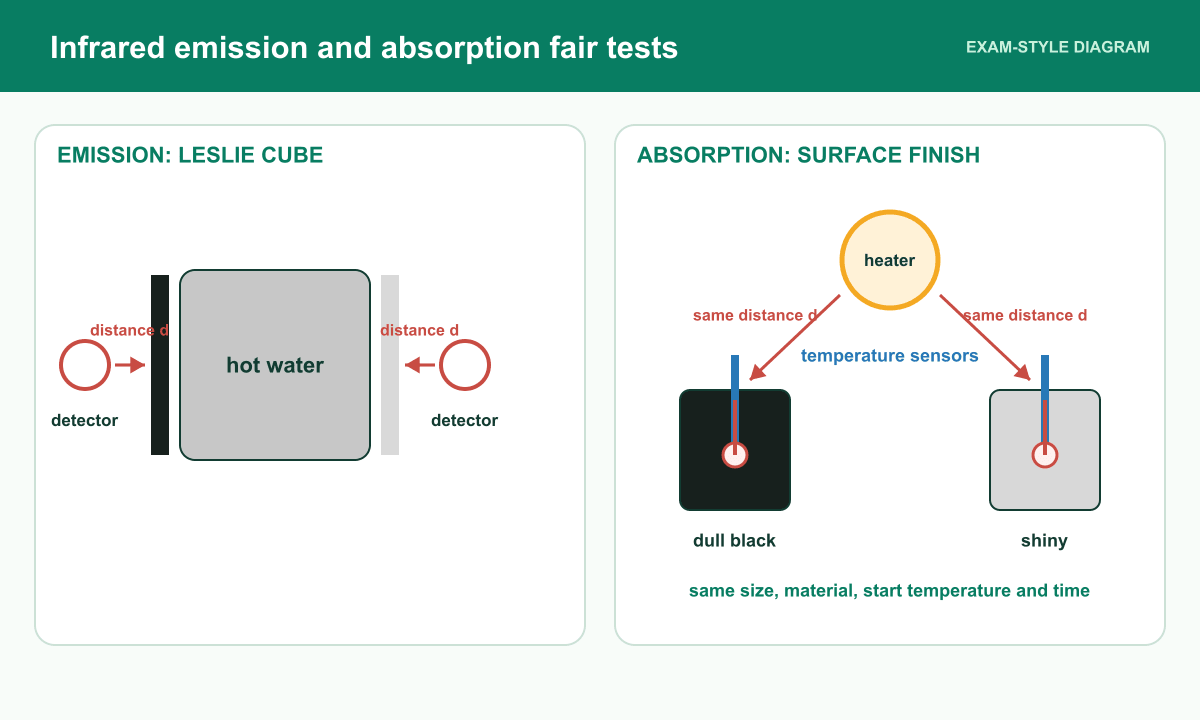
Fill a Leslie cube with hot water under staff supervision. Its differently finished faces are at nearly the same temperature. Place an infrared detector at the same perpendicular distance and orientation to each face; record repeated readings while monitoring water temperature. Compare faces over a short interval or re-establish the same temperature. Dull black generally emits more than shiny metal.
02
Measure absorption independently
Scope: 8463 and 8464 · Foundation and Higher
Use identical metal plates or containers with different finishes, at equal distances and angles from an infrared lamp. Keep area, mass, starting temperature and lamp power the same. Record temperature rise in a fixed time, repeat and compare mean rises. Do not infer absorption solely by moving the detector used for an emission measurement.
03
Avoid competing explanations
Scope: 8463 and 8464 · Foundation and Higher
Different distances change detected radiation even for the same surface. Different starting temperatures change emission. Surface area, convection and conduction can affect cooling comparisons, so a direct detector comparison with controlled geometry is useful. Keep hot-water apparatus stable, avoid contact with the lamp and do not shine it into eyes.
04
Perfect black bodies and temperature-dependent emission
Scope: 8463 Physics only · Foundation and Higher
All bodies emit and absorb radiation. A perfect black body is an ideal absorber of all incident radiation: it reflects none and transmits none. As good absorbers are also good emitters, it is the best possible emitter at a given temperature. A real dull black surface approximates this behaviour; it is not defined only by looking black in visible light. Increasing temperature increases emitted intensity and changes the wavelength distribution, with its peak shifting towards shorter wavelengths. A very hot body may glow visibly while a cooler body emits mainly infrared. No numerical black-body law is needed here.
05
Radiative balance and Earth
Scope: 8463 Physics only · Higher only
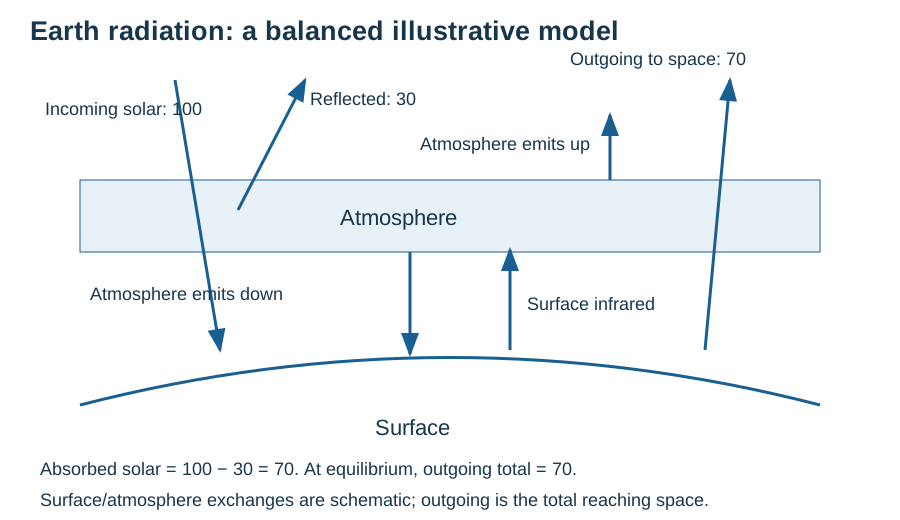
Compare absorbed and emitted energy per second. If absorption exceeds emission, internal energy and temperature increase; if emission exceeds absorption, temperature decreases. At constant temperature these rates balance in the radiation-only model, although radiation still flows both ways. For Earth, some incoming solar radiation is reflected into space without being absorbed, while the surface and atmosphere absorb the rest. The surface emits infrared; the atmosphere absorbs and emits some infrared both upwards and downwards. At overall steady temperature, Earth’s absorbed solar rate equals its total outgoing radiation rate to space. More reflection lowers absorption; changes to absorption or escaping emission alter the balance. Use the supplied diagram/data rather than attributing Earth’s temperature to distance alone.
Read each belief, say what is wrong with it, then compare your correction.
Tempting idea: All surfaces emit exactly equally.
Use instead: The experiment is intended to compare finish. Geometry is a confounding variable.
Tempting idea: Only their names.
Use instead: Names have no physical role. These controls isolate surface finish.
Retrieval practice
Quick checks
Worked examples
See the method being built
Apply measure emission with a leslie cube in the worked reasoning, then try the changed-context questions below.
Example 1 · Absorption comparison
Scope: 8463 and 8464 · Foundation and Higher
A black and a shiny metal surface are equal distance from an infrared lamp. Which warms faster and why?
Keep conditions equal.
State the observation.
Link colour/finish to absorption.
Show the answer
The dull black surface warms faster because it absorbs more infrared radiation than the shiny surface.
Example 2 · Emission comparison
Scope: 8463 and 8464 · Foundation and Higher
Identical hot cans have dull black and shiny surfaces. Which cools faster?
Compare starting temperature and size.
Use cooling rate.
Link to infrared emission.
Show the answer
The dull black can cools faster because it is a better emitter of infrared radiation.
Example 3 · Fair test
Scope: 8463 and 8464 · Foundation and Higher
A detector gives different readings when moved nearer the surface. Explain why distance must be controlled.
Identify distance as a variable.
Link to detected intensity.
State fair-comparison rule.
Show the answer
Infrared intensity at the detector changes with distance, so all surfaces must be measured at the same distance.
Exam precision
Use the physics precisely
Do this: Separate the emission and absorption methods. In a balance task subtract reflected input before comparing absorbed and emitted rates.
Independent practice
Exam-style questions
Write an answer before opening the marking guidance. Then edit the exact phrase or step that would gain the next mark.
1. Describe a fair test comparing infrared emission from two Leslie-cube faces.
[4 marks]
Scope: 8463 and 8464 · Foundation and Higher
Show marking guidance and model answer
Original PhysicsUK mark scheme: Point 1 (1 mark): Use hot water to bring faces to a common temperature and monitor it. Point 2 (1 mark): Hold detector at the same distance, angle and measured face area. Point 3 (1 mark): Record repeated readings for both finishes at comparable temperature. Point 4 (1 mark): Compare mean detector readings and identify which emits more. Award each distinct point once. Accept equivalent scientifically correct wording. No half marks.
Use hot water to bring faces to a common temperature and monitor it. (1 mark)
Hold detector at the same distance, angle and measured face area. (1 mark)
Record repeated readings for both finishes at comparable temperature. (1 mark)
Compare mean detector readings and identify which emits more. (1 mark)
Model answer: Measure each face at the same distance and angle while the cube is at a common monitored temperature. Repeat, compare means, and identify the stronger emitter.
2. Explain why a shiny foil surface may reduce infrared transfer from a hot object.
[2 marks]
Scope: 8463 and 8464 · Foundation and Higher
Show marking guidance and model answer
Original PhysicsUK mark scheme: Point 1 (1 mark): Shiny metal is a poorer infrared emitter than dull black under comparable conditions. Point 2 (1 mark): It therefore transfers less energy by radiation at the same temperature/area. Award each distinct point once. Accept equivalent scientifically correct wording. No half marks.
Shiny metal is a poorer infrared emitter than dull black under comparable conditions. (1 mark)
It therefore transfers less energy by radiation at the same temperature/area. (1 mark)
Model answer: The shiny surface emits less infrared at the same temperature and area, reducing radiative energy transfer.
3. Physics Higher: in a supplied Earth radiation model, all powers use the same arbitrary power unit. Incoming solar power is 100 units and 30 units are reflected. Initially 70 units are emitted to space. Later absorption stays the same but outgoing emission falls to 65 units. Explain the initial balance, the later temperature change, and what a new steady temperature requires.
[4 marks]
Scope: 8463 Physics only · Higher only
Show marking guidance and model answer
Original PhysicsUK mark scheme: Point 1 (1 mark): Absorbed solar power = 100 − 30 = 70 units; reflected radiation does not heat the model. Point 2 (1 mark): Initially absorption and emission are equal at 70, so temperature is steady while radiation flows. Point 3 (1 mark): Later there is a net input power of 70 − 65 = 5 power units, increasing internal energy and warming the model. Point 4 (1 mark): A new radiation-only steady temperature requires outgoing emission to equal the unchanged absorbed rate of 70 units. Award each distinct point once. Accept equivalent scientifically correct wording. No half marks.
Absorbed solar power = 100 − 30 = 70 units; reflected radiation does not heat the model. (1 mark)
Initially absorption and emission are equal at 70, so temperature is steady while radiation flows. (1 mark)
Later there is a net input power of 70 − 65 = 5 power units, increasing internal energy and warming the model. (1 mark)
A new radiation-only steady temperature requires outgoing emission to equal the unchanged absorbed rate of 70 units. (1 mark)
Model answer: Only 70 of the 100 incoming units are absorbed; 30 are reflected. Initially the absorbed and emitted rates both equal 70, so temperature is steady. When emission falls to 65, the net input of 5 power units increases internal energy and temperature. At a new steady temperature, outgoing emission must again equal 70 units for unchanged absorption.
Questions pupils ask
Infrared Absorption and Emission Required Practical FAQs
Why match surface temperatures in an emission comparison?
Emission also depends on temperature. Unequal temperatures would confound the effect of surface finish.