The light practical includes different reflecting surfaces and different refracting substances. A glass block investigation is one part of the complete activity.
AQA 8463GCSE PhysicsFoundationHigher
Learn · practise · improve
Start here
The revision snapshot
The light practical includes different reflecting surfaces and different refracting substances. A glass block investigation is one part of the complete activity.
By the end, you should be able to:
Trace reflection from smooth and rough surfaces.
Compare refraction through different substances.
Control angles and record light paths safely.
Before you revise
Diagnostic question
Choose an answer from memory. Your result tells you what to watch for in the guide.
Core revision guide
Learn the model, then use it
The light practical includes different reflecting surfaces and different refracting substances. A glass block investigation is one part of the complete activity.
01
Specular and diffuse reflection
Scope: 8463 Physics only · Foundation and Higher
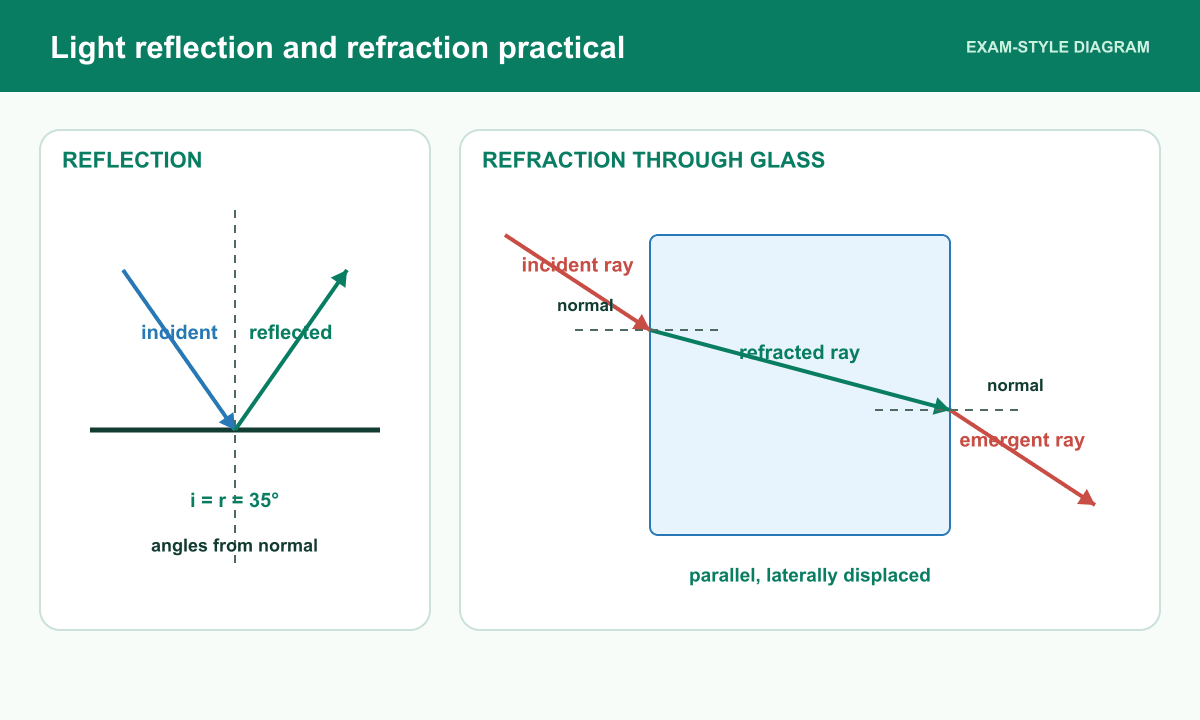
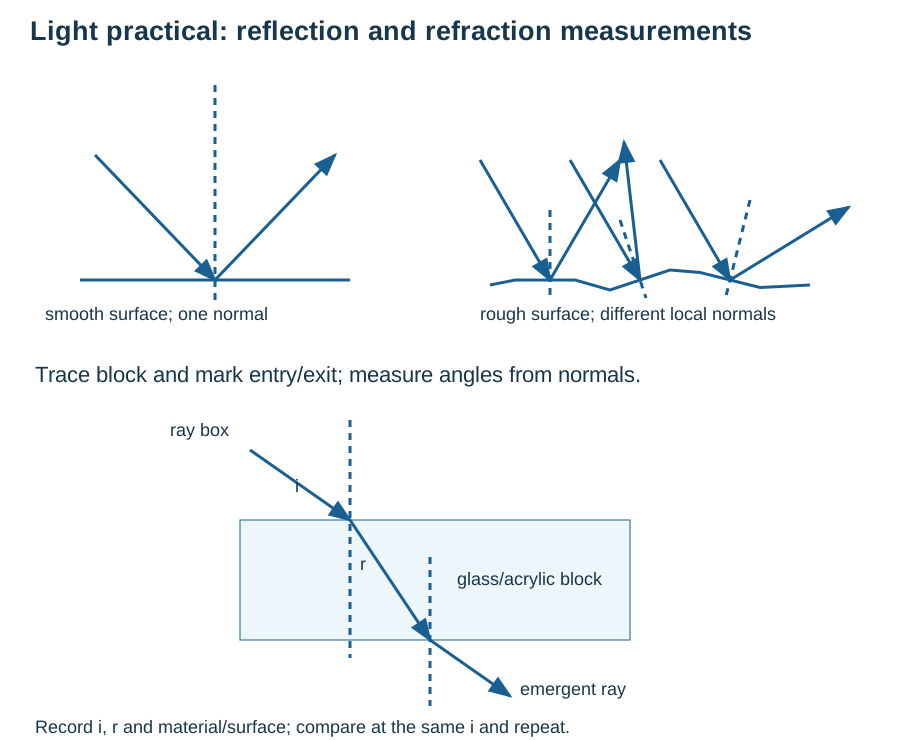
Place a smooth mirror upright on paper, draw its surface line and send a narrow ray at it. Mark the incident and reflected ray with separated points, remove apparatus, draw rays and a normal, then measure i and r. Repeat at several i. Compare a smooth reflective sheet with a rough surface at the same incident geometry: the smooth surface gives a narrow reflected beam while the rough surface scatters it. Local i = r still holds on each differently oriented patch.
02
Compare refraction in substances
Scope: 8463 Physics only · Foundation and Higher
Trace a glass or acrylic block on paper. Direct the same colour narrow ray at a chosen non-zero incident angle. Mark entry, exit and external ray points, remove block and join entry/exit for the internal ray. Draw the entry normal and measure i and the refracted r. Repeat for several i and for another suitable substance using comparable block geometry. Keep i the same when comparing materials.
03
Measurements, controls and safe handling
Scope: 8463 Physics only · Foundation and Higher
Record i,r and material/surface in a results table. Repeat, use thin pencil marks and a narrow beam, and align the protractor centre at incidence to reduce reading error. Control ray colour, geometry and surface orientation. Do not look into the beam; allow a warm ray box to cool before moving it and handle glass carefully.
Measure angles from the normal, not from the surface; mark rays with crosses before removing the block.Open the full-size exam diagram
The full practical compares reflecting surfaces and refracting substances.
Misconception clinic
Replace the tempting answer
Read each belief, say what is wrong with it, then compare your correction.
Tempting idea: 30°.
Use instead: The angle is defined from the normal. Normal is 90° to surface, so i = 60°.
Tempting idea: It breaks the law of reflection at every point.
Use instead: The law still holds locally. Different normal directions produce different outgoing rays.
Retrieval practice
Quick checks
Worked examples
See the method being built
Apply specular and diffuse reflection in the worked reasoning, then try the changed-context questions below.
Example 1 · Reflection result
Scope: 8463 Physics only · Foundation and Higher
Incident angle is 42° to normal. Predict reflected angle.
Use law of reflection.
Angles from normal.
State degrees.
Show the answer
Reflected angle = 42°.
Example 2 · Refraction method
Scope: 8463 Physics only · Foundation and Higher
Describe how to measure refraction through a glass block.
Trace block, mark incident/refracted rays.
Remove block and draw rays/normal.
Measure from normal.
Show the answer
Use a narrow ray, mark positions, draw normal at boundary and measure angles with a protractor.
Example 3 · Uncertainty
Scope: 8463 Physics only · Foundation and Higher
A wide ray makes angle reading difficult. Improve.
Identify broad ray as uncertainty.
Narrow beam/slit.
Use fine pencil marks.
Show the answer
Use a narrow ray box slit and thin pencil lines to reduce angular uncertainty.
Exam precision
Use the physics precisely
Do this: Trace the surface and both beam paths before removing the block. Construct local normals and compare substances using the same incident angle.
Independent practice
Exam-style questions
Write an answer before opening the marking guidance. Then edit the exact phrase or step that would gain the next mark.
1. Describe how to compare reflection by smooth and rough surfaces.
[4 marks]
Scope: 8463 Physics only · Foundation and Higher
Show marking guidance and model answer
Original PhysicsUK mark scheme: Point 1 (1 mark): Use the same narrow incident ray and macroscopic angle on both surfaces. Point 2 (1 mark): Mark/detect reflected paths or the spread of reflected light. Point 3 (1 mark): Smooth gives a concentrated direction; rough gives a spread. Point 4 (1 mark): Explain the spread with different local normals and i = r locally. Award each distinct point once. Accept equivalent scientifically correct wording. No half marks.
Use the same narrow incident ray and macroscopic angle on both surfaces. (1 mark)
Mark/detect reflected paths or the spread of reflected light. (1 mark)
Smooth gives a concentrated direction; rough gives a spread. (1 mark)
Explain the spread with different local normals and i = r locally. (1 mark)
Model answer: Keep incident geometry fixed and observe outgoing light. The smooth surface gives a narrow beam; rough patches have different normals and scatter reflection even though each patch obeys i = r.
2. Describe four steps to measure refraction by a transparent block.
[4 marks]
Scope: 8463 Physics only · Foundation and Higher
Show marking guidance and model answer
Original PhysicsUK mark scheme: Point 1 (1 mark): Trace the block and use a narrow incident ray at a chosen angle. Point 2 (1 mark): Mark entry/exit and two separated external ray points. Point 3 (1 mark): Remove the block, join paths and draw the normal at entry. Point 4 (1 mark): Measure angles from normal; repeat with controlled colour/geometry. Award each distinct point once. Accept equivalent scientifically correct wording. No half marks.
Trace the block and use a narrow incident ray at a chosen angle. (1 mark)
Mark entry/exit and two separated external ray points. (1 mark)
Remove the block, join paths and draw the normal at entry. (1 mark)
Measure angles from normal; repeat with controlled colour/geometry. (1 mark)
Model answer: Trace the block, mark incident and outgoing paths and entry/exit points, remove it, draw the internal path and normal, then measure angles and repeat.
Questions pupils ask
Light Required Practical FAQs
Do rough surfaces break the law of reflection?
No. Each small surface region reflects with equal angles to its own normal. Different local normals spread the reflected rays.