The required practical uses waves in a ripple tank and waves in a solid. Measure frequency and wavelength in each, and judge whether the apparatus provides usable readings.
The required practical uses waves in a ripple tank and waves in a solid. Measure frequency and wavelength in each, and judge whether the apparatus provides usable readings.
By the end, you should be able to:
Measure ripple wavelength and frequency.
Measure wave quantities in a solid.
Judge apparatus suitability and timing uncertainty.
Before you revise
Diagnostic question
Choose an answer from memory. Your result tells you what to watch for in the guide.
Core revision guide
Learn the model, then use it
The required practical uses waves in a ripple tank and waves in a solid. Measure frequency and wavelength in each, and judge whether the apparatus provides usable readings.
01
Ripple tank
Scope: 8463 and 8464 · Foundation and Higher
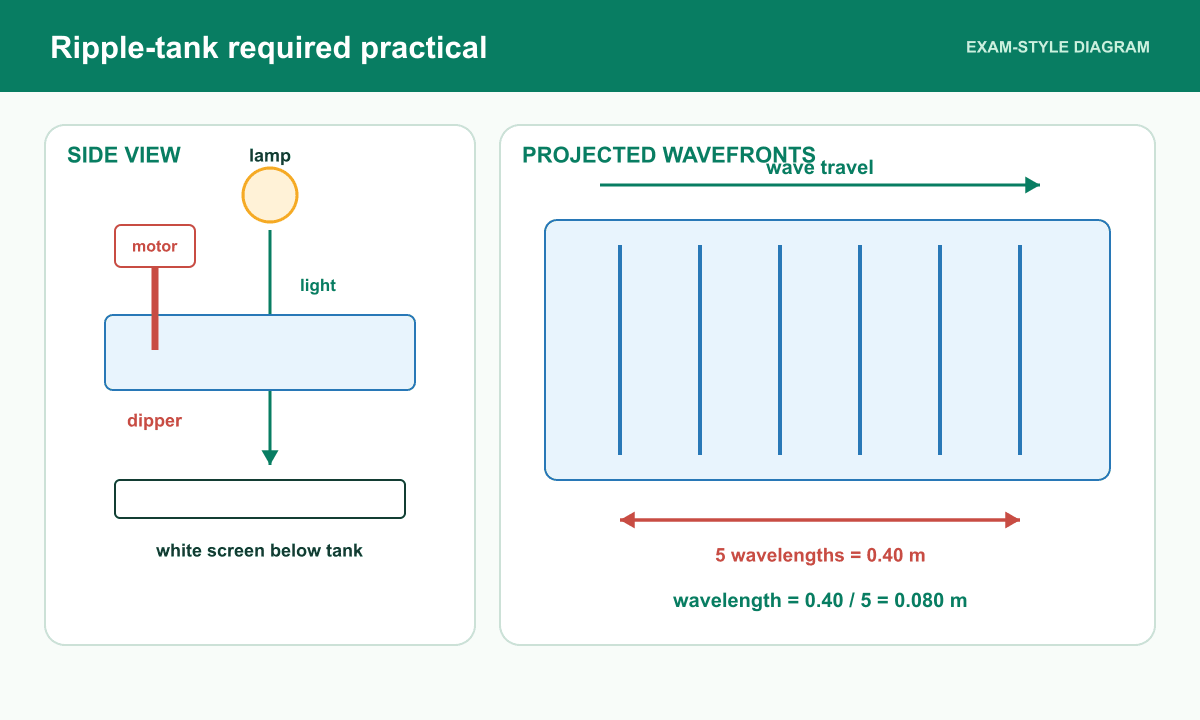
Use a vibrating dipper driven at a known frequency to make regular waves. Illuminate and project the pattern onto a screen with a suitable scale, allowing for projection magnification. Use a strobe cautiously to freeze the pattern or a frame from a recording. Measure across several crest spacings and divide by the number of wavelengths. Keep water depth and dipper settings steady; reduce reflected waves with suitable edges.
02
Waves in a solid
Scope: 8463 and 8464 · Foundation and Higher
Use a vibration generator and signal generator attached to a string with controlled tension. Adjust frequency to produce a clear standing-wave pattern. Adjacent nodes are half a wavelength apart: for a distance L spanning n node gaps, λ = 2L/n. Read frequency from the generator. Calculate v = fλ and repeat measurements. The string is the solid medium, not air from the loudspeaker.
03
Check suitability and uncertainty
Scope: 8463 and 8464 · Foundation and Higher
A larger measured length lowers percentage ruler uncertainty. Stabilise tension and observe scale at right angles. Use appropriate brightness and modest vibration amplitude; keep electricity away from spilled water and guard the hanging mass. A sound-speed method is also useful syllabus work, but does not replace the two stated practical media.
04
Related sound-speed method
Scope: 8463 and 8464 · Foundation and Higher
For sound in air, use two microphones with measured separation and compare pulse arrival times on two recording channels. The Wave Properties guide gives the full method, repeated-delay calculation and echo distance check. This supplements the required practical’s ripple-tank and solid-wave measurements; microphone separation replaces wavelength as the measured distance in this time-of-flight method.
Measure several wave spacings and divide, then combine wavelength with the measured frequency.Open the full-size exam diagram
Read each belief, say what is wrong with it, then compare your correction.
Tempting idea: 0.10 m.
Use instead: A node gap is λ/2, not 2λ. λ = 2 × 0.20.
Tempting idea: 25/6 cm.
Use instead: Count gaps, not crest count. Five wavelengths occupy 25 cm.
Retrieval practice
Quick checks
Worked examples
See the method being built
Apply ripple tank in the worked reasoning, then try the changed-context questions below.
Example 1 · Several wavelengths
Scope: 8463 and 8464 · Foundation and Higher
Five wavelengths on a string occupy 2.0 m. Find wavelength.
Measure several cycles.
Divide total length by 5.
Give metres.
Show the answer
λ = 2.0 ÷ 5 = 0.40 m.
Example 2 · Calculate speed
Scope: 8463 and 8464 · Foundation and Higher
Frequency is 8.0 Hz and wavelength 0.40 m. Find speed.
Use v = fλ.
8.0 × 0.40.
Give m/s.
Show the answer
v = 3.2 m/s.
Example 3 · Improve measurement
Scope: 8463 and 8464 · Foundation and Higher
A student measures one crest gap with a ruler. Improve method.
Identify small-distance uncertainty.
Measure many waves.
Divide by number.
Show the answer
Measure across several wavelengths and divide, reducing percentage uncertainty.
Exam precision
Use the physics precisely
Do this: Specify how both frequency and wavelength are measured for each apparatus. Choose an interval large enough to measure reliably and explain the limitation it reduces.
Independent practice
Exam-style questions
Write an answer before opening the marking guidance. Then edit the exact phrase or step that would gain the next mark.
1. Outline a ripple-tank method for determining wave speed.
[4 marks]
Scope: 8463 and 8464 · Foundation and Higher
Show marking guidance and model answer
Original PhysicsUK mark scheme: Point 1 (1 mark): Produce regular waves with a known/measured frequency. Point 2 (1 mark): Measure a scale-corrected distance across several wavelength gaps and divide by their number. Point 3 (1 mark): Calculate v = fλ with consistent units. Point 4 (1 mark): Keep water depth fixed, reduce reflections and repeat. Award each distinct point once. Accept equivalent scientifically correct wording. No half marks.
Produce regular waves with a known/measured frequency. (1 mark)
Measure a scale-corrected distance across several wavelength gaps and divide by their number. (1 mark)
Calculate v = fλ with consistent units. (1 mark)
Keep water depth fixed, reduce reflections and repeat. (1 mark)
Model answer: Drive a dipper at a known frequency. Measure several correctly scaled crest gaps, divide for wavelength and multiply by frequency. Keep depth steady, reduce reflections and repeat.
2. A 40 Hz vibrating string has adjacent nodes 0.15 m apart. Calculate wave speed.
[3 marks]
Scope: 8463 and 8464 · Foundation and Higher
Show marking guidance and model answer
Original PhysicsUK mark scheme: Point 1 (1 mark): λ = 2 × node gap; v = fλ. Point 2 (1 mark): λ = 0.30 m; v = 40 × 0.30. Point 3 (1 mark): v = 12 m/s. Award each distinct point once. Accept equivalent scientifically correct wording. No half marks.
λ = 2 × node gap; v = fλ. (1 mark)
λ = 0.30 m; v = 40 × 0.30. (1 mark)
v = 12 m/s. (1 mark)
Model answer: λ = 2 × node gap; v = fλ. λ = 0.30 m; v = 40 × 0.30. v = 12 m/s.
Acceptable answers: Expected result: v = 12 m/s. Accept the unrounded value or a correctly rounded equivalent to two or more significant figures; accept equivalent units if converted correctly. No additional measurement interval is implied.
Marking notes: Method marks remain available after an arithmetic error. Carry an earlier numerical error into a later valid step; award that method point if the unit conversion and physics are correct. A fully correct answer with unit earns all marks unless working is expressly requested.
Questions pupils ask
Waves Required Practical FAQs
Why measure several wavelengths at once?
A longer measured distance reduces the fractional effect of ruler resolution; divide by the number of complete wavelengths.