Use actual ray intersections for real images and backward ray extensions for virtual images. Colour questions require tracking which wavelengths are available to reflect or transmit.
AQA 8463GCSE PhysicsFoundationHigher
Learn · practise · improve
Start here
The revision snapshot
Use actual ray intersections for real images and backward ray extensions for virtual images. Colour questions require tracking which wavelengths are available to reflect or transmit.
By the end, you should be able to:
Construct real and virtual lens images.
Calculate dimensionless magnification.
Predict colours through filters and at opaque surfaces.
Before you revise
Diagnostic question
Choose an answer from memory. Your result tells you what to watch for in the guide.
Core revision guide
Learn the model, then use it
Use actual ray intersections for real images and backward ray extensions for virtual images. Colour questions require tracking which wavelengths are available to reflect or transmit.
01
Convex lens: real and virtual cases
Scope: 8463 Physics only · Foundation and Higher
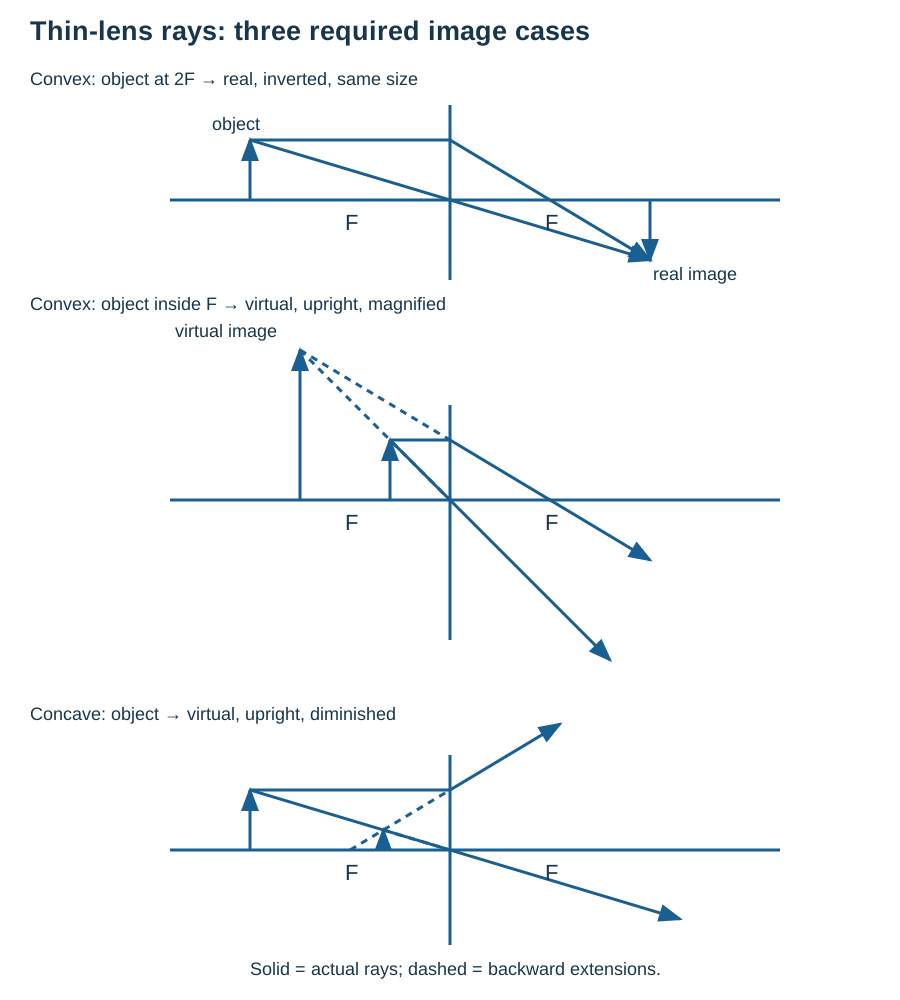
Draw the axis, optical centre and equal focal distances. A parallel ray refracts through the far focus; a centre ray continues straight. With an object beyond F, outgoing rays can meet to form a real inverted image on a screen. Beyond 2F it is diminished; between F and 2F it is magnified. With the object inside F, rays diverge after the lens: extend them backwards with dashed lines to find an upright magnified virtual image on the object side.
02
Concave lens and magnification
Scope: 8463 Physics only · Foundation and Higher
A parallel ray diverges as though from the near focus; a centre ray continues straight. Their backward extensions meet on the object side, giving an upright diminished virtual image. It cannot be caught on a screen because outgoing rays do not actually meet there. Magnification = image height/object height using identical units; the size ratio has no unit.
03
Colour, filters and surfaces
Scope: 8463 Physics only · Foundation and Higher
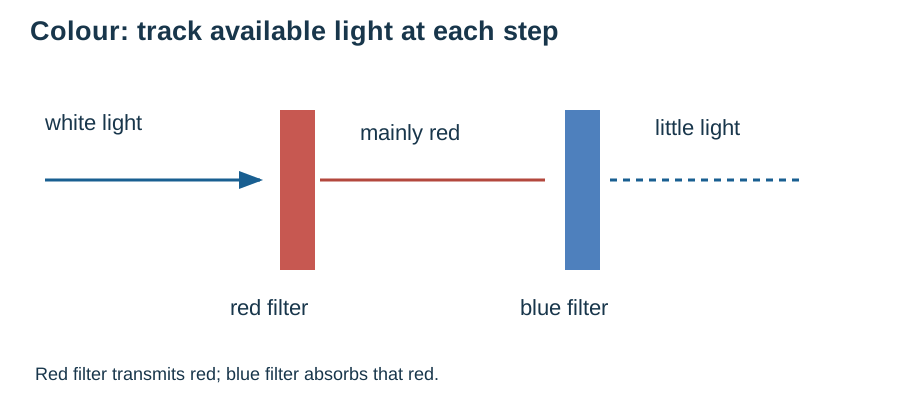
White light contains the visible wavelengths. An opaque red object reflects red strongly and absorbs most other colours. In blue light alone it looks dark because there is little red available to reflect. A red filter transmits mainly red and absorbs other colours; a blue filter after it leaves little common transmitted light. White reflects the available colours broadly, while black absorbs broadly. A translucent material scatters transmitted light; a transparent one transmits with little scattering.
04
Eye contexts are optional enrichment
Scope: Optional enrichment
The eye focuses light onto its retina. Diverging correction can help short sight and converging correction can help long sight. These contexts may support lens understanding, but detailed eye-defect mechanisms are optional enrichment here rather than a listed AQA GCSE Physics requirement. Practise the lens constructions and colour tasks first.
Track selective transmission and absorption instead of assuming a filter creates its colour.
Magnificationmagnification = image height ÷ object heightno unit
Misconception clinic
Replace the tempting answer
Read each belief, say what is wrong with it, then compare your correction.
Tempting idea: Real, inverted and diminished.
Use instead: That case belongs beyond 2F. Backward extensions meet on the object side.
Tempting idea: Red because the object creates red light.
Use instead: An ordinary object reflects rather than creates its colour. Track available light and selective reflection.
Retrieval practice
Quick checks
Worked examples
See the method being built
Apply convex lens: real and virtual cases in the worked reasoning, then try the changed-context questions below.
Example 1 · Virtual convex image
Scope: 8463 Physics only · Foundation and Higher
Describe how to locate the image of an object inside F of a convex lens.
Draw a ray parallel to the axis refracted through the far focus.
Draw the ray through the centre straight.
Extend the outgoing rays backwards with dashed lines.
Show the answer
The extensions meet on the object side, forming an upright magnified virtual image.
Example 2 · Two filters
Scope: 8463 Physics only · Foundation and Higher
White light passes through ideal red then blue filters. What emerges?
The first filter transmits red and absorbs most other wavelengths.
The blue filter absorbs red.
Identify the overlapping transmission.
Show the answer
Very little light emerges because the ideal transmission bands have little overlap.
Exam precision
Use the physics precisely
Do this: Use solid outgoing rays and dashed backward extensions consistently. Track transmitted or reflected wavelengths through every filter or surface.
Independent practice
Exam-style questions
Write an answer before opening the marking guidance. Then edit the exact phrase or step that would gain the next mark.
1. A lens forms an image 30 mm high from an object 12 mm high. Calculate magnification.
[3 marks]
Scope: 8463 Physics only · Foundation and Higher
Show marking guidance and model answer
Original PhysicsUK mark scheme: Point 1 (1 mark): Magnification = image height/object height. Point 2 (1 mark): Magnification = 30/12. Point 3 (1 mark): Magnification = 2.5 (no unit). Award each distinct point once. Accept equivalent scientifically correct wording. No half marks.
Model answer: Magnification = image height/object height. Magnification = 30/12. Magnification = 2.5 (no unit).
Acceptable answers: Expected result: Magnification = 2.5 (no unit). Accept the unrounded value or a correctly rounded equivalent to two or more significant figures; accept equivalent units if converted correctly. No additional measurement interval is implied.
Marking notes: Method marks remain available after an arithmetic error. Carry an earlier numerical error into a later valid step; award that method point if the unit conversion and physics are correct. A fully correct answer with unit earns all marks unless working is expressly requested.
2. Explain why a concave-lens virtual image cannot be formed on a screen at its apparent position.
[2 marks]
Scope: 8463 Physics only · Foundation and Higher
Show marking guidance and model answer
Original PhysicsUK mark scheme: Point 1 (1 mark): The outgoing rays diverge and do not actually meet at that position. Point 2 (1 mark): Only their backward extensions meet, so no real concentration of rays exists there. Award each distinct point once. Accept equivalent scientifically correct wording. No half marks.
The outgoing rays diverge and do not actually meet at that position. (1 mark)
Only their backward extensions meet, so no real concentration of rays exists there. (1 mark)
Model answer: The apparent position is the intersection of backward extensions. Actual rays diverge and cannot form a screen image there.
Questions pupils ask
Light, Lenses, Image Formation and the Eye FAQs
Can a virtual image be seen?
Yes. The eye traces diverging rays back to their apparent origin, even though the image cannot be formed directly on a screen.