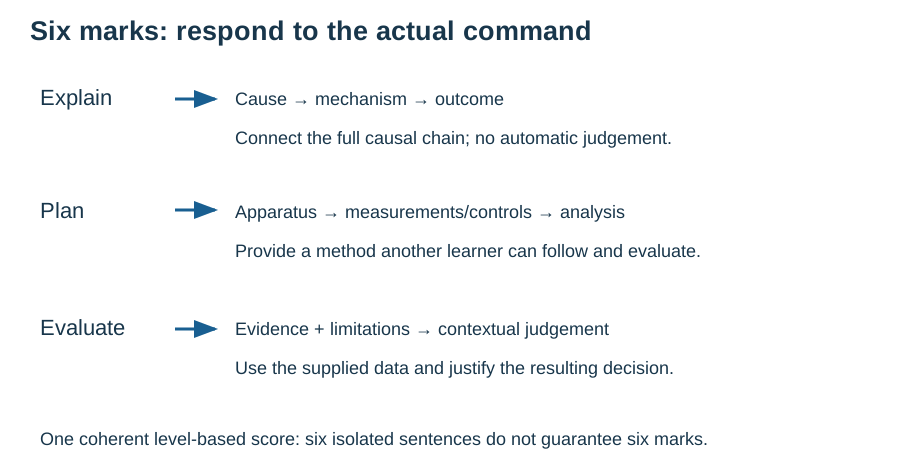
Six marks describe the demand of a complete response. Answer the command: an explanation develops a mechanism, a plan gives a usable method, and an evaluation weighs evidence to reach a judgement.
Six marks describe the demand of a complete response. Answer the command: an explanation develops a mechanism, a plan gives a usable method, and an evaluation weighs evidence to reach a judgement.
By the end, you should be able to:
Choose a response structure from the command word.
Develop a complete causal explanation or practical plan.
Evaluate evidence and self-mark a coherent six-mark response.
Before you revise
Diagnostic question
Choose an answer from memory. Your result tells you what to watch for in the guide.
Core revision guide
Learn the model, then use it
Six marks describe the demand of a complete response. Answer the command: an explanation develops a mechanism, a plan gives a usable method, and an evaluation weighs evidence to reach a judgement.
01
Build the response around the command
Scope: 8463 and 8464 · Foundation and Higher
For explain, join cause to mechanism and consequence. For a practical plan, give apparatus, measurements, variables, repeats, processing and a linked error control. For evaluate, use relevant advantages and limitations plus a decision for the stated context. A judgement is not a compulsory ending to an explanation or method.
02
Use a flexible sequence
Scope: 8463 and 8464 · Foundation and Higher
Read the context and identify what must be accounted for. Make a short plan, develop each link and use quantities or given evidence accurately. A list of six disconnected phrases may show less understanding than a coherent paragraph. Avoid repeating the same point in different words or claiming every long response automatically gains six marks.
03
How to self-mark the three complete models
Scope: 8463 and 8464 · Foundation and Higher
The three tasks below each carry six marks using an original PhysicsUK level rubric. Read the model, identify why its sequence covers the complete task, and compare your answer against the indicated content. The explanatory task does not require a judgement; the evaluation does. These are original teaching tasks, not official AQA questions or mark schemes.
Match the response to its command. A judgement belongs to an evaluation; a complete explanation or plan can finish differently.Open the full-size exam diagram
Misconception clinic
Replace the tempting answer
Read each belief, say what is wrong with it, then compare your correction.
Tempting idea: The words “in conclusion” without evidence.
Use instead: Phrasing alone earns no evidence credit. A judgement answers evaluate.
Tempting idea: Be more careful.
Use instead: No operation or error is named. It names the error and the corrective method.
Retrieval practice
Quick checks
Exam precision
Use the physics precisely
Do this: Read the command and build a connected response that fulfils it. Use the model checklist to find missing physics rather than counting isolated sentences.
Independent practice
Exam-style questions
Write an answer before opening the marking guidance. Then edit the exact phrase or step that would gain the next mark.
1. Explain why an insulated cup with a lid cools more slowly than an identical uncovered bare cup. Both contain equal water volumes at the same initial temperature.
[6 marks]
Scope: 8463 and 8464 · Foundation and Higher
Show marking guidance and model answer
Level-based marking: PhysicsUK original level scheme: use the descriptors to choose a level, then the lower integer for a partial response and upper integer for a complete response within that level. The six content points are an indicative checklist, not six automatically additive marks.
Water is initially warmer than the surroundings.
Energy transfers from water to surrounding thermal stores.
Insulation/trapped air reduces conduction through sides.
Restricting air movement reduces convection.
A lid reduces surface convection and evaporation.
The smaller transfer rate gives a smaller temperature fall in the same time.
0 marks: no relevant physics.
1–2 marks (Level 1): isolated relevant statements with little usable sequence or linkage.
3–4 marks (Level 2): mostly correct linked reasoning or a workable method/comparison, with a significant omission.
5–6 marks (Level 3): coherent, scientifically correct and complete reasoning meeting the stated task, using its context and data where relevant.
Model answer: The hot water transfers energy to the cooler surroundings. An insulating jacket has low thermal conductivity and trapped air, reducing conduction through the sides. Trapped air also limits circulation and hence convection within the insulation. A lid restricts warm air leaving the surface and reduces evaporation, so less energy is carried away by these routes. With the same initial water volume and temperature, the insulated covered cup loses energy more slowly. Its temperature therefore falls by less in the same interval. It still cools: insulation lowers the transfer rate rather than producing energy or stopping all transfer.
Marking notes: Award one integer score from 0 to 6. Accept equivalent scientifically valid explanations or methods. A judgement is required only for the evaluation task.
Why this model meets the level: The answer reaches Level 3 because it links specific design features to transfer mechanisms and then to the controlled temperature comparison. It needs no choice or judgement.
2. Plan an investigation of how wire length affects resistance, including controls, measurements and analysis.
[6 marks]
Scope: 8463 and 8464 · Foundation and Higher
Show marking guidance and model answer
Level-based marking: PhysicsUK original level scheme: use the descriptors to choose a level, then the lower integer for a partial response and upper integer for a complete response within that level. The six content points are an indicative checklist, not six automatically additive marks.
Same uniform wire fixed beside ruler, several measured lengths.
Low-voltage supply with ammeter in series and voltmeter across test length.
Paired V and I readings at each length, R = V/I.
Control material, diameter and temperature; low current/switch off.
Repeat each condition, inspect anomalies and use means.
Plot mean R against length and link the trend to the conclusion.
0 marks: no relevant physics.
1–2 marks (Level 1): isolated relevant statements with little usable sequence or linkage.
3–4 marks (Level 2): mostly correct linked reasoning or a workable method/comparison, with a significant omission.
5–6 marks (Level 3): coherent, scientifically correct and complete reasoning meeting the stated task, using its context and data where relevant.
Model answer: Fix a uniform resistance wire beside a ruler and set several lengths using contacts. Connect it to a low-voltage supply and switch with an ammeter in series; put a voltmeter across the selected wire length. For each length record V and I, then calculate R = V/I. Keep material and diameter fixed. Use a low current, switch off between readings and allow cooling to limit temperature changes. Repeat each length, check unexpected readings and calculate mean resistance. Plot mean resistance against length with units. A straight proportional trend supports resistance increasing with length under those conditions. Check safe component ratings and avoid shorting the supply.
Marking notes: Award one integer score from 0 to 6. Accept equivalent scientifically valid explanations or methods. A judgement is required only for the evaluation task.
Why this model meets the level: The answer reaches Level 3 because another learner could follow the circuit, isolate length, obtain usable values and interpret the graph. The heating control targets a real confounder.
3. A windy island needs 2 MW continuously. Its proposed wind farm can produce 4 MW in strong wind but near zero during calm weather; a battery stores 12 MWh. Evaluate using this wind farm and battery as the island’s only supply.
[6 marks]
Scope: 8463 and 8464 · Foundation and Higher
Show marking guidance and model answer
Level-based marking: PhysicsUK original level scheme: use the descriptors to choose a level, then the lower integer for a partial response and upper integer for a complete response within that level. The six content points are an indicative checklist, not six automatically additive marks.
Wind is renewable with low operational combustion emissions.
Output varies and calm output may be below the 2 MW demand.
12 MWh/2 MW gives at most 6 h ideal backup.
Storage losses/reserve or recharge requirements reduce practical cover.
Calm periods longer than cover require another dependable source/connection.
A conditional judgement uses continuous demand and storage duration.
0 marks: no relevant physics.
1–2 marks (Level 1): isolated relevant statements with little usable sequence or linkage.
3–4 marks (Level 2): mostly correct linked reasoning or a workable method/comparison, with a significant omission.
5–6 marks (Level 3): coherent, scientifically correct and complete reasoning meeting the stated task, using its context and data where relevant.
Model answer: Wind is renewable and its operation avoids burning fossil fuel. At 4 MW the farm can meet the 2 MW load and charge the battery, but calm conditions give little generation. The ideal battery duration is 12 MWh divided by 2 MW, or 6 hours, and losses or a required reserve shorten practical cover. Recharging also depends on sufficiently windy periods after use. Because the demand is continuous, a calm period longer than that cover leaves an unmet load. This proposal is therefore unsuitable as the only supply unless evidence establishes that storage and recharge can reliably bridge every expected lull; it should include dependable backup, interconnection or substantially adequate additional storage.
Marking notes: Accept another reasoned conditional judgement with correct ideal 6 h calculation. Credit a later coherent reliability argument despite an isolated arithmetic slip, within the chosen level.
Why this model meets the level: The answer reaches Level 3 because it uses the supplied numbers, weighs a benefit against reliability and reaches a context-dependent decision. An unsupported “wind is best” would not meet the evaluation.
Questions pupils ask
How to Answer GCSE Physics Six-Mark Questions FAQs
Must I always finish with a judgement?
No. Use a justified decision for evaluate or a choice task. Explain and plan require the specified mechanism or method.
Are six marks always six independent facts?
No. These tasks use levels, considering completeness, correctness and linkage. The content checklist helps assess coverage but does not replace the rubric.