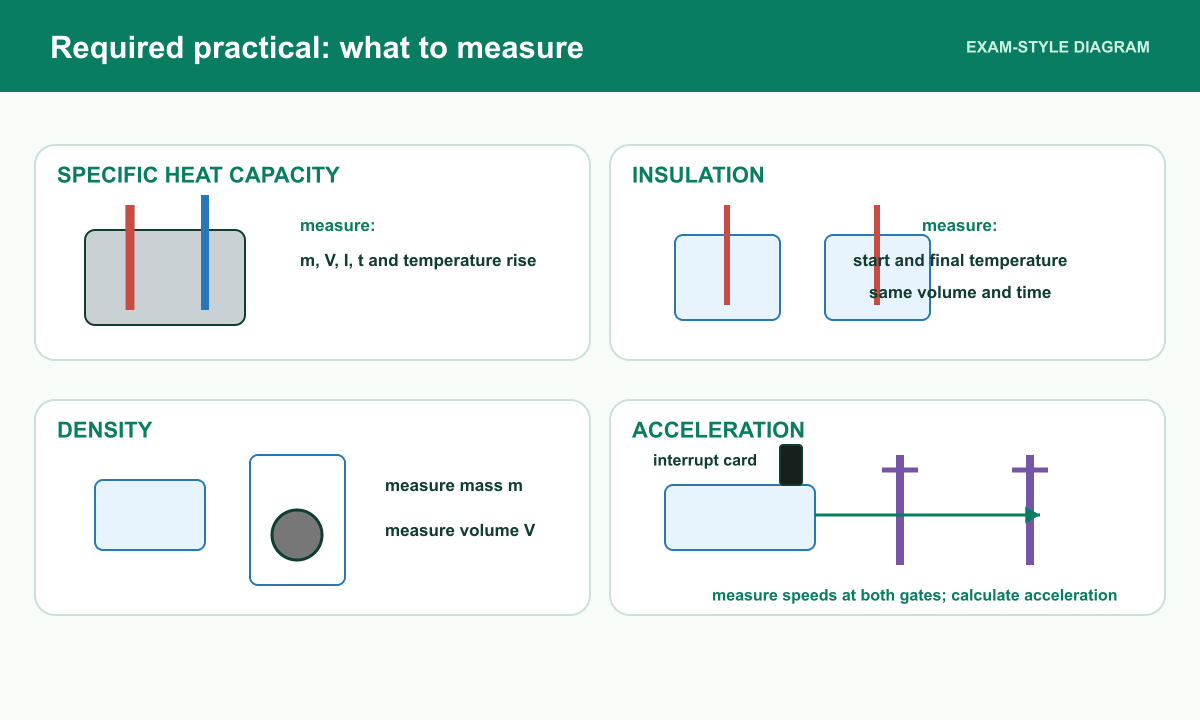
A practical method must produce measurements that answer the question. Name a control and explain its physical role rather than listing arbitrary quantities.
A practical method must produce measurements that answer the question. Name a control and explain its physical role rather than listing arbitrary quantities.
By the end, you should be able to:
Specify independent, dependent and control variables.
Distinguish resolution, precision and accuracy.
Use graphs and uncertainty to justify an improvement.
Before you revise
Diagnostic question
Choose an answer from memory. Your result tells you what to watch for in the guide.
Core revision guide
Learn the model, then use it
A practical method must produce measurements that answer the question. Name a control and explain its physical role rather than listing arbitrary quantities.
01
Plan measurements, not slogans
Scope: 8463 and 8464 · Foundation and Higher
Identify the independent variable and a measured dependent variable. Describe apparatus connections/positions, a useful measurement range and repeat runs. Keep a variable constant only when it could otherwise affect the result: wire temperature affects resistance, and initial water temperature affects cooling. “Make it fair” is not an operational instruction.
02
Resolution, precision and accuracy
Scope: 8463 and 8464 · Foundation and Higher
Resolution is the smallest change the instrument can display. Precision concerns agreement/spread of repeated measurements; accuracy is closeness to the true value. A precise result can be biased by a zero error or heat loss. Repeats and means reduce effects of random variation; correcting a zero offset or insulating targets a systematic limitation.
03
Process, judge and improve
Scope: 8463 and 8464 · Foundation and Higher
Give the equation/graph that connects measurements to the target. Use mean values after checking anomalies. Explain an improvement by identifying the error, the change and why it reduces that error. Finer scale divisions improve resolution, but do not by themselves remove poor calibration. Use the course-specific practical list below; 8463 includes thermal-insulation and light activities that are not 8464 practicals.
Name the measured quantities precisely, including units, before describing repeats and control variables.Open the full-size exam diagram
Official AQA coverage
Required practicals by course
The activity numbers differ between Separate Physics and Combined Science. Use the list for the course on your timetable.
AQA GCSE Physics 8463
Required practical activity 1: Specific heat capacity (4.1.1.3)
Required practical activity 17: Density of solids and liquids (6.3.1.1)
Required practical activity 18: Force and extension (6.5.3)
Required practical activity 19: Force, mass and acceleration (6.5.4.2.2)
Required practical activity 20: Wave speed, frequency and wavelength (6.6.1.2)
Required practical activity 21: Infrared absorption and emission (6.6.2.2)
Misconception clinic
Replace the tempting answer
Read each belief, say what is wrong with it, then compare your correction.
Tempting idea: Accurate because repeats agree.
Use instead: Accuracy needs the true value. Agreement does not eliminate a bias.
Tempting idea: Repeat without changing the viewing angle.
Use instead: Repeats preserve the same viewing bias. This aligns pointer and scale.
Retrieval practice
Quick checks
Worked examples
See the method being built
Apply plan measurements, not slogans in the worked reasoning, then try the changed-context questions below.
Example 1 · Control variables
Scope: 8463 and 8464 · Foundation and Higher
A student compares two insulating materials. Name two variables that should be kept constant.
Choose variables that could affect cooling apart from the material.
State them clearly and measurably.
Show the answer
Use the same volume and starting temperature of water, identical containers, the same room conditions and the same time intervals.
Example 2 · Graph evidence
Scope: 8463 and 8464 · Foundation and Higher
What does a smaller negative gradient on a cooling graph show?
The gradient represents temperature change per unit time.
Compare the magnitude of the negative gradient.
Show the answer
A lower rate of cooling.
Example 3 · Systematic error
Scope: 8463 and 8464 · Foundation and Higher
Why does failing to subtract background radiation affect a half-life experiment?
The detector records source plus background.
The count rate does not fall to zero with the source.
The calculated half-life may be biased.
Show the answer
The readings are too high, so the decay curve and calculated half-life can be distorted.
Exam precision
Use the physics precisely
Do this: Describe measurements that another pupil could perform. Name a specific limitation, its effect on the result and the improvement that addresses it.
Independent practice
Exam-style questions
Write an answer before opening the marking guidance. Then edit the exact phrase or step that would gain the next mark.
1. A balance reads 5 g with nothing on it. Describe the error and how to correct measurements.
[2 marks]
Scope: 8463 and 8464 · Foundation and Higher
Show marking guidance and model answer
Original PhysicsUK mark scheme: Point 1 (1 mark): It has a systematic zero offset. Point 2 (1 mark): Zero/tare it correctly before weighing, or subtract 5 g from each reading if the offset is stable. Award each distinct point once. Accept equivalent scientifically correct wording. No half marks.
It has a systematic zero offset. (1 mark)
Zero/tare it correctly before weighing, or subtract 5 g from each reading if the offset is stable. (1 mark)
Model answer: A fixed positive zero offset biases all masses high. Re-zero the balance or subtract a verified stable 5 g offset.
2. Explain how repeats and a mean improve a practical result, and state one limit.
[3 marks]
Scope: 8463 and 8464 · Foundation and Higher
Show marking guidance and model answer
Original PhysicsUK mark scheme: Point 1 (1 mark): Repeats reveal scatter and possible anomalies. Point 2 (1 mark): A mean reduces the effect of random variation. Point 3 (1 mark): They do not remove a consistent systematic error. Award each distinct point once. Accept equivalent scientifically correct wording. No half marks.
Repeats reveal scatter and possible anomalies. (1 mark)
A mean reduces the effect of random variation. (1 mark)
They do not remove a consistent systematic error. (1 mark)
Model answer: Repeats reveal scatter and let a mean reduce random variation, but a consistent bias remains.
Questions pupils ask
AQA GCSE Physics Required Practicals FAQs
Does a smaller display division guarantee accuracy?
No. It improves resolution, but calibration, zero error and method bias can still affect accuracy.
Which Physics practicals are additional to Trilogy?
Thermal insulation and reflection/refraction of light are required activities in Physics 8463, while the eight Trilogy physics activities have separate numbering.