Use this page as the equation and unit reference. The neighbouring calculation guide supplies complete multi-step practice rather than repeating the reference.
Use this page as the equation and unit reference. The neighbouring calculation guide supplies complete multi-step practice rather than repeating the reference.
By the end, you should be able to:
Select and rearrange equations for the required variable.
Convert prefixes, squared and cubed units.
Check course scope and the supplied equation-sheet policy.
Before you revise
Diagnostic question
Choose an answer from memory. Your result tells you what to watch for in the guide.
Core revision guide
Learn the model, then use it
Use this page as the equation and unit reference. The neighbouring calculation guide supplies complete multi-step practice rather than repeating the reference.
01
Read and rearrange relationships
Scope: 8463 and 8464 · Foundation and Higher
Identify the requested symbol and the physical quantities available. From P = E/t, multiply by t then divide by P to get t = E/P. From E = ½mv², v = √(2E/m); square roots and brackets matter. From E = mcΔθ, c = E/(mΔθ), not (E/m)Δθ. Ratio equations should be multiplied across symbolically before values are substituted.
02
Prefixes, powers and ratios
Scope: 8463 and 8464 · Foundation and Higher
kilo = 10³; milli = 10⁻³; micro = 10⁻⁶. Convert centimetres to metres before squaring/cubing: 1 cm² = 10⁻⁴ m², 1 cm³ = 10⁻⁶ m³. A km/h speed is divided by 3.6 to become m/s. Efficiency and magnification are dimensionless ratios. In standard form 0.00486 = 4.86 × 10⁻³; to two significant figures it is 0.0049.
03
Core reference by topic
Scope: 8463 and 8464 · Foundation and Higher
Energy: Ek = ½mv²; Ep = mgh; Ee = ½ke²; E = mcΔθ; W = Fs; P = E/t or W/t; efficiency = useful/total energy or power. Electricity: Q = It; V = IR; P = VI = I²R; E = Pt = QV; series R = R₁ + R₂. Particle model: ρ = m/V; E = mL. Forces/motion: Wweight = mg; F = ke; speed = distance/time; a = Δv/t; Fresultant = ma. Waves: v = fλ; T = 1/f. Use the exact current course equation sheet linked below for the full official set and printed symbols.
04
Apply scope before choosing an equation
Scope: 8463 and 8464 · Foundation and Higher
Physics-only additions include moments, basic pressure, pV = constant and lens magnification at both tiers; hρg, force from momentum change and transformer turns ratio are Physics Higher. Momentum p = mv, motor force BIl and ideal-transformer power equality VpIp = VsIs are Higher for both courses. Use each subsection label rather than assuming every equation belongs to every tier.
05
Equation-sheet policy reviewed 7 October 2026
Scope: 8463 and 8464 · Foundation and Higher
AQA’s September 2026 announcement confirms supplied equation sheets for 2027 and continuing support for 2028 onwards. Learners still need to select and apply relationships, rearrange and convert units. Check the sheet for your exact examination year and qualification; older “recall” wording in the specification does not alone describe the current support policy.
Kinetic energyEₖ = ½mv²J, kg, m/s8463 and 8464 · Foundation and HigherGravitational energy changeEₚ = mghJ, kg, N/kg, m8463 and 8464 · Foundation and HigherElastic energyEₑ = ½ke²J, N/m, m; proportional region8463 and 8464 · Foundation and HigherTemperature changeE = mcΔθJ, kg, J/(kg °C), °C8463 and 8464 · Foundation and HigherWorkW = FsJ, N, m along force8463 and 8464 · Foundation and HigherPowerP = E/t = W/tW, J, s8463 and 8464 · Foundation and HigherEfficiencyuseful energy/total energy or useful power/total powerno unit; ×100 for %8463 and 8464 · Foundation and HigherChargeQ = ItC, A, s8463 and 8464 · Foundation and HigherResistanceV = IRV, A, Ω; ratio at non-zero I8463 and 8464 · Foundation and HigherSeries resistanceRtotal = R₁ + R₂Ω8463 and 8464 · Foundation and HigherElectrical powerP = VI = I²RW, V, A, Ω8463 and 8464 · Foundation and HigherElectrical energyE = Pt = QVJ, W, s, C, V8463 and 8464 · Foundation and HigherDensityρ = m/Vkg/m³, kg, m³8463 and 8464 · Foundation and HigherLatent heatE = mLJ, kg, J/kg; state change8463 and 8464 · Foundation and HigherWeightW = mgN, kg, N/kg8463 and 8464 · Foundation and HigherSpring forceF = keN, N/m, m; proportional region8463 and 8464 · Foundation and HigherSteady speeds = vtm, m/s, s8463 and 8464 · Foundation and HigherAccelerationa = (v − u)/tm/s², m/s, s8463 and 8464 · Foundation and HigherUniform accelerationv² − u² = 2asm/s, m/s², m8463 and 8464 · Foundation and HigherResultant forceF = maN, kg, m/s²8463 and 8464 · Foundation and HigherWave speedv = fλm/s, Hz, m8463 and 8464 · Foundation and HigherWave periodT = 1/fs, Hz8463 and 8464 · Foundation and HigherMomentump = mvkg m/s, kg, m/s8463 and 8464 · Higher onlyMotor forceF = BIlN, T, A, m; conductor perpendicular to field8463 and 8464 · Higher onlyMomentmoment = FdperpendicularN m, N, m8463 Physics only · Foundation and HigherFluid pressurep = F/APa, N, m²8463 Physics only · Foundation and HigherGas at constant temperaturep₁V₁ = p₂V₂absolute Pa; consistent volume8463 Physics only · Foundation and HigherMagnificationimage height/object heightno unit; same length units8463 Physics only · Foundation and HigherLiquid-depth pressurep = hρgPa, m, kg/m³, N/kg8463 Physics only · Higher onlyAverage force from momentumFaverage = Δp/ΔtN, kg m/s, s8463 Physics only · Higher onlyTransformer voltageVp/Vs = Np/NsV, turns8463 Physics only · Higher onlyIdeal transformer powerVpIp = VsIsW (V × A)8463 and 8464 · Higher only
Read each belief, say what is wrong with it, then compare your correction.
Tempting idea: c = (E/m)Δθ.
Use instead: This multiplies by Δθ instead of dividing. Both multiplying factors divide E.
Tempting idea: 1 cm³ = 10⁻² m³.
Use instead: The conversion is cubed. (10⁻²)³ = 10⁻⁶.
Retrieval practice
Quick checks
Worked examples
See the method being built
Apply read and rearrange relationships in the worked reasoning, then try the changed-context questions below.
Example 1 · Prefix conversion
Scope: 8463 and 8464 · Foundation and Higher
Convert 3.5 kJ to joules.
The prefix kilo means ×1 000.
3.5 × 1 000 = 3 500.
Show the answer
3 500 J.
Example 2 · Rearranging
Scope: 8463 and 8464 · Foundation and Higher
Rearrange P = E ÷ t to make t the subject.
Multiply both sides by t.
Divide both sides by P.
Show the answer
t = E ÷ P.
Example 3 · Sense check
Scope: 8463 and 8464 · Foundation and Higher
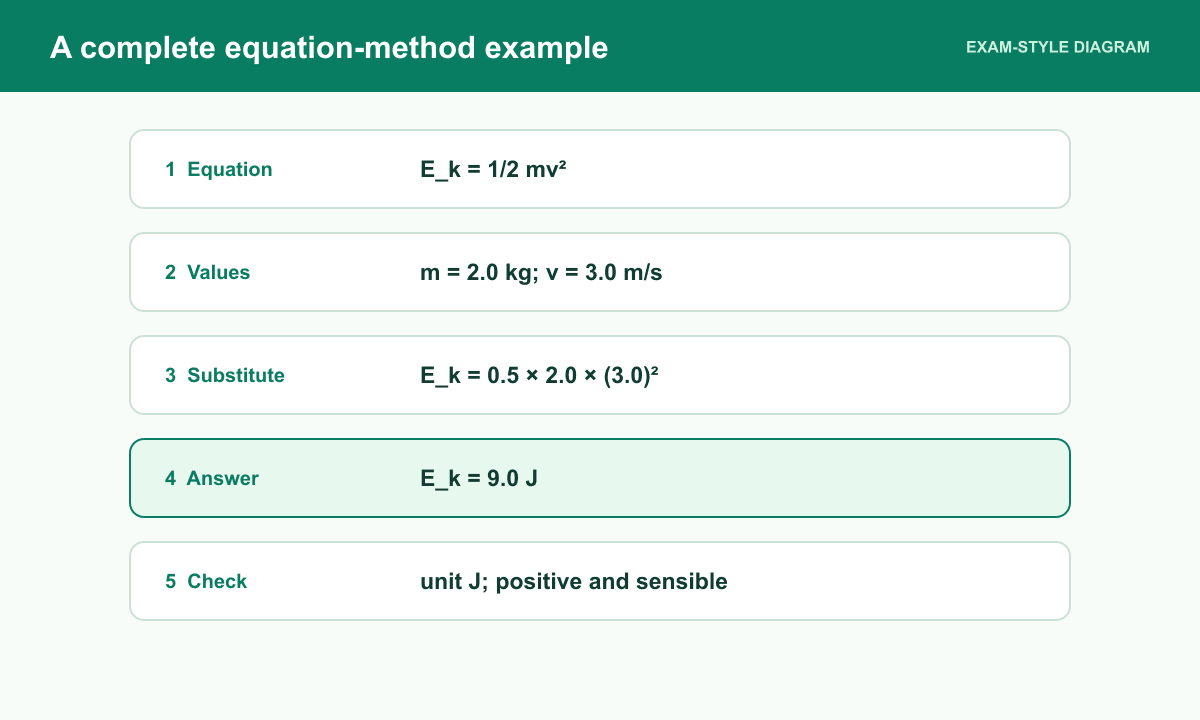
A 2 kg object moving at 3 m/s has a calculated kinetic energy of 90 J. What should you check first?
Write Eₖ = ½mv².
The speed must be squared before multiplying.
Show the answer
Check that v² was used; the correct value is 9 J.
Exam precision
Use the physics precisely
Do this: Rearrange symbolically, then convert and substitute. Use the equation’s scope label and check the examination-year sheet.
Independent practice
Exam-style questions
Write an answer before opening the marking guidance. Then edit the exact phrase or step that would gain the next mark.
1. Rearrange E = ½mv² for v and state the SI mass unit.
[3 marks]
Scope: 8463 and 8464 · Foundation and Higher
Show marking guidance and model answer
Original PhysicsUK mark scheme: Point 1 (1 mark): v² = 2E/m. Point 2 (1 mark): v = √(2E/m). Point 3 (1 mark): Mass must be in kg. Award each distinct point once. Accept equivalent scientifically correct wording. No half marks.
v² = 2E/m. (1 mark)
v = √(2E/m). (1 mark)
Mass must be in kg. (1 mark)
Model answer: v = √(2E/m), with mass in kg.
2. Convert 250 mA to A and 20 cm³ to m³.
[2 marks]
Scope: 8463 and 8464 · Foundation and Higher
Show marking guidance and model answer
Original PhysicsUK mark scheme: Point 1 (1 mark): 250 mA = 0.250 A. Point 2 (1 mark): 20 cm³ = 20 × 10⁻⁶ m³ = 2.0 × 10⁻⁵ m³. Award each distinct point once. Accept equivalent scientifically correct wording. No half marks.
250 mA = 0.250 A. (1 mark)
20 cm³ = 20 × 10⁻⁶ m³ = 2.0 × 10⁻⁵ m³. (1 mark)
Model answer: 0.250 A; 2.0 × 10⁻⁵ m³.
Questions pupils ask
GCSE Physics Equations and Maths Skills FAQs
Do I still need to learn how to use equations when a sheet is supplied?
Yes. A sheet supplies relationships; you must recognise the correct quantities, rearrange when required, convert units and interpret the answer.
Why does cm³ need a different conversion factor from cm?
Volume involves three lengths. Each length contributes a factor of 0.01, giving 0.01³ = 10⁻⁶.