Practise connecting two physical stages. Keep intermediate values and units visible so a later valid step remains checkable after an arithmetic slip.
By the end, you should be able to:
Connect energy, power and efficiency stages.
Cross-check electrical energy by charge or power.
Keep linked temperature and state-change calculations separate.
Before you revise
Diagnostic question
Choose an answer from memory. Your result tells you what to watch for in the guide.
Core revision guide
Learn the model, then use it
Practise connecting two physical stages. Keep intermediate values and units visible so a later valid step remains checkable after an arithmetic slip.
01
A lift with efficiency
Scope: 8463 and 8464 · Foundation and Higher
A 4 kg mass rises 3 m in 2 s with g = 9.8 N/kg. Useful energy = mgh = 117.6 J and useful power = 58.8 W. If the motor is 70% efficient, input power = useful/0.70 = 84 W. Dividing by efficiency gives a larger input; multiplying would incorrectly make input smaller than useful output.
02
An electrical cross-check
Scope: 8463 and 8464 · Foundation and Higher
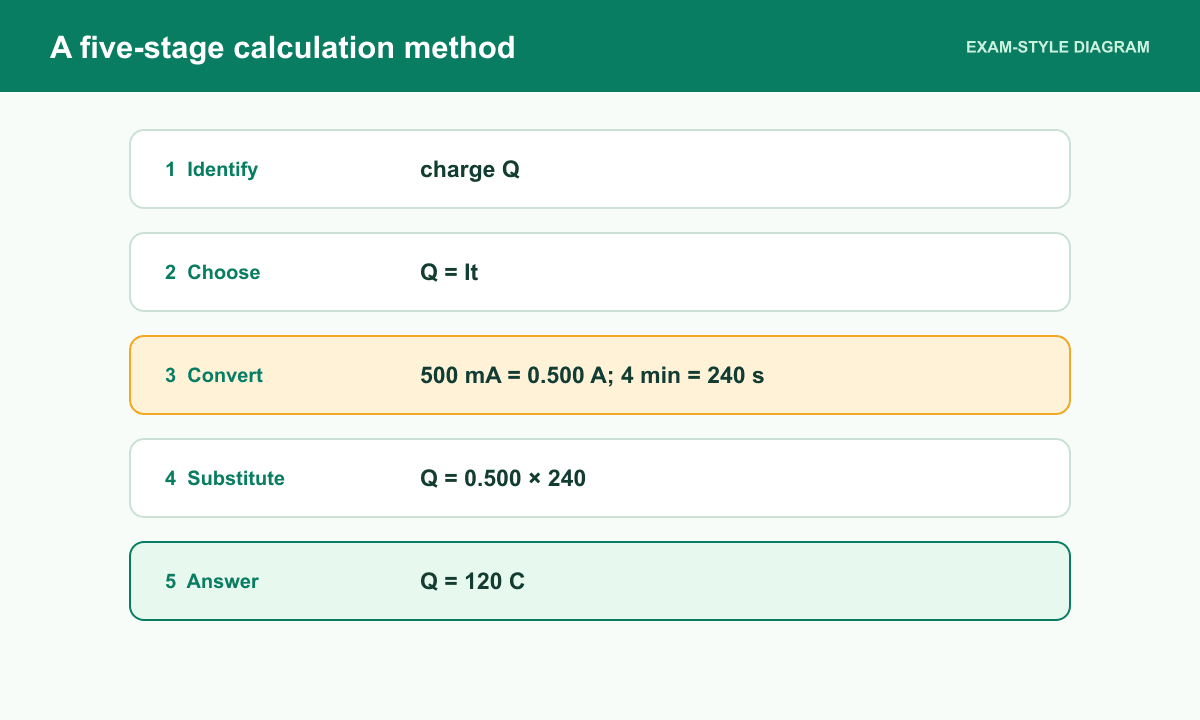
A 12 V, 0.50 A lamp running for 4 min has P = 6 W and E = 6 × 240 = 1440 J. Alternatively Q = 0.50 × 240 = 120 C and E = QV = 1440 J. Matching independent routes checks the method. 4 minutes is not 4 seconds, and 500 mA is not 500 A.
03
Separate state-change stages
Scope: 8463 and 8464 · Foundation and Higher
Melting ice at 0 °C uses E = mL. Heating the melted water uses E = mcΔθ. Add energies for sequential stages, divide the total by heater power for time, and account for efficiency only if given. Do not substitute zero Δθ into the state-change equation or round each stage before summing.
Read each belief, say what is wrong with it, then compare your correction.
Tempting idea: 45 W.
Use instead: Multiplying gives an input smaller than useful output. 60/0.75 = 80 W.
Tempting idea: 2000 C.
Use instead: Both units need conversion. 0.500 × 240 = 120.
Retrieval practice
Quick checks
Worked examples
See the method being built
Apply a lift with efficiency in the worked reasoning, then try the changed-context questions below.
Example 1 · Lift plus efficiency
Scope: 8463 and 8464 · Foundation and Higher
A 4 kg mass rises 3 m in 2 s; g = 9.8 N/kg and efficiency is 70%. Find input power.
Euseful = mgh = 117.6 J.
Puseful = 117.6/2 = 58.8 W.
Pinput = 58.8/0.70 = 84 W.
Show the answer
84 W input, with 58.8 W useful output and 25.2 W unwanted transfer.
Exam precision
Use the physics precisely
Do this: Write each intermediate result with its unit and retain unrounded values. Check that input exceeds useful output when efficiency is below one.
Independent practice
Exam-style questions
Write an answer before opening the marking guidance. Then edit the exact phrase or step that would gain the next mark.
1. A motor lifts 5.0 kg through 2.0 m in 4.0 s. g = 10 N/kg and efficiency = 80%. Find useful power and input power.
[4 marks]
Scope: 8463 and 8464 · Foundation and Higher
Show marking guidance and model answer
Original PhysicsUK mark scheme: Point 1 (1 mark): Useful energy = mgh = 5.0 × 10 × 2.0 = 100 J. Point 2 (1 mark): Useful power = 100/4.0 = 25 W. Point 3 (1 mark): Efficiency = 0.80; input power = useful power/efficiency. Point 4 (1 mark): Input power = 25/0.80 = 31.25 W (31 W acceptable). Award each distinct point once. Accept equivalent scientifically correct wording. No half marks.
Useful energy = mgh = 5.0 × 10 × 2.0 = 100 J. (1 mark)
Useful power = 100/4.0 = 25 W. (1 mark)
Efficiency = 0.80; input power = useful power/efficiency. (1 mark)
Input power = 25/0.80 = 31.25 W (31 W acceptable). (1 mark)
Model answer: Useful energy = mgh = 5.0 × 10 × 2.0 = 100 J. Useful power = E/t = 100/4.0 = 25 W. Efficiency = 80/100 = 0.80, so input power = useful power/efficiency = 25/0.80 = 31.25 W (31 W to two significant figures). Input exceeds useful output because efficiency is below one.
Marking notes: Carry a numerical error from energy into a correct E/t method, then carry useful power into correct division by 0.80. Do not carry a physically invalid efficiency inversion.
2. A 6.0 V device carries 300 mA for 5.0 min. Find energy transferred using charge.
[3 marks]
Scope: 8463 and 8464 · Foundation and Higher
Show marking guidance and model answer
Original PhysicsUK mark scheme: Point 1 (1 mark): I = 0.300 A and t = 300 s. Point 2 (1 mark): Q = It = 90 C. Point 3 (1 mark): E = QV = 90 × 6.0 = 540 J. Award each distinct point once. Accept equivalent scientifically correct wording. No half marks.
I = 0.300 A and t = 300 s. (1 mark)
Q = It = 90 C. (1 mark)
E = QV = 90 × 6.0 = 540 J. (1 mark)
Model answer: Convert 300 mA to 0.300 A and 5.0 min to 300 s. Q = It = 0.300 × 300 = 90 C. E = QV = 90 × 6.0 = 540 J. Alternatively P = VI = 6.0 × 0.300 = 1.8 W, then E = Pt = 1.8 × 300 = 540 J.
Marking notes: Accept P = VI then E = Pt as an alternative complete method with the same conversions. Later method marks may carry a previous arithmetic error.
Questions pupils ask
How to Answer GCSE Physics Calculation Questions FAQs