

What happens at the autumn equinox?
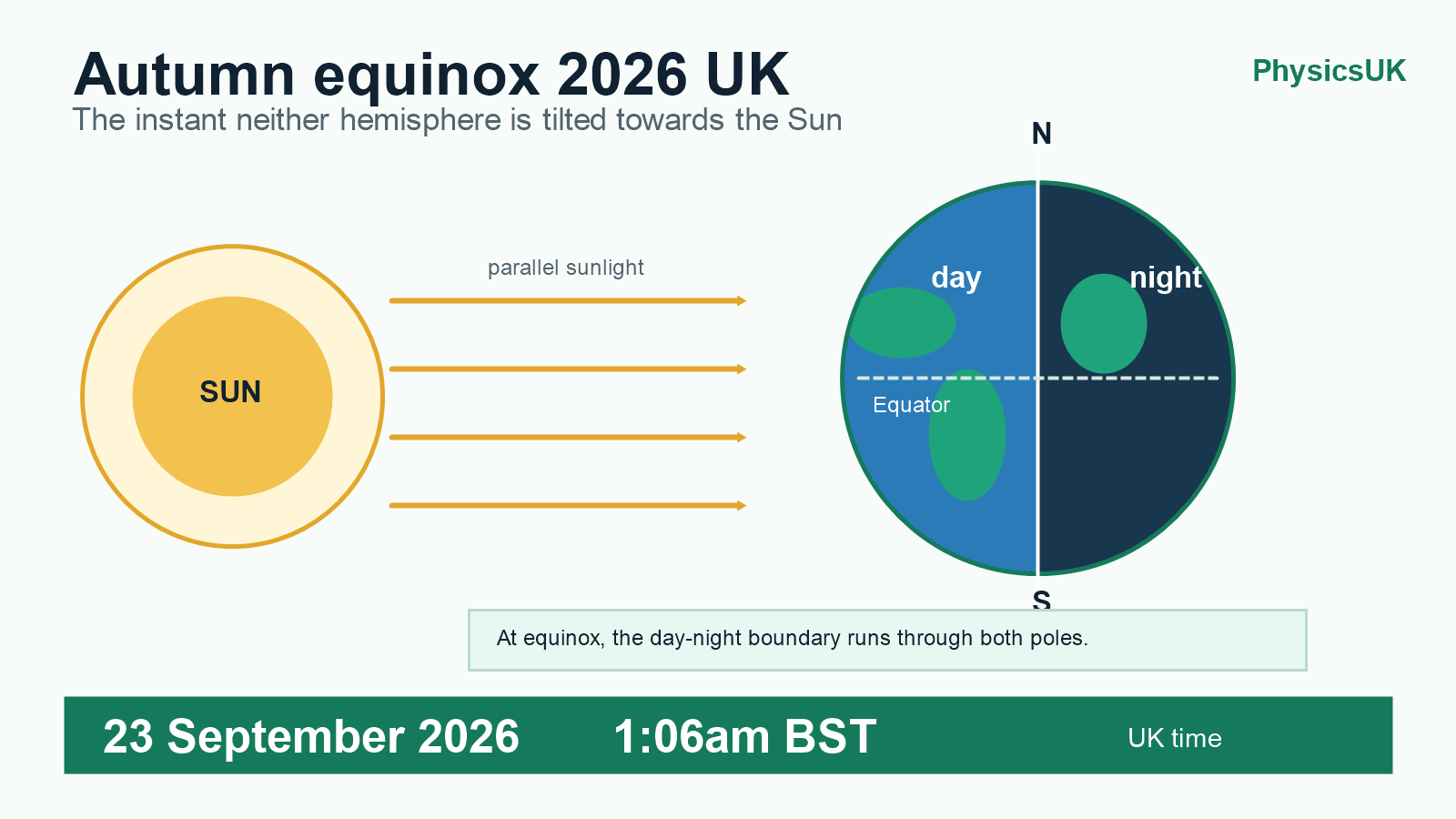
The autumn equinox happens at 1:06am BST on Wednesday 23 September 2026 in the UK. The Royal Observatory Greenwich gives 12:06am GMT, which is 1:06am while the UK is still using British Summer Time.
At that instant, the centre of the Sun crosses the celestial equator moving south. Put another way, the line from Earth to the Sun lies in the plane of Earth's equator. Neither the Northern nor the Southern Hemisphere is leaning towards the Sun, so both receive almost the same total amount of sunlight.
Nothing flashes or clicks into place in the sky at 1:06am. The equinox is a calculated crossing point in continuous orbital motion. The change in sunrise time, sunset time and the height of the midday Sun happens gradually from one day to the next.
For many people, this is the start of astronomical autumn in the Northern Hemisphere and astronomical spring in the Southern Hemisphere. Meteorologists use whole months for seasonal statistics, so meteorological autumn in the UK runs from 1 September to 30 November.
Why do days get shorter after the autumn equinox?
Earth spins once each day and travels around the Sun once each year. Its rotational axis is tilted by about 23.4 degrees and keeps pointing in almost the same direction as Earth moves around its orbit. That tilt changes which hemisphere faces the Sun more directly.
At the June solstice, the Northern Hemisphere leans most towards the Sun. The Sun follows a higher, longer path across the UK sky. By the September equinox, the sideways position of the tilt means neither hemisphere leans towards the Sun. After the equinox, the Northern Hemisphere leans increasingly away until the December solstice.
That is why UK days get shorter. The Sun rises later, sets earlier and takes a lower path across the sky. Its light arrives at a shallower angle, so the same incoming solar energy is spread over a larger area of ground.
Earth's distance from the Sun is not the main cause. Earth is actually closest to the Sun in early January, during Northern Hemisphere winter, and farthest away in early July. The opposite seasons in the two hemispheres are another clue that axial tilt is the important factor.
What will you notice in the UK?
There is no special viewing window, but the weeks around the equinox make the changing Sun path easy to notice.
Later sunrise and earlier sunset
The loss of daylight continues through autumn. The rate varies with latitude, so northern parts of the UK change faster than southern parts.
A lower midday Sun
Shadows become longer at the same clock time because the Sun reaches a lower angle above the horizon.
No instant weather switch
Air, land and sea store thermal energy. Temperatures respond with a delay, so an equinox does not guarantee an immediate cold spell.
A nearby Harvest Moon
The full Moon nearest the equinox is called the Harvest Moon. In 2026 it is full on 26 September at 5:49pm BST in the UK.
Why are day and night not exactly equal at the equinox?
The word equinox comes from words meaning equal night, but sunrise and sunset tables do not normally show exactly 12 hours of each on the equinox date. The difference is real rather than a mistake in the forecast.
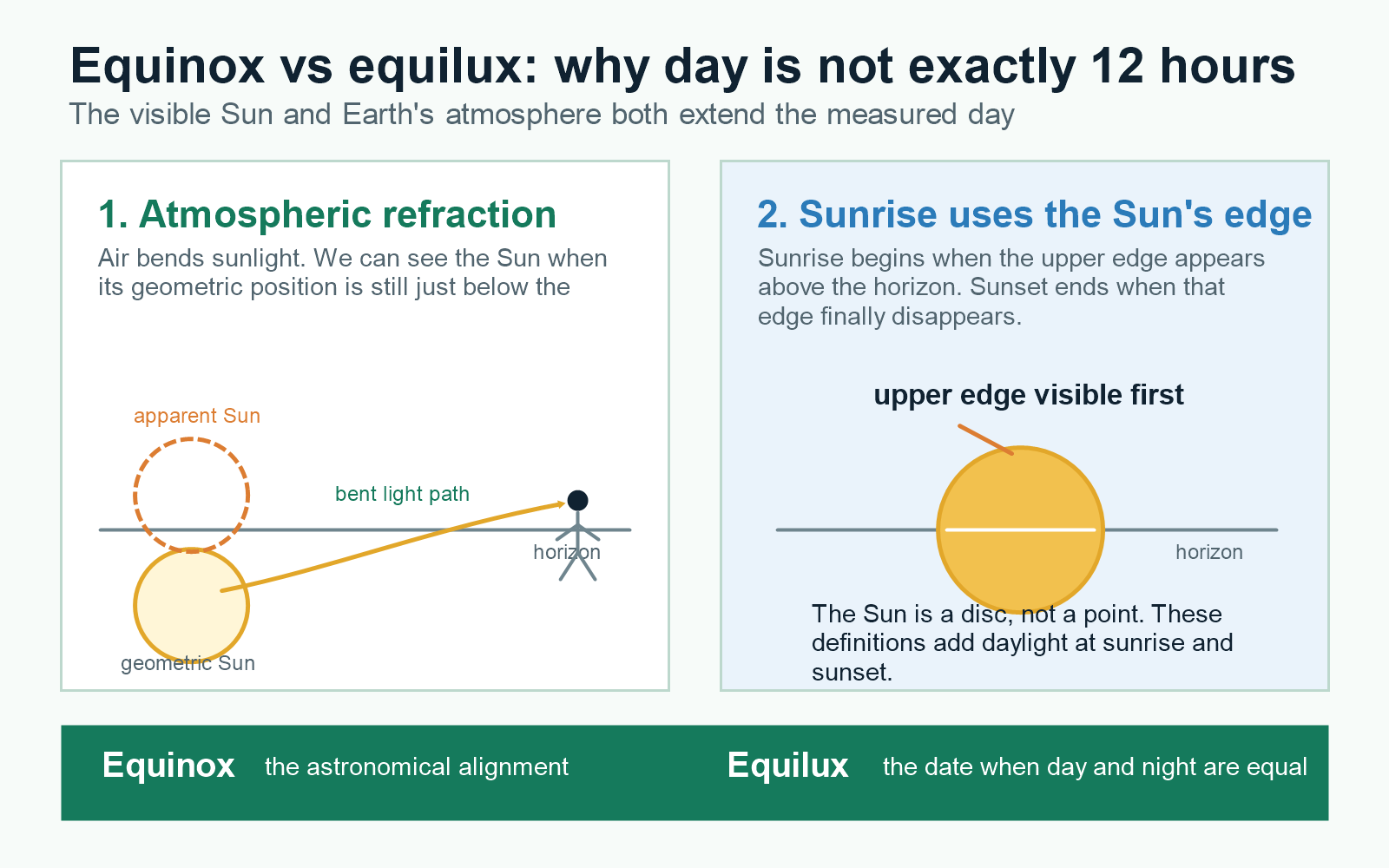
One reason is that the Sun is a disc, not a point. Sunrise is timed from the first appearance of the Sun's upper edge, while sunset finishes when that edge disappears. This adds daylight at both ends of the day.
The second reason is atmospheric refraction. Earth's atmosphere bends sunlight, allowing us to see the Sun when its geometric position is still slightly below the horizon. Refraction therefore brings sunrise forward and delays sunset.
The date when daylight and darkness are closest to exactly equal is called the equilux. It falls a few days after the autumn equinox in the Northern Hemisphere, and its exact date depends on latitude and the local definition of sunrise and sunset.
The school physics behind the changing seasons
Earth's orbit and rotation connect the event directly to GCSE Space Physics. Gravity provides the force that continually changes the direction of Earth's velocity, keeping the planet in orbit around the Sun. Rotation produces the daily cycle of daylight and darkness.
The seasonal change comes from geometry. A higher Sun means the incoming radiation is concentrated onto a smaller surface area and lasts for more hours. A lower Sun spreads the same beam over more ground and is above the horizon for less time.
The slightly extended day links to wave physics. Atmospheric refraction occurs because light changes speed as it passes through layers of air with different densities. The curved path makes the Sun appear a little higher than its geometric position near the horizon.
At A Level, gravitational fields and orbits provide the dynamics behind the yearly motion, while intensity, geometry and refraction explain what an observer measures. An astrophysicist and space scientist may calculate precise event times, model Earth's orientation or work with satellite images of the moving day-night boundary.
Science ideas to understand
Equinox is an alignment
Neither hemisphere is tilted towards the Sun at the exact equinox instant.
Tilt causes seasons
Earth's 23.4-degree axial tilt changes solar height and daylight duration during the orbit.
Equilux is different
Equal measured day and night occur on a nearby latitude-dependent date, not necessarily on the equinox.
Distance is not the cause
Northern winter occurs close to Earth's nearest point to the Sun, so distance cannot explain the seasons.
A Level stretch: the equinox as a precise alignment
Astronomers describe the Sun's north-south position using solar declination. It is approximately zero at an equinox because the Sun is directly above the equator. It reaches its largest positive value near the June solstice and its largest negative value near the December solstice.
The line separating day from night is called the terminator. At an equinox it runs almost exactly from pole to pole. At a solstice it is tilted strongly relative to the poles, producing very long summer days in one hemisphere and very short days in the other.
The equinox is an instant, so it occurs at the same physical moment everywhere. Clock time and sometimes calendar date differ between time zones. That is why a search result written for the United States may show 22 September while the UK date is 23 September.
Key words
Autumn equinox 2026 UK: common questions
When is the autumn equinox 2026 in the UK?
The autumn equinox occurs on Wednesday 23 September 2026 at 1:06am BST in the UK, according to Royal Observatory Greenwich.
Is the 2026 autumn equinox on 22 or 23 September?
It is 23 September in the UK. The equinox is one worldwide instant, but time zones can place it on 22 September in parts of North America.
What time is the autumn equinox 2026?
The exact UK time is 1:06am BST on Wednesday 23 September. NASA gives approximately 00:05 UTC, with the one-minute difference caused by rounding in published event tables.
When does autumn start in the UK in 2026?
Astronomical autumn is commonly said to start at the equinox on 23 September. Meteorological autumn uses fixed months and began on 1 September.
Why do the days get shorter after the autumn equinox?
After the September equinox, the Northern Hemisphere tilts increasingly away from the Sun. The Sun follows a lower, shorter path across the UK sky, so sunrise becomes later and sunset earlier.
Are day and night exactly equal on the equinox?
Not when measured from published sunrise and sunset times. Atmospheric refraction and timing sunrise from the Sun's upper edge make daylight slightly longer than 12 hours.
What is the difference between equinox and equilux?
Equinox is the astronomical alignment of Earth and the Sun. Equilux is the nearby date when measured day and night are equal at a particular latitude.
Can you see the autumn equinox happen?
There is no sudden flash or shadow at the exact instant. You can observe its effects over several days through changing sunrise, sunset, shadow length and the height of the midday Sun.
Are seasons caused by Earth being farther from the Sun?
No. Earth's axial tilt is the main cause. Earth is closest to the Sun during Northern Hemisphere winter and farthest away during Northern Hemisphere summer.
What season begins in the Southern Hemisphere?
The September equinox marks the beginning of astronomical spring in the Southern Hemisphere while autumn begins in the Northern Hemisphere.
When is the Harvest Moon 2026 in the UK?
The Harvest Moon is full on Saturday 26 September 2026 at 5:49pm BST. It is the full Moon closest to the autumn equinox.
Does the equinox cause colder weather immediately?
No. The equinox changes the Sun-Earth geometry, but land, oceans and the atmosphere store energy. UK temperatures respond gradually and day-to-day weather can still vary widely.