Locate the Solar System within the galaxy, then use gravity to explain why planets and satellites follow curved paths.
AQA 8463GCSE PhysicsFoundationHigher
Learn · practise · improve
Start here
The revision snapshot
Locate the Solar System within the galaxy, then use gravity to explain why planets and satellites follow curved paths.
By the end, you should be able to:
Locate planets and satellites within the Solar System and galaxy.
Higher: explain circular acceleration at constant speed.
Distinguish satellite uses from optional quantitative orbit models.
Before you revise
Diagnostic question
Choose an answer from memory. Your result tells you what to watch for in the guide.
Core revision guide
Learn the model, then use it
Locate the Solar System within the galaxy, then use gravity to explain why planets and satellites follow curved paths.
01
The hierarchy
Scope: 8463 Physics only · Foundation and Higher
The Sun is a star in the Milky Way galaxy, one of many galaxies. Its Solar System contains eight planets, natural satellites, dwarf planets, asteroids and comets. Mercury, Venus, Earth and Mars are the inner rocky planets; Jupiter, Saturn, Uranus and Neptune are the outer giant planets. Planets orbit the Sun; moons orbit planets; artificial satellites can orbit Earth. A galaxy is not another name for the Solar System.
02
Circular orbit reasoning
Scope: 8463 Physics only · circular-orbit explanation Higher
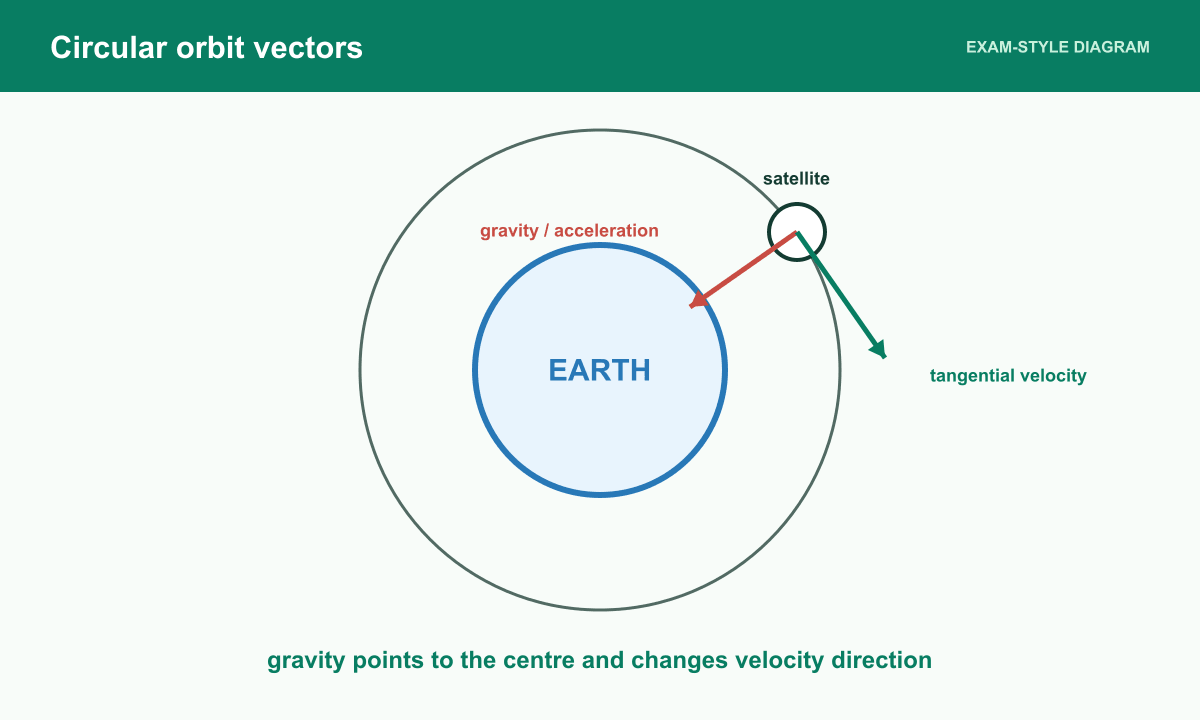
Gravity supplies an inward resultant force. A circular-orbit satellite’s instantaneous velocity is tangential, while acceleration is towards the centre. Its speed can stay constant while its velocity changes direction. No extra outward force is required in the orbital free-body account. Without the inward force it would continue along a tangent, rather than fly radially outwards.
03
Satellites and uses
Scope: 8463 Physics only · Foundation and Higher
Artificial satellites support weather observation, navigation, imaging and communication. Geostationary is useful enrichment: a suitable equatorial orbit in Earth’s rotation direction with a roughly one-day period appears fixed to a ground observer. Other orbits allow coverage of different regions. At Higher, changing speed in a circular-orbit comparison requires a different stable radius; generic launch outcomes need conditions rather than “faster always escapes”.
04
Optional quantitative orbit model
Scope: Optional enrichment
The explorer assumes a tangential launch around a point mass without atmosphere or collisions. At one radius, circular speed is a reference. A slower launch initially moves inward on a bound elliptical path; a faster launch below √2 times circular speed is also bound and initially moves outward. At √2 the ideal trajectory is parabolic; above it the path is unbound. The displayed circle is a reference, not an integrated flight path. These quantitative launch conditions are enrichment, separate from the GCSE Higher explanation of circular velocity and gravity.
Velocity is tangential while gravity continually changes its direction towards the centre of the orbit.Open the full-size exam diagram
Misconception clinic
Replace the tempting answer
Read each belief, say what is wrong with it, then compare your correction.
Tempting idea: Earth is a star in the Solar System galaxy.
Use instead: Earth is a planet; Solar System is not a galaxy. This distinguishes each scale correctly.
Tempting idea: Radially towards the centre.
Use instead: Gravity’s removal does not create inward velocity. Its existing velocity points tangentially.
Retrieval practice
Quick checks
Explore the relationship
Satellite orbit model
Compare the selected speed with the circular-orbit speed for the selected radius.
Model scope: Optional orbital calculation enrichment
What to notice: use the readout to describe how one variable changes when the other is controlled.
Worked examples
See the method being built
Apply the hierarchy in the worked reasoning, then try the changed-context questions below.
Example 1 · Why orbit
Scope: 8463 Physics only · Higher only
Explain why a satellite does not fly off in a straight line.
Identify gravity as resultant force.
State velocity direction changes.
Describe continuous curved path.
Show the answer
Gravity continually changes the direction of the satellite’s velocity, producing an orbit.
It stays above the same point on Earth, so a ground dish can point in one fixed direction.
Example 3 · Low orbit
Scope: Optional enrichment
State one advantage of a low-Earth satellite for imaging.
Identify shorter distance.
Link to image detail/latency.
Avoid claiming it is stationary.
Show the answer
Being closer to Earth can provide higher-resolution images, though it moves relative to the ground.
Exam precision
Use the physics precisely
Do this: Name the hierarchy or force requested. For a circular orbit distinguish constant speed from changing velocity and avoid adding an outward force.
Independent practice
Exam-style questions
Write an answer before opening the marking guidance. Then edit the exact phrase or step that would gain the next mark.
1. Distinguish a star, planet and natural satellite using the Solar System.
[3 marks]
Scope: 8463 Physics only · Foundation and Higher
Show marking guidance and model answer
Original PhysicsUK mark scheme: Point 1 (1 mark): The Sun is a star, releasing energy by nuclear fusion. Point 2 (1 mark): Earth is a planet orbiting the Sun. Point 3 (1 mark): The Moon is a natural satellite orbiting Earth. Award each distinct point once. Accept equivalent scientifically correct wording. No half marks.
The Sun is a star, releasing energy by nuclear fusion. (1 mark)
Earth is a planet orbiting the Sun. (1 mark)
The Moon is a natural satellite orbiting Earth. (1 mark)
Model answer: The Sun is a star that releases energy by nuclear fusion. Earth is a planet orbiting the Sun. The Moon is Earth’s natural satellite, orbiting Earth.
2. Physics Higher: explain how a satellite can accelerate while its speed is constant in a circular orbit.
[2 marks]
Scope: 8463 Physics only · Higher only
Show marking guidance and model answer
Original PhysicsUK mark scheme: Point 1 (1 mark): Its velocity changes direction even with constant speed. Point 2 (1 mark): Gravity provides an inward resultant and hence centripetal acceleration. Award each distinct point once. Accept equivalent scientifically correct wording. No half marks.
Its velocity changes direction even with constant speed. (1 mark)
Gravity provides an inward resultant and hence centripetal acceleration. (1 mark)
Model answer: Acceleration is change of velocity. Gravity continually turns the tangential velocity towards the centre.
Questions pupils ask
The Solar System, Satellites and Orbital Motion FAQs
How can an orbit have constant speed but changing velocity?
Velocity includes direction. Gravity continually changes that direction towards the centre while the speed may remain constant.