Red Shift, the Expanding Universe and the Big Bang
Compare identifiable spectral lines, then distinguish what was observed, what it supports and what remains unexplained.
AQA 8463GCSE PhysicsFoundationHigher
Learn · practise · improve
Start here
The revision snapshot
Compare identifiable spectral lines, then distinguish what was observed, what it supports and what remains unexplained.
By the end, you should be able to:
Identify red shift from matching spectral lines.
Explain how a distance trend supports expansion.
Separate acceleration evidence from unresolved causes.
Before you revise
Diagnostic question
Choose an answer from memory. Your result tells you what to watch for in the guide.
Core revision guide
Learn the model, then use it
Compare identifiable spectral lines, then distinguish what was observed, what it supports and what remains unexplained.
01
Red shift and the expansion pattern
Scope: 8463 Physics only · Foundation and Higher
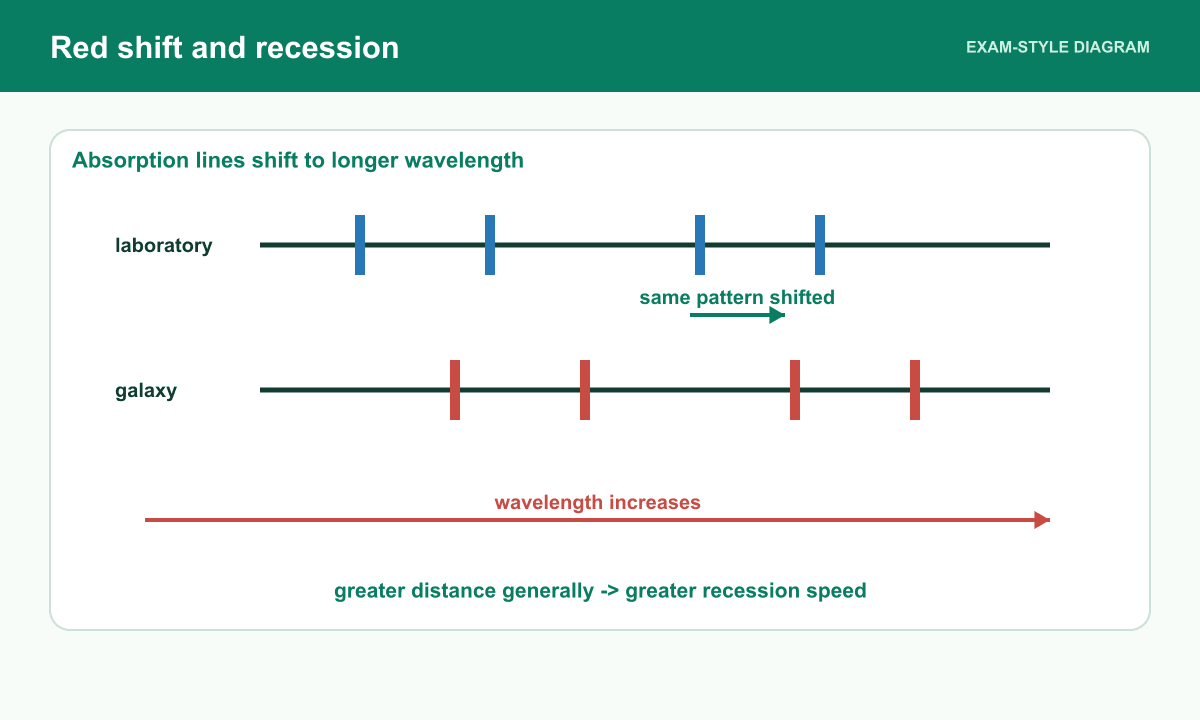
An element has a characteristic pattern of laboratory wavelengths. If matching galaxy lines appear at longer wavelengths, the spectrum is red-shifted, indicating recession in the GCSE interpretation. More distant galaxies generally show larger red shift and greater recession speed. The distance trend supports expansion of space, rather than an explosion from Earth at the centre.
02
The hot dense past
Scope: 8463 Physics only · Foundation and Higher
Extrapolating expansion backwards supports a universe that was once much smaller, denser and hotter: the Big Bang model. Red shift is observational evidence for expansion. Cosmic microwave background is useful enrichment corroborating the hot early universe; advanced cosmological equations are not required to explain this GCSE evidence.
03
Accelerating expansion and open questions
Scope: 8463 Physics only · Foundation and Higher
Since 1998, observations of distant supernovae have suggested that the universe’s expansion is speeding up. These observations extend a constant-expansion picture. GCSE scope asks students to distinguish the evidence from the unresolved cause: dark energy and dark matter are names used in current models, while their nature remains unknown. Do not treat a proposed cause as a directly observed substance.
The line pattern stays the same but moves towards longer wavelength; more distant galaxies generally recede faster.Open the full-size exam diagram
Misconception clinic
Replace the tempting answer
Read each belief, say what is wrong with it, then compare your correction.
Tempting idea: The line was destroyed.
Use instead: The line is still identifiable. Longer matched wavelengths indicate red shift.
Tempting idea: Dark energy has been directly photographed causing every red shift.
Use instead: Its nature is not directly established that way. This states the evidence and its limit.
Retrieval practice
Quick checks
Explore the relationship
Red-shift evidence model
Compare an observed red shift with the red shift predicted by Hubble’s law for the selected distance.
Model scope: Optional numerical red-shift/Hubble-law enrichment
What to notice: use the readout to describe how one variable changes when the other is controlled.
Worked examples
See the method being built
Apply red shift and the expansion pattern in the worked reasoning, then try the changed-context questions below.
Example 1 · Interpret spectrum
Scope: 8463 Physics only · Foundation and Higher
A galaxy’s hydrogen line is observed at a longer wavelength than in a lab. State conclusion.
Compare wavelengths.
Name red shift.
State direction of motion.
Show the answer
The light is red-shifted, so the galaxy is moving away.
Example 2 · Expansion evidence
Scope: 8463 Physics only · Foundation and Higher
More distant galaxies show greater red shift. Explain how this supports expansion.
State greater recession effect.
Link to distance pattern.
Conclude universe expanding.
Show the answer
The trend shows more distant galaxies are generally receding faster, supporting an expanding-universe model.
Example 3 · Big Bang evidence
Scope: 8463 Physics only · Foundation and Higher
Explain how red shift relates to the Big Bang model.
Use expansion evidence.
Run expansion back in time.
State denser/hotter past.
Show the answer
If the universe is expanding, it was smaller, denser and hotter in the past, consistent with the Big Bang model.
Exam precision
Use the physics precisely
Do this: State the measured spectral change before the inference. Separate the observed expansion pattern from proposed explanations of its cause.
Independent practice
Exam-style questions
Write an answer before opening the marking guidance. Then edit the exact phrase or step that would gain the next mark.
1. Explain how galaxy red-shift data support an expanding universe.
[3 marks]
Scope: 8463 Physics only · Foundation and Higher
Show marking guidance and model answer
Original PhysicsUK mark scheme: Point 1 (1 mark): Matched spectral lines occur at longer wavelengths. Point 2 (1 mark): This indicates recession of distant galaxies. Point 3 (1 mark): More distant galaxies generally recede faster, supporting expansion. Award each distinct point once. Accept equivalent scientifically correct wording. No half marks.
Matched spectral lines occur at longer wavelengths. (1 mark)
This indicates recession of distant galaxies. (1 mark)
More distant galaxies generally recede faster, supporting expansion. (1 mark)
Model answer: Matched lines are red-shifted. Distant galaxies are receding, and recession increases with distance, supporting expansion.
2. State evidence for accelerating expansion and explain one limit of the conclusion.
[2 marks]
Scope: 8463 Physics only · Foundation and Higher
Show marking guidance and model answer
Original PhysicsUK mark scheme: Point 1 (1 mark): Distant-supernova observations since 1998 suggest expansion is speeding up. Point 2 (1 mark): They do not establish the physical nature/cause of dark energy or dark matter. Award each distinct point once. Accept equivalent scientifically correct wording. No half marks.
Distant-supernova observations since 1998 suggest expansion is speeding up. (1 mark)
They do not establish the physical nature/cause of dark energy or dark matter. (1 mark)
Model answer: Supernova observations suggest accelerating expansion, but the physical nature of the proposed causes remains unknown.
Questions pupils ask
Red Shift, the Expanding Universe and the Big Bang FAQs
Does red shift reveal what dark energy is?
No. Red shift supports expansion; supernova observations indicate acceleration. The nature and cause associated with dark energy remain uncertain.