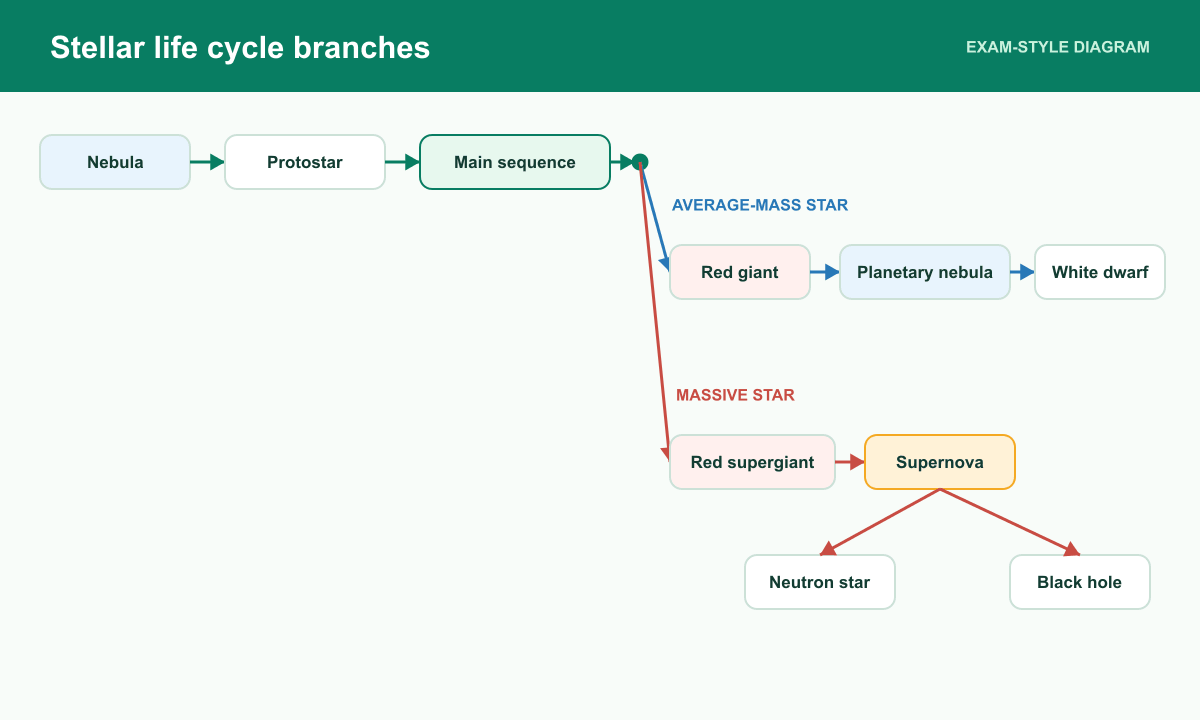
Initial mass determines a star’s evolutionary route. Fusion powers a main-sequence star and later stellar processes produce the elements in planets and living things.
AQA 8463GCSE PhysicsFoundationHigher
Learn · practise · improve
Start here
The revision snapshot
Initial mass determines a star’s evolutionary route. Fusion powers a main-sequence star and later stellar processes produce the elements in planets and living things.
By the end, you should be able to:
Describe gravitational collapse and the start of fusion.
Choose a stellar life-cycle route from initial mass.
Explain heavy-element production and dispersal.
Before you revise
Diagnostic question
Choose an answer from memory. Your result tells you what to watch for in the guide.
Core revision guide
Learn the model, then use it
Initial mass determines a star’s evolutionary route. Fusion powers a main-sequence star and later stellar processes produce the elements in planets and living things.
01
Formation and stable stage
Scope: 8463 Physics only · Foundation and Higher
Gravity pulls a nebula of gas and dust together into a protostar. Gravitational collapse heats it until hydrogen nuclei can fuse to helium. During the main sequence, gravity’s inward effect balances outward pressure arising from the high-temperature material and radiation sustained by fusion. Fusion releases energy; ordinary chemical burning cannot account for a star’s long-lived output.
02
Two later routes
Scope: 8463 Physics only · Foundation and Higher
When hydrogen fuel in the core runs low, a Sun-like star evolves into a red giant, loses outer layers and leaves a white dwarf that cools. A much more massive star becomes a red supergiant and can explode as a supernova, leaving a neutron star or black hole. Use mass as the branch condition; do not place every stage on one chain. Planetary-nebula detail and final black-dwarf terminology are context/enrichment rather than necessary extra stages in every answer.
03
Where heavier elements come from
Scope: 8463 Physics only · Foundation and Higher
Fusion during stellar evolution builds heavier nuclei from lighter ones, including elements up to iron in massive stars. Elements heavier than iron are produced in supernova processes in the GCSE model. The explosion disperses enriched material into space, becoming part of later nebulae, stars and planets. The Sun’s hydrogen fusion is not uranium fission.
Read each belief, say what is wrong with it, then compare your correction.
Tempting idea: Red giant → white dwarf only.
Use instead: That is the Sun-like route. Massive stars can follow this route.
Tempting idea: They remain forever only inside the first star.
Use instead: Explosions/loss of material distribute them. The ejecta enrich later nebulae.
Retrieval practice
Quick checks
Worked examples
See the method being built
Apply formation and stable stage in the worked reasoning, then try the changed-context questions below.
Example 1 · Sun-like sequence
Scope: 8463 Physics only · Foundation and Higher
Order the late stages of a Sun-like star.
Start main sequence.
Use lower-mass branch.
End white dwarf.
Show the answer
Main sequence → red giant → planetary nebula → white dwarf.
Example 2 · Massive sequence
Scope: 8463 Physics only · Foundation and Higher
Order the late stages of a massive star.
Start main sequence.
Use red supergiant.
Include supernova then remnant.
Show the answer
Main sequence → red supergiant → supernova → neutron star or black hole.
Example 3 · Why mass matters
Scope: 8463 Physics only · Foundation and Higher
Explain why two stars can have different final stages.
Identify initial mass.
Link to gravity/fusion balance.
State different paths.
Show the answer
Greater initial mass changes gravitational pressure and the later evolution, leading to a supernova route rather than a white dwarf route.
Exam precision
Use the physics precisely
Do this: Give the mass-dependent stages and explain the trigger between them. Include fusion and fuel depletion rather than relying on an unexplained arrow chain.
Independent practice
Exam-style questions
Write an answer before opening the marking guidance. Then edit the exact phrase or step that would gain the next mark.
1. Describe the main life-cycle stages of a star much more massive than the Sun.
[4 marks]
Scope: 8463 Physics only · Foundation and Higher
Show marking guidance and model answer
Original PhysicsUK mark scheme: Point 1 (1 mark): Nebula collapses to a protostar. Point 2 (1 mark): Fusion starts and a stable main-sequence phase occurs. Point 3 (1 mark): After core fuel depletion it becomes a red supergiant. Point 4 (1 mark): A supernova leaves a neutron star or black hole. Award each distinct point once. Accept equivalent scientifically correct wording. No half marks.
Nebula collapses to a protostar. (1 mark)
Fusion starts and a stable main-sequence phase occurs. (1 mark)
After core fuel depletion it becomes a red supergiant. (1 mark)
A supernova leaves a neutron star or black hole. (1 mark)
Model answer: Gravity collapses a nebula of gas and dust into a protostar. Collapse heats the core until fusion starts, producing a stable main-sequence star. After depletion of the core hydrogen fuel, a much more massive star becomes a red supergiant. A supernova then leaves a neutron star or black hole.
2. Explain how material from stars can become part of a new planet.
[3 marks]
Scope: 8463 Physics only · Foundation and Higher
Show marking guidance and model answer
Original PhysicsUK mark scheme: Point 1 (1 mark): Stellar fusion and supernova processes produce heavier elements. Point 2 (1 mark): Supernovae eject/disperse these elements into space. Point 3 (1 mark): Enriched gas and dust join later nebulae that form stars and planetary systems. Award each distinct point once. Accept equivalent scientifically correct wording. No half marks.
Stellar fusion and supernova processes produce heavier elements. (1 mark)
Supernovae eject/disperse these elements into space. (1 mark)
Enriched gas and dust join later nebulae that form stars and planetary systems. (1 mark)
Model answer: Stellar nuclear processes make heavier elements, which explosions disperse. The enriched dust and gas can form new nebulae and later planets.
Questions pupils ask
Stars, Life Cycle and Classification FAQs
Why are supernovae important to the material in planets?
Massive stellar evolution and supernovae produce/disperse elements, supplying the material from which later stars and planetary systems form.