
What happened?
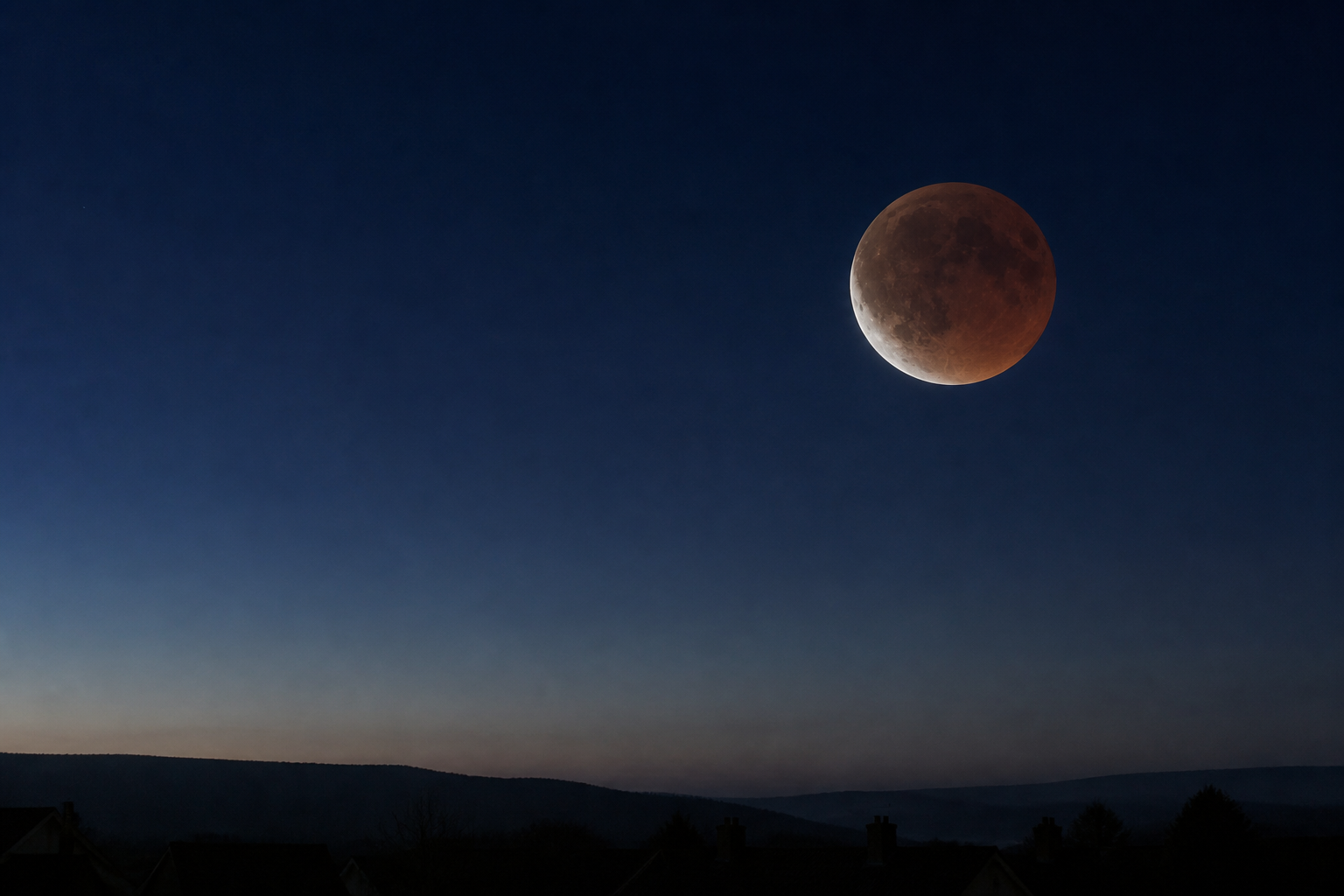
In the early hours of Friday 28 August 2026, a deep partial lunar eclipse will be visible from across the UK if the sky is clear. Earth's shadow will move across the full Moon, leaving only a slim part outside the darkest shadow at maximum eclipse.
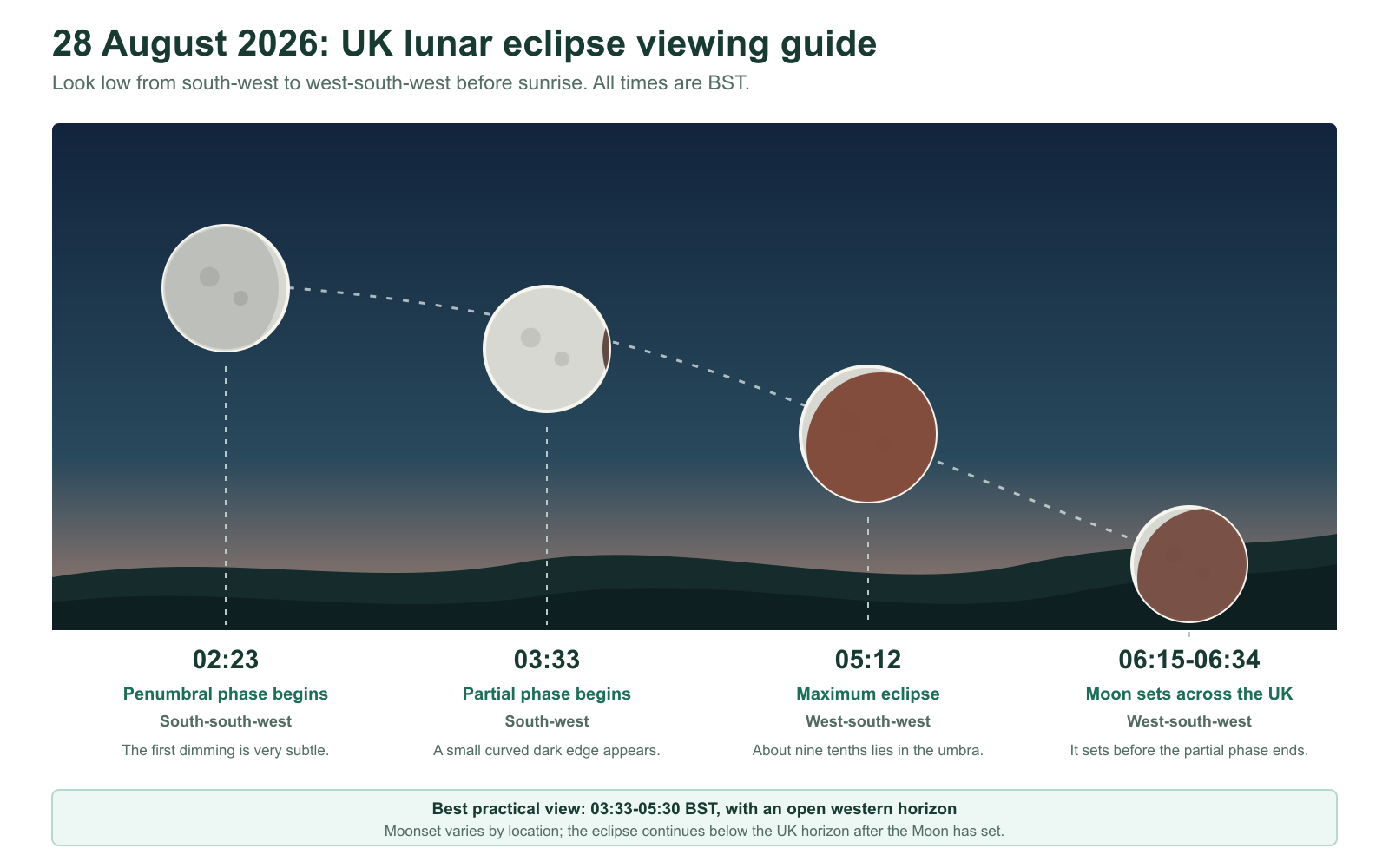
The first penumbral contact is at about 02:23 BST, but this early shading is so faint that many people will not notice it. The obvious partial phase begins at about 03:33, when the curved edge of Earth's umbra starts to look like a dark bite taken from the Moon.
Maximum eclipse is at 05:12 BST. Royal Observatory Greenwich says approximately 90% of the Moon will then be in Earth's umbra. It is a partial eclipse everywhere: the Moon never becomes completely covered by the umbra at any location on Earth during this event.
The main challenge is not eye safety but the horizon. By maximum eclipse the Moon will be only about 7-11 degrees above the west-south-western horizon across much of the UK. Look for an open view without nearby buildings, hills or trees. The Moon sets at about 06:15 in London and roughly 06:20-06:35 in several western and northern UK cities, before the partial phase has finished.
This event follows the 12 August solar eclipse by just over two weeks. That is not a coincidence. The solar eclipse occurred at new Moon; the lunar eclipse arrives at the following full Moon while the Sun, Earth and Moon are still close enough to the same eclipse-season alignment.
What time is the lunar eclipse in the UK?
These British Summer Time values are a practical UK guide. The eclipse phases occur at the same moment nationwide, but the Moon's direction, height and setting time depend on your location.
| Stage | Time (BST) | Where to look | What you may notice |
|---|---|---|---|
| Penumbral eclipse begins | 02:23 | South-south-west | Very faint shading; easy to miss |
| Partial eclipse begins | 03:33 | South-west | A curved dark edge enters the Moon |
| Maximum eclipse | 05:12 | Low in the west-south-west | About nine tenths of the Moon in the umbra |
| Moonset across the UK | About 06:15-06:35 | Very low in the west-south-west | The Moon sets while still eclipsed |
| Partial eclipse ends | 06:51 | Below the UK horizon | Not directly visible from the UK |
Times are rounded and shown in BST. Check your exact local moonset and choose the clearest possible western horizon; the Moon will be low during the most dramatic part.
The simple version
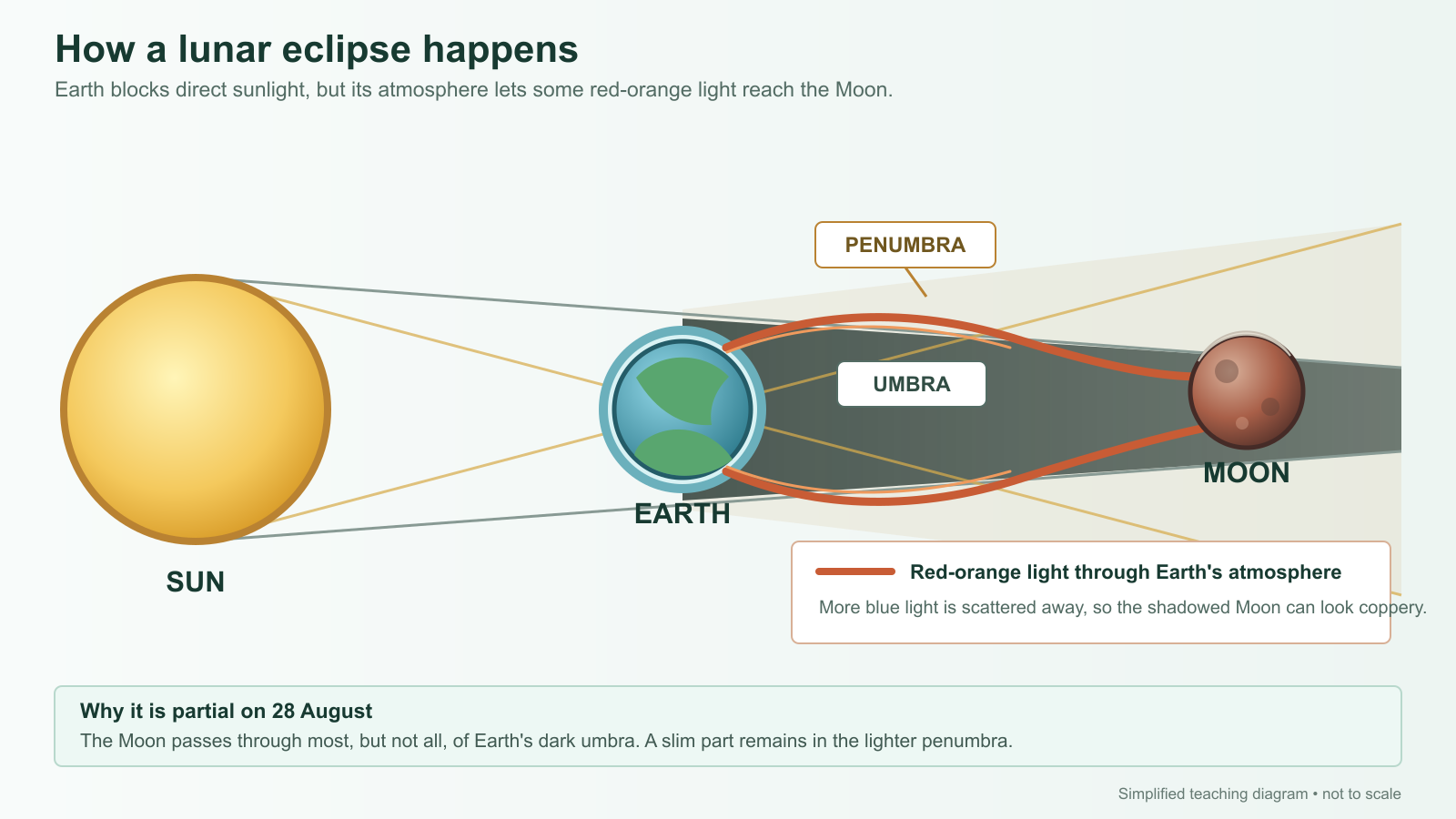
A lunar eclipse happens when the Sun, Earth and Moon line up in that order at full Moon. Earth blocks the direct sunlight that would normally illuminate the Moon, so Earth's shadow falls across the lunar surface.
Earth's shadow has two main parts. The penumbra is the faint outer region, where Earth blocks only part of the Sun as seen from the Moon. The umbra is the much darker central region, where Earth blocks the whole bright face of the Sun. The 28 August event is partial because most, but not all, of the Moon passes into the umbra.
The shadowed Moon is not always black. A small amount of sunlight travels through the edge of Earth's atmosphere and is bent towards the shadow. Shorter blue and violet wavelengths are scattered in many directions more strongly, while more red and orange light continues through the atmosphere and reaches the Moon. The lunar surface reflects some of that light back to us.
This is the same broad reason that the daytime sky looks blue and sunsets can look red. It connects the eclipse directly to visible light and the electromagnetic spectrum. The Moon itself has not changed colour and it is not producing red light.
A lunar eclipse does not happen at every full Moon because the Moon's orbit is tilted by about five degrees relative to Earth's orbit around the Sun. Most full Moons pass above or below Earth's shadow. An eclipse needs the full Moon to be close to one of the points where the two orbital planes cross.
The PhysicsUK page on satellites and orbital motion includes an orbit simulation that helps show how gravity continually turns an orbiting object's velocity. It does not model an eclipse, but it does help explain why the Moon keeps moving through Earth's shadow rather than stopping in it.
How to watch and photograph the lunar eclipse
A lunar eclipse is safe to watch directly. You are looking at the Moon, not the Sun, so you do not need eclipse glasses or a solar filter at any stage.
The Moon will be low and the event happens before dawn. Choose a legal, stable observing place in daylight and take care near roads, water, cliffs and uneven ground.
Use your eyes first
No equipment is required. Give your eyes time away from bright screens and watch for the umbra's curved boundary. Ordinary binoculars or a telescope are also safe to use on the Moon and will show the colour and surface detail more clearly.
Find the horizon before the morning
Scout a place with a clear south-west to west-south-west view while it is still light. At maximum the Moon is low enough for one roofline, ridge or mature tree to hide it completely.
Steady your phone or camera
Use a tripod, wall or firm support and trigger the shutter with a timer. Tap the Moon to focus and reduce the exposure until surface detail returns. Avoid heavy digital zoom, which enlarges pixels rather than revealing new detail.
Expose for two very different brightnesses
The small uneclipsed part can be much brighter than the copper-coloured shadow. Take several exposures rather than trusting one setting. A shorter exposure protects detail in the bright edge; a longer one may reveal the darker eclipsed surface but can blur if the camera moves.
Build a sequence
Keep the framing and zoom fixed, then take a photograph every ten or fifteen minutes. Record the time of each image. A sequence makes the movement of Earth's shadow and the Moon's descent towards the horizon much easier to compare.
Include the place, not only the Moon
A wide photograph with a recognisable foreground can show how low the Moon really was. Keep the foreground as a silhouette if necessary, and write down the location, weather, direction and equipment so the image is also a useful observation record.
Why it matters
A lunar eclipse makes Earth's shadow visible on another world. The curved edge crossing the Moon is a direct result of the geometry of a nearly spherical Earth blocking straight-line rays from the Sun.
It also lets us see our own atmosphere from an unusual angle. Light reaching the eclipsed Moon has skimmed through a long path around Earth's edge. Its colour carries information about scattering, clouds, dust and other material in the atmosphere at that time.
The event links two eclipses that UK pupils can observe in the same month. During a solar eclipse, the Moon's shadow reaches Earth. During a lunar eclipse, Earth's much larger shadow reaches the Moon. The order of the three bodies decides which world falls into shadow.
Lunar eclipses are useful to spacecraft teams too. NASA's Lunar Reconnaissance Orbiter loses direct sunlight while it is inside Earth's shadow, so most instruments are switched off to conserve power. Its Diviner instrument can measure how quickly different parts of the lunar surface cool and warm again.
Predicting the phases and local sky position combines orbital models, precise timing and observation. An astrophysicist and space scientist may work on those calculations, telescope systems, spacecraft instruments or the data used to test the prediction.
Physics you already know
At GCSE, a shadow forms because light travels in straight lines and an opaque object blocks it. The Sun is an extended source rather than one point, so Earth produces both a dark umbra and a fainter penumbra.
Visible light is only one small part of the electromagnetic spectrum. Different wavelengths interact with Earth's atmosphere differently. More shorter-wavelength blue light is scattered out of the beam, leaving a greater proportion of red-orange light to continue towards the Moon.
Refraction also matters. Air density changes with height, so light passing through the atmosphere follows a slightly curved path rather than one perfectly straight line. This helps some filtered sunlight enter a region that simple ray geometry would otherwise leave dark.
For AQA pupils, gravitational fields and orbits connect the eclipse to the Moon's motion through Earth's field. For OCR pupils, circular motion develops the idea that an inward acceleration continually changes the direction of the Moon's velocity.
The low horizon creates a second colour effect. After light reflects from the Moon, it must travel through more of the atmosphere to reach a UK observer than it would if the Moon were high overhead. That extra path can make the Moon look dimmer or redder, but it is separate from the filtering that happened before the light reached the Moon.
Treat your photographs as data. Keep the time interval, framing and exposure notes consistent where possible. Then compare the position of the shadow boundary, the Moon's colour and its height above the horizon rather than relying on memory.
Science ideas to understand
It happens on Friday morning
For UK observers the useful viewing window is before dawn on Friday 28 August, not during Friday evening. The obvious partial phase starts at about 03:33 BST.
Partial can still mean deeply eclipsed
The event is called partial because a slim part of the Moon remains outside the umbra. Most of the lunar disc will still be in Earth's darkest shadow near maximum.
The Moon is safe to view
Solar-viewing filters are for looking towards the Sun. A lunar eclipse is safe to observe with your eyes, binoculars or a telescope.
Red is possible, not guaranteed
Atmospheric filtering can make the eclipsed part look copper, orange, dull red or brown. Cloud, haze, dust, camera exposure and your viewing conditions all affect the result.
Your horizon matters
At maximum the Moon is low in the west-south-west. A clear, open horizon is more useful than travelling to a dark site with trees or buildings blocking that direction.
A Level stretch
The umbral magnitude of this eclipse is about 0.93. That describes how far the Moon's diameter enters the umbra at maximum; it is not exactly the same measurement as the percentage of the circular lunar surface covered. This is why different summaries may quote slightly different percentages without disagreeing about the event.
The Moon's orbit crosses the plane of Earth's orbit at two nodes. The 12 August new Moon and the 28 August full Moon occur close enough to nodes to produce two eclipses in one eclipse season. Half a lunar orbit changes which body lies in the middle.
Rayleigh scattering depends strongly on wavelength, so the shorter visible wavelengths are removed from the direct beam more effectively. Absorption by gases and particles also changes the spectrum. The exact colour is therefore not fixed and a partial lunar eclipse should not be promised as a vivid scarlet Moon.
The edge of the umbra is not perfectly sharp. The Sun has a finite angular size, Earth has an atmosphere rather than a hard optical edge, and the lunar surface has mountains and craters. Careful brightness measurements across the boundary contain more information than a simple dark-or-light description.
During an eclipse the lunar surface can cool quickly because the Moon has almost no atmosphere to redistribute heat. Different rocks and loose surface material respond at different rates, giving infrared instruments another way to investigate the physical properties of the surface.
Key words
Quick pupil questions
What time is the partial lunar eclipse in the UK on 28 August 2026?
The faint penumbral phase begins at about 02:23 BST, the obvious partial phase begins at 03:33 and maximum eclipse is at 05:12. The Moon then sets across the UK at roughly 06:15-06:35, depending on location.
Where should I look to see the August 2026 lunar eclipse?
Look towards the south-west as the partial phase begins, then low in the west-south-west near maximum. Choose a place with an open western horizon because the Moon will be only about 7-11 degrees high across much of the UK at 05:12 BST.
How much of the Moon will be eclipsed in the UK?
At maximum, approximately nine tenths of the Moon will be in Earth's dark umbra. A slim part remains outside it, so the event is a deep partial lunar eclipse rather than a total eclipse.
Why does the Moon turn red during a lunar eclipse?
Sunlight passing through Earth's atmosphere loses more blue and violet light through scattering. More red-orange light reaches the Moon, reflects from its surface and travels back to observers on Earth.
Is the August 2026 lunar eclipse a blood moon?
Blood moon is an informal name most often used for a total lunar eclipse. The 28 August event is partial, although the part inside Earth's shadow may still look copper, orange, red or brown.
Is it safe to look at a lunar eclipse?
Yes. A lunar eclipse is safe to view with the naked eye, binoculars or a telescope because you are looking at the Moon, not directly at the Sun. Eclipse glasses and solar filters are not needed.
How can I photograph the lunar eclipse with a phone?
Steady the phone on a tripod or firm support, use a timer, tap the Moon to focus and lower the exposure until surface detail is visible. Avoid heavy digital zoom and try a sequence of images taken at regular intervals.
Why is the lunar eclipse just over two weeks after the solar eclipse?
Both happen during the same eclipse season. The solar eclipse occurred at new Moon on 12 August; about half a lunar orbit later, the full Moon is still close enough to an orbital node to pass through Earth's shadow.