What happened?
On Wednesday 12 August 2026, everyone in the UK can see a deep partial solar eclipse if the weather cooperates. Around 90-96% of the Sun will be covered across the UK and Ireland, with the greatest coverage towards the south-west. Royal Observatory Greenwich describes it as the greatest coverage seen from these islands since the 1999 eclipse.
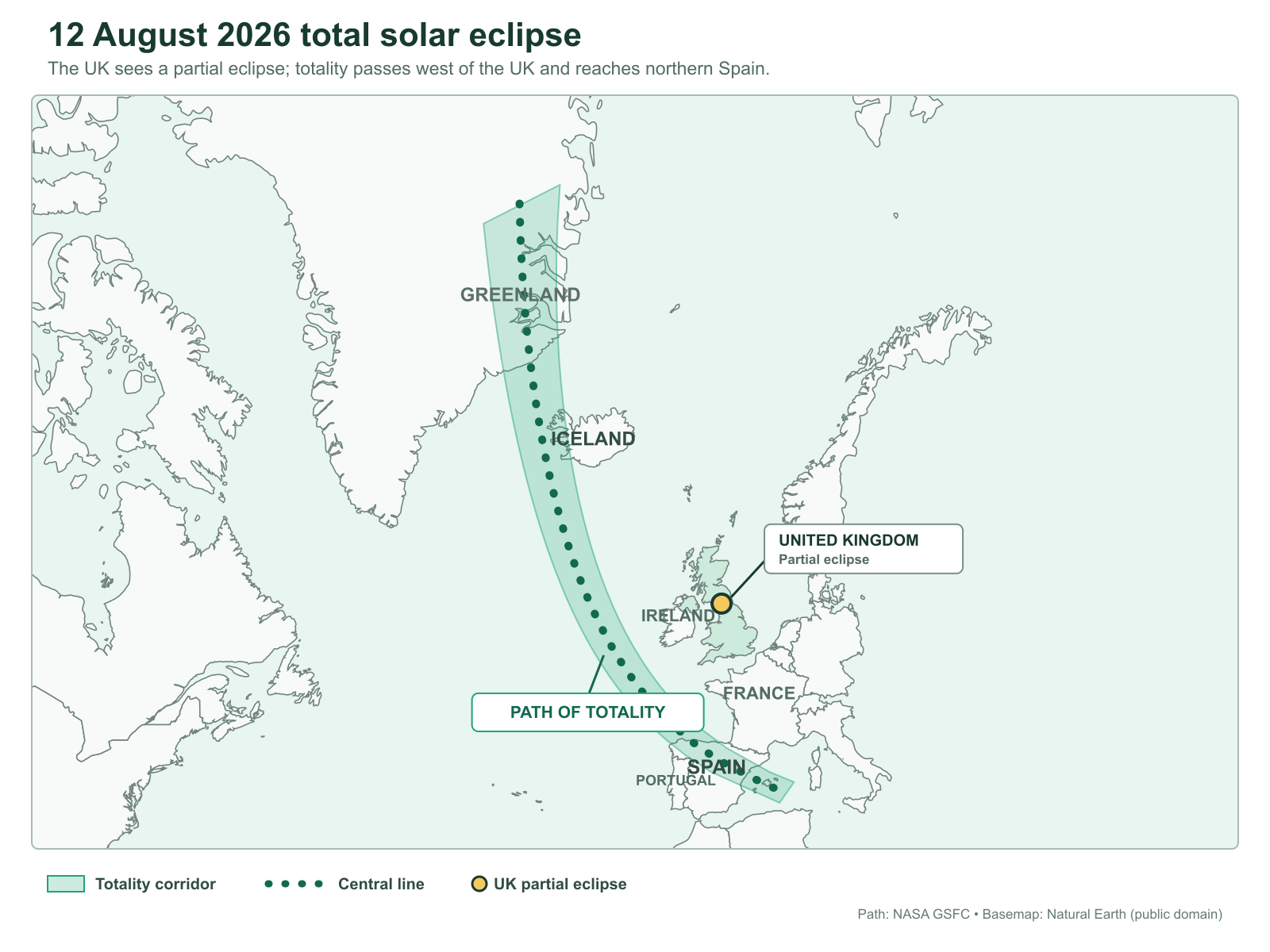
This is a total solar eclipse globally, but not from the UK. The narrow path of totality crosses northern Russia, Greenland, western Iceland, the North Atlantic, northern Spain and a small part of Portugal. The Moon's central shadow passes west of Britain, leaving the UK inside the much wider partial shadow.
The event happens in the evening. In London the eclipse begins at about 18:17 BST, reaches maximum at about 19:12-19:13 and ends at about 20:06. Times shift by a few minutes around the country, and the Sun will be low in the western sky, so buildings, hills and trees could matter as much as cloud.
A high place with a clear western horizon gives the best chance of following the event. Do not treat thin cloud as eye protection: the Sun can still damage your retina even when it looks dimmer or is partly hidden.
There is a second reason to keep looking skyward after dark. The annual Perseid meteor shower peaks overnight on 12-13 August. A solar eclipse can only happen at new Moon, so there will be little moonlight to wash out faint meteors once the sky becomes properly dark.
What time is the solar eclipse around the UK?
These rounded British Summer Time values from Royal Observatory Greenwich are a practical guide. Your exact contact times depend on your position.
| Area | Eclipse begins | Maximum eclipse | Eclipse ends |
|---|---|---|---|
| Edinburgh and Glasgow | 18:08 | 19:05 | 20:00 |
| Manchester and Liverpool | 18:13 | 19:10 | 20:03-20:04 |
| Norwich and Birmingham | 18:15 | 19:11 | 20:04 |
| London, Bristol and Cardiff | 18:17 | 19:12 | 20:06 |
| Truro and Cornwall | 18:18 | 19:16 | 20:10 |
Times are approximate and shown in BST. The south-west generally sees more of the Sun covered, but every UK location remains outside the path of totality.
The simple version
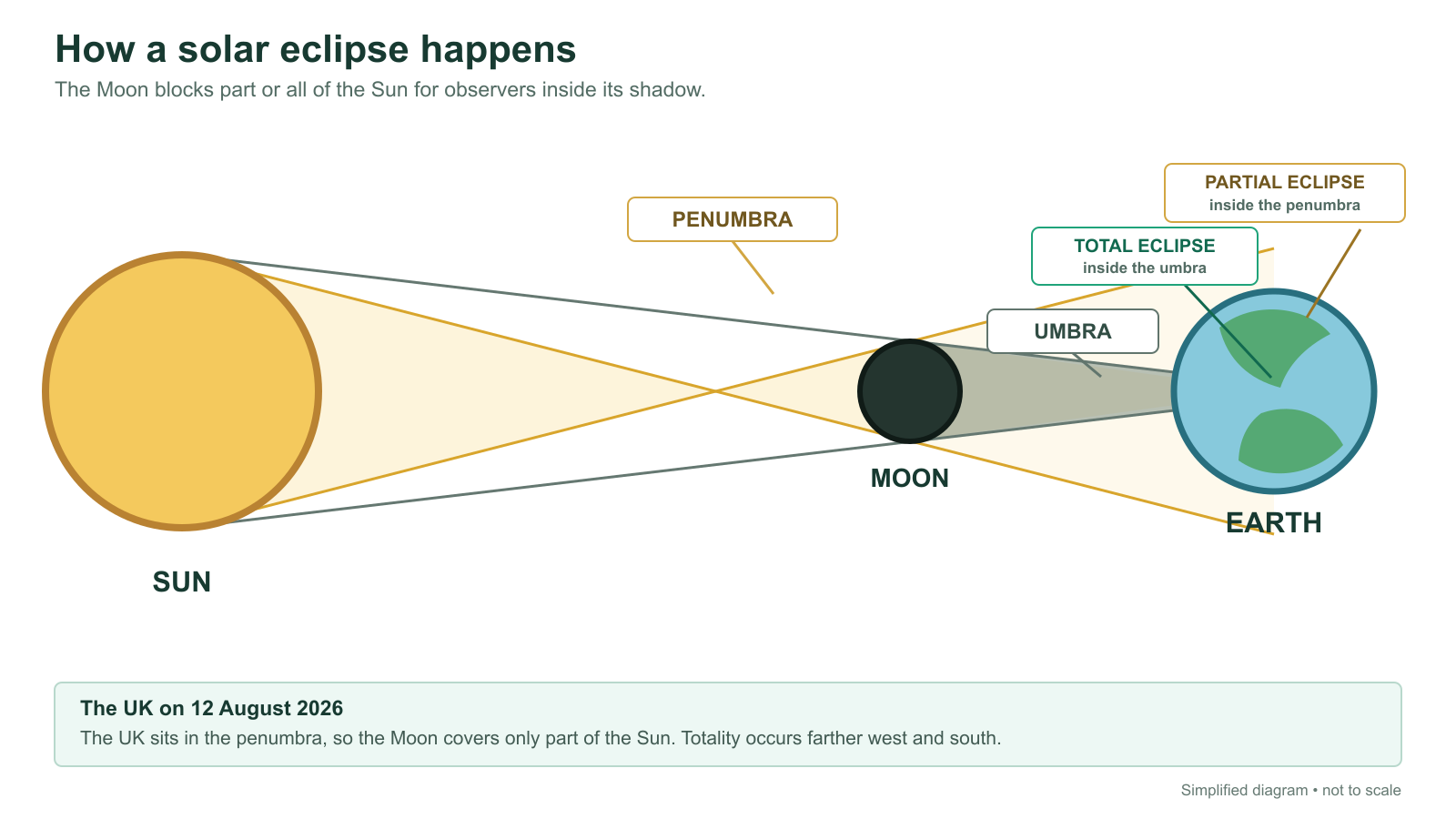
A solar eclipse happens when the Moon passes between Earth and the Sun. The Moon blocks some of the light that would otherwise travel towards part of Earth, so the Moon's shadow falls across our planet.
The Sun is about 400 times wider than the Moon, but it is also roughly 400 times farther away. That coincidence makes their discs look almost the same size in our sky. When the alignment is exact and the Moon looks large enough, it can cover the bright solar disc completely.
A new Moon happens every month, but an eclipse does not. The Moon's orbit is tilted by about five degrees compared with the plane of Earth's orbit around the Sun. Most months the new Moon passes slightly above or below the Sun in our sky. An eclipse needs new Moon to occur close to one of the crossing points of those two orbital planes.
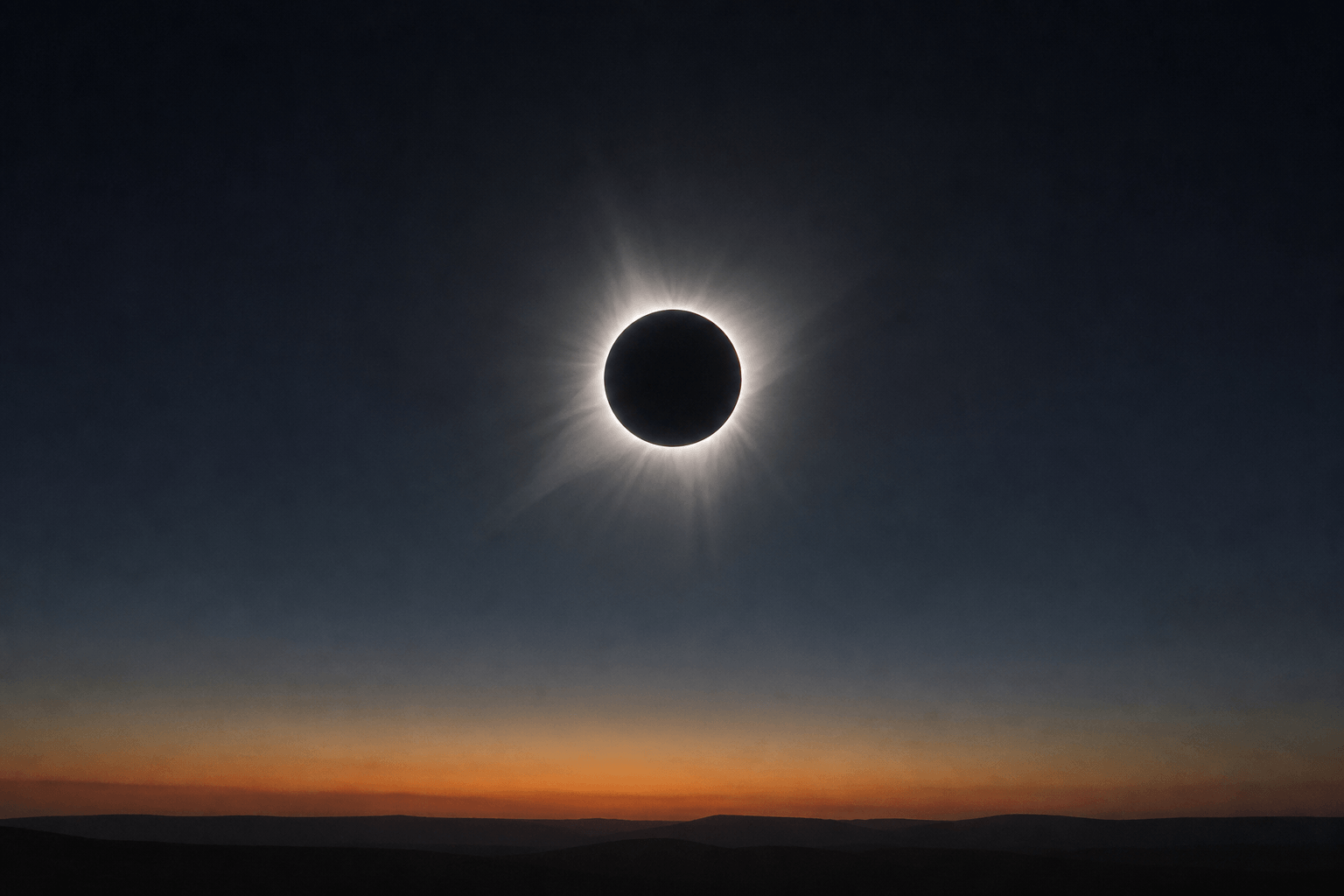
The darkest central part of the Moon's shadow is the umbra. If it reaches you, the Sun is completely hidden and you see a total eclipse. The wider, lighter shadow is the penumbra. The UK sits in the penumbra on 12 August, so a bright crescent of the Sun remains visible.
PhysicsUK's satellite orbit model can help you explore how gravity continually redirects an orbiting object. It does not simulate eclipse alignment, but it does show why an orbit is curved motion rather than an object simply floating in a circle.
How to watch and photograph the eclipse safely
Because the eclipse is partial everywhere in the UK, there is no safe naked-eye phase. The remaining crescent of the Sun is still intense enough to damage retinal cells.
Never look directly at the UK eclipse without genuine solar viewing protection. Ordinary sunglasses, clouds and a quick glance are not safe substitutes.
Use proper eclipse glasses
Choose solar viewers from a reputable supplier that meet ISO 12312-2. Inspect them before use and discard them if the filter is scratched, punctured, torn or coming away from the frame. Children should be supervised.
Filter a phone or camera at the front
To photograph the partly eclipsed Sun, a special-purpose solar filter must cover the front of the camera lens. Do not hold eclipse glasses behind a lens or rely on the screen to make an unfiltered camera safe.
Take extra care with magnification
Never look through unfiltered binoculars, a telescope or a camera viewfinder, even while wearing eclipse glasses. Magnifying optics concentrate sunlight and need a correctly fitted solar filter over the Sun-facing end; seek expert advice before using one.
Project it instead
A pinhole projector lets you watch without looking towards the Sun. Stand with the Sun behind you and project its image onto paper or card. Never look through the pinhole. A colander or gaps between tree leaves can project many tiny crescent Suns.
Photograph the experience
A phone can capture people using viewers, the changing colour of the landscape and crescent shadows beneath trees without pointing straight at the Sun. A tripod or timer helps keep low-light pictures steady.
Connect the safety to physics
The GCSE topic light, lenses and the eye explains why a lens focuses light. Your eye also focuses light onto the retina, which is why reducing glare with ordinary sunglasses is not enough for solar viewing.
Why it matters
An eclipse turns several diagrams from school physics into something you can observe. The straight-line travel of light produces a shadow; orbital motion changes the alignment; and your position inside the umbra or penumbra decides what you see.
Look away from the Sun as well as towards it safely. Tree leaves and small gaps act like pinhole projectors, covering the ground with crescent images. The shape changes as the Moon moves, giving you a simple record of the eclipse without specialist equipment.
For solar researchers, totality briefly blocks the bright solar surface and exposes the much fainter corona. Instruments on the ground, aircraft and balloons can use those minutes to investigate the Sun's outer atmosphere and how it connects to the solar wind.
The event is also a good example of prediction in physics. Astronomers can calculate the path and timing years ahead, then compare the prediction with observations. An astrophysicist or space scientist may work on the orbital models, detectors, imaging or data analysis behind that prediction.
The Perseid peak on the same night creates a rare astronomy double bill. The eclipse needs a very specific Sun-Moon-Earth alignment; Perseid meteors are pieces of comet debris entering Earth's atmosphere. They look connected in the calendar, but they have completely different causes.
Physics you already know
At GCSE, light rays are drawn as straight lines. An opaque object blocks those rays and makes a shadow. Because the Sun is a large extended source rather than a single point, the Moon produces both a fully shaded umbra and a partly shaded penumbra.
The Moon stays in orbit because Earth's gravity changes the direction of its velocity. The same idea appears in circular motion: a force towards the centre continually turns the velocity even when the speed is almost constant.
For AQA pupils, gravitational fields and orbits connect the eclipse to field strength, orbital energy and satellite motion. For OCR pupils, the circular-motion resource develops the inward acceleration needed for a curved path.
Visible light is electromagnetic radiation. The eclipse changes how much reaches you, but the uncovered solar surface remains dangerous. This is why safe observing depends on a purpose-made filter rather than whether the Sun feels comfortable to look at.
Observation matters too. Contact time, maximum coverage, weather, horizon height and location are all variables. A useful record should include where you observed, the time, the method and what changed, rather than only a photograph.
Science ideas to understand
Ninety per cent covered is still not safe
Coverage describes how much of the solar disc is hidden. The remaining bright crescent can still injure the retina, and the UK has no moment of totality.
New Moon does not mean an eclipse every month
The Moon usually passes above or below the Sun because its orbital plane is tilted. The new Moon must also be close to an orbital node.
Umbra and penumbra describe your location
Inside the umbra the bright Sun is fully blocked. Inside the penumbra only part is blocked. The shadow region reaching you determines the type of eclipse you observe.
A photograph needs context
Record the time, location, direction and filter method. A sequence of safely filtered images or projected crescents shows change more clearly than one isolated picture.
The Perseids are a separate event
Perseid meteors come from comet debris entering the atmosphere. Their peak happens to follow the eclipse this year; the eclipse does not cause the meteor shower.
A Level stretch
The two points where the Moon's tilted orbit crosses the plane of Earth's orbit are called nodes. Solar eclipses occur only when new Moon is close enough to a node. Roughly six months later, the Sun is near the opposite node and another eclipse season occurs.
Whether an eclipse is total or annular depends partly on apparent size. The Moon follows a slightly elliptical orbit, so its distance and apparent diameter change. If it appears too small to cover the Sun completely, a bright ring remains and the eclipse is annular.
The edge of the shadow is not just a line created by one light ray. Different points across the Sun's wide visible surface are blocked at slightly different places. That geometry creates the penumbra and the gradual partial phases seen across a much larger area than totality.
The path of totality moves because the Moon travels in its orbit while Earth rotates beneath the shadow. The umbra is small compared with Earth, which is why totality is limited to a narrow track even though a partial eclipse can be seen across much of a hemisphere.
During totality the corona becomes visible because the photosphere is hidden. The corona is a very hot, thin plasma shaped by magnetic fields. The UK partial eclipse will not reveal it to the naked eye, but live streams from the totality path can show the difference.
Key words
Quick pupil questions
What time is the solar eclipse in the UK on 12 August 2026?
Times vary by location. In London it begins at about 18:17 BST, reaches maximum at about 19:12-19:13 and ends around 20:06. Elsewhere in the UK the stages occur within several minutes of those times.
How much of the Sun will be covered in the UK?
Around 90-96% of the Sun will be covered across the UK and Ireland, with generally greater coverage towards the south-west. The UK remains outside the path of totality.
Will the 2026 solar eclipse be total in the UK?
No. The path of totality passes west of the UK through Greenland, Iceland and the Atlantic before reaching northern Spain. Every UK location sees a partial eclipse.
Is it safe to look at the UK solar eclipse?
Only through genuine eclipse glasses or a safe handheld solar viewer that meets ISO 12312-2, or by using an indirect method such as pinhole projection. Ordinary sunglasses and cloud are not safe.
How can I photograph the partial solar eclipse safely?
Put a special-purpose solar filter securely over the front of the phone or camera lens before aiming it at the Sun. Never look through unfiltered magnifying optics. Landscape, people and projected crescent shadows offer safer alternative subjects.
Why does a solar eclipse not happen every new Moon?
The Moon's orbit is tilted by about five degrees relative to Earth's orbit around the Sun. Most new Moons pass above or below the Sun; an eclipse needs a new Moon close to an orbital node.