
When is the Hunter's Moon in the UK?
The Hunter's Moon is full at 4:12am GMT on Monday 26 October 2026, according to the Royal Observatory Greenwich. Look on Sunday 25 October or Monday 26 October in the evening, weather permitting. The Moon changes gradually enough that it will look almost full around the exact time.
There is a useful detail this year: the clocks go back on Sunday morning, before the full Moon. Monday's time is GMT. Our clock-change guide explains the change if you are comparing an observing app with an older table.
The name Hunter's Moon refers to the full Moon following the Harvest Moon. It does not promise a particular colour, an eclipse or an unusually close approach. Halloween is five days later; the exact full Moon is not on Halloween night.
Why can the Moon look orange and enormous?
The Moon does not make its own visible light. Sunlight reaches its surface and some is reflected towards us. Around full Moon, we see almost all of its sunlit face.
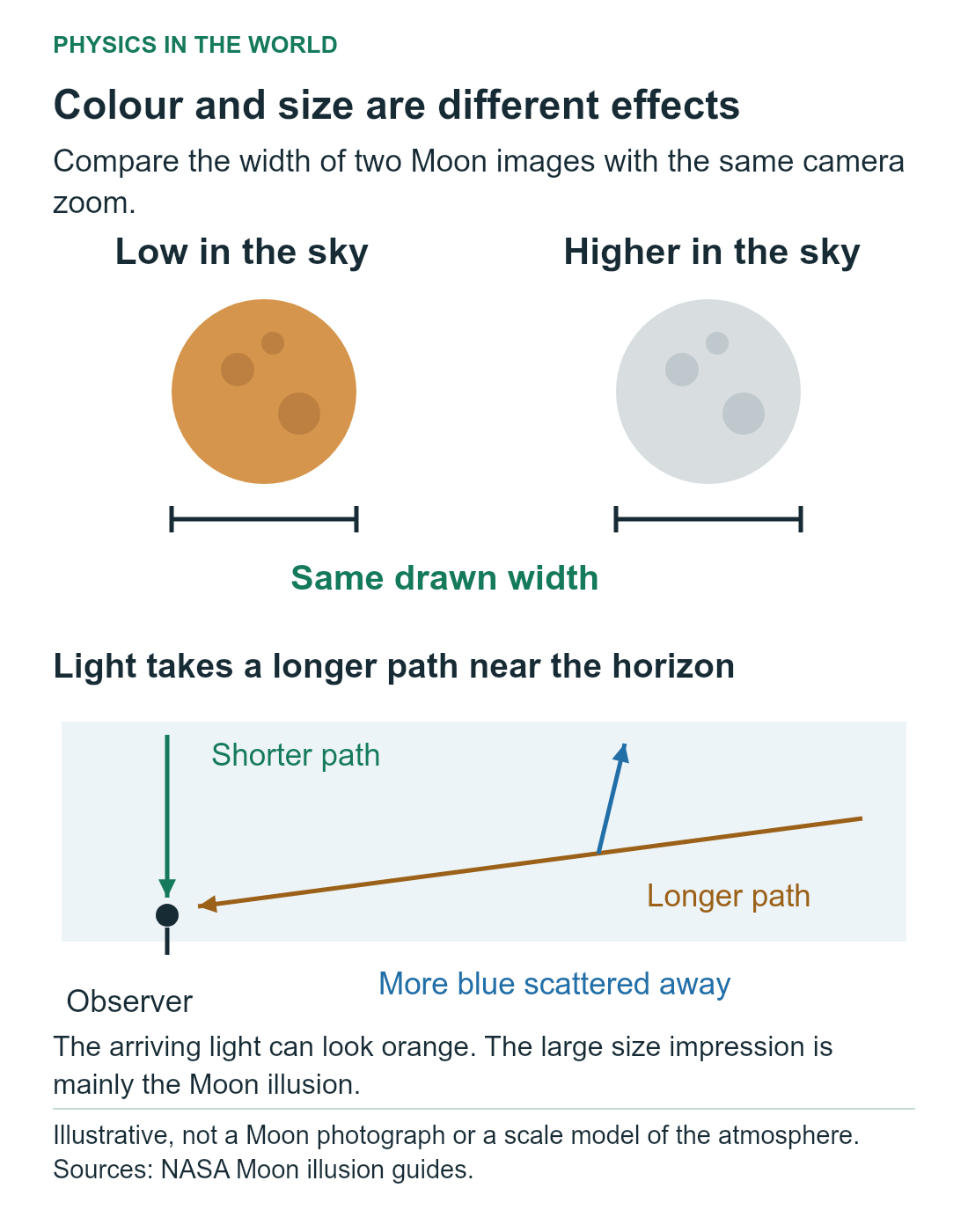
When the Moon is low, that light takes a longer route through the atmosphere before reaching your eyes. Shorter, bluer wavelengths are scattered away from the direct beam more strongly. The light that reaches you can therefore look more yellow, orange or red.
As it climbs higher, its light takes a shorter path through the air and the colour often becomes paler. Haze, smoke and dust can affect the view too. The name of the full Moon does not decide its colour.
Size is a different question. A rising Moon can look much bigger beside trees or buildings than it does high in the sky. This is called the Moon illusion. NASA explains that it is mainly about how we judge the view, rather than the atmosphere magnifying the Moon.
You can separate the two effects: the orange colour can be a real change in the arriving light, while the dramatic increase in apparent size is largely a perception effect. Both are worth looking for.
How to watch and photograph it
Find a place with a clear view towards the eastern horizon around your local moonrise. The exact rise time varies across the UK, and hills or buildings can hide the Moon after the calculated horizon-crossing time. Check a local forecast as well as the astronomy time.
Ordinary lunar viewing does not require eclipse glasses. The Moon reflects sunlight; it is not the same viewing hazard as looking directly at the Sun. Never point binoculars or a telescope towards the Sun.
For a phone photograph, support the phone, keep the lens clean and reduce the exposure if the Moon appears as a featureless white patch. Try a few exposures rather than assuming the camera will choose the best one. A phone may record the landscape better than fine lunar detail.
To test the size illusion, keep the same camera, lens and zoom for a low-Moon photograph and another later that night. Compare the horizontal width of the Moon in pixels. Cropping one image or switching zoom halfway through makes it a different test.
The GCSE physics in the view
Start with the source of the light. The Sun emits visible radiation; the Moon reflects some of it. Reflection and emission are different processes, even though both can send light towards an observer.
The electromagnetic spectrum revision page helps connect colour to wavelength. Blue visible light has a shorter wavelength than red visible light. Scattering changes how much of each wavelength remains in the direct light reaching your eyes.
A full Moon is not usually in Earth's shadow. A lunar eclipse requires a closer alignment, with the Moon passing through that shadow. The Moon's orbit is tilted, so most full Moons pass above or below it. Our lunar eclipse guide shows the difference.
The Moon is also a natural satellite. The orbital motion resource explains why gravity is needed to change the direction of its velocity. Moon phases come from the changing viewing geometry as it orbits Earth, not from Earth covering a different fraction of the Moon every week.
A Level stretch: test the claim with a photograph
A fair photograph comparison needs more than the same object. Keep the focal length, zoom and image scaling unchanged. Exposure can change without changing the geometric scale, but overexposing the bright edge makes the diameter harder to measure.
Measure the horizontal diameter rather than assuming the disc is a perfect circle. Atmospheric refraction can flatten a low Moon slightly. That small optical effect is different from the much stronger impression that the whole Moon has become enormous.
You may find small differences from measurement uncertainty or the changing distance between you and the Moon. The useful question is whether the photographs support the large size change you thought you saw.
An astrophysicist makes the same distinction between an object and the effects introduced by the atmosphere, instrument and analysis. A simple Moon photograph is a good first example of why the way we measure matters.
Key words
Quick pupil questions
When is the Hunter's Moon in 2026 in the UK?
The full Moon is at 4:12am GMT on Monday 26 October 2026. It will look almost full on the surrounding evenings; check local moonrise and cloud conditions.
Why is the Moon orange tonight?
A low Moon is seen through a longer path in the atmosphere. More shorter-wavelength blue light is scattered away from the direct beam, so the arriving light can look orange or red.
Why does the Moon look so big near the horizon?
The dramatic impression of a huge horizon Moon is mainly the Moon illusion, a perception effect. Compare photographs taken with the same lens and zoom to test its image width.
Is there a full Moon on Halloween 2026?
The October full Moon is on 26 October, five days before Halloween. Its exact full phase is not on 31 October.