

When do the clocks go back in the UK?
UK clocks go back one hour at 2am on Sunday 25 October 2026. An automatically updated clock will jump from 1:59am BST back to 1:00am GMT. If you change a manual clock before bed on Saturday, move it back by an hour.
That is the end of British Summer Time for 2026. GMT is the time used on UK clocks in winter; BST is one hour ahead of it. We are changing the way we label the time of day.
The date applies across the UK. Sunrise and sunset do not have one UK-wide time, however. Your latitude, longitude and local horizon matter, so use a forecast or astronomical table for your location when planning an outdoor activity.
Why does sunset suddenly seem earlier?
Picture a school clock reading 5pm while the Sun is still above the horizon. Wind the clock back to 4pm. Nothing about the Sun has moved because you touched the clock; the same event now has an earlier label.
The national change works in that way. For the same instant, 6pm BST and 5pm GMT are equivalent. Sunday's sunset will therefore look about an hour earlier than Saturday's on a clock, with a small extra difference from the seasonal change.
Sunrise shifts earlier on the clock too. That can make the journey to school lighter for a while, while the journey home becomes darker. It does not mean the Sun has started moving faster across the sky.
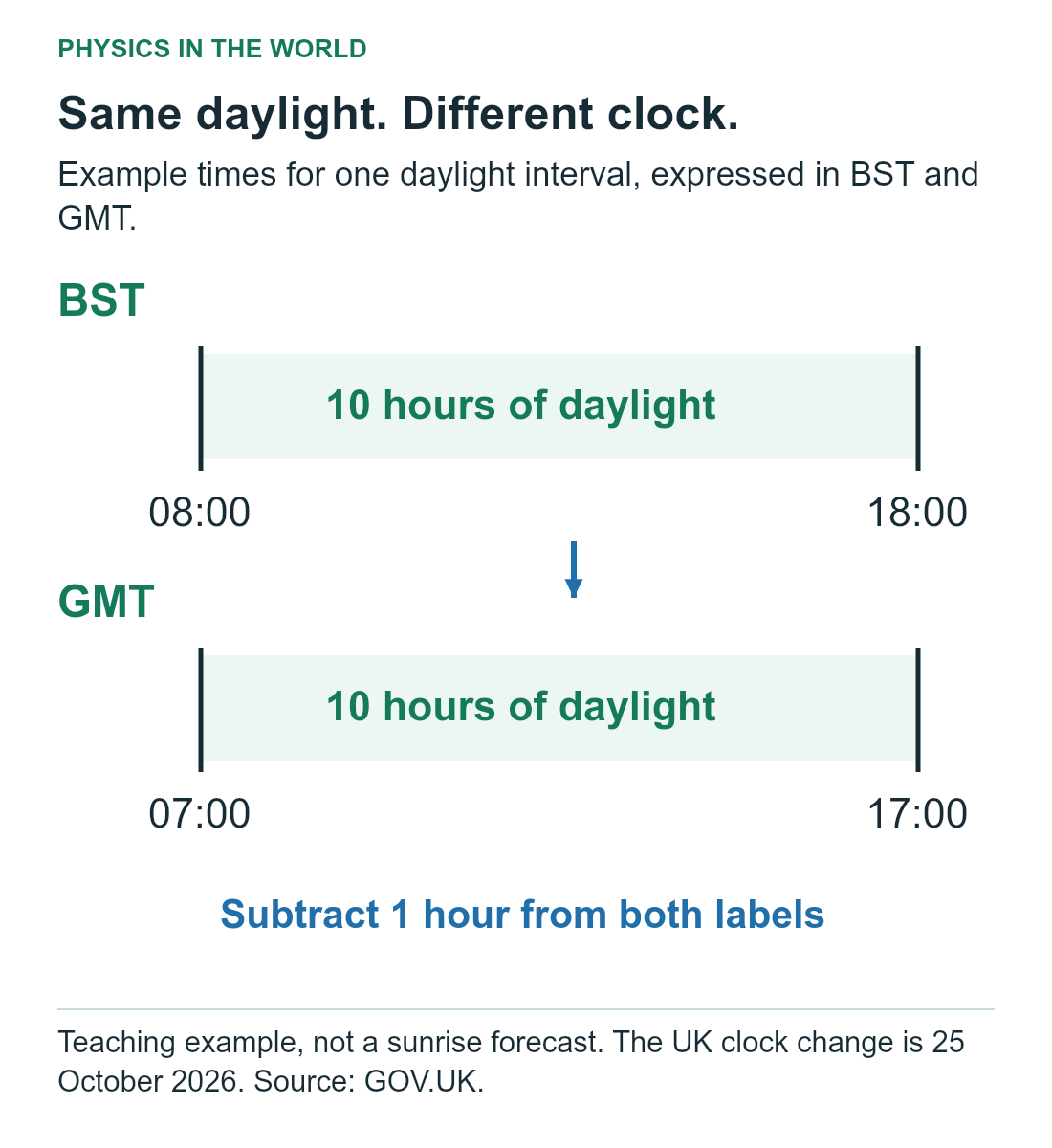
The diagram below uses invented times to keep the comparison clean. A daylight interval from 8am to 6pm lasts ten hours. Relabel both ends as 7am and 5pm and it still lasts ten hours. Subtracting an hour from both readings leaves the interval unchanged.
What to check before Sunday morning
Most phones and computers update automatically when their time-zone settings are correct. Check the automatic setting rather than winding the time back manually as well. Kitchen clocks, watches and some car clocks may need attention.
For anything booked around the repeated hour, read the operator's stated time carefully. The label 1:30am occurs twice: once before the change in BST and once afterwards in GMT. Adding the time zone removes that ambiguity.
For an ordinary Sunday plan, the useful check is simple: confirm your clock, then check the local sunset time. A walk that ended comfortably before dusk last weekend may now finish after sunset by the clock.
Sunset is also not an instant switch to complete darkness. Twilight follows while sunlight still reaches the upper atmosphere and is scattered towards us. Its duration depends on place and season, so it should not be replaced with a fixed guess.
Why do the days get shorter in autumn?
There are two motions to keep straight. Earth rotates, producing the daily cycle of daylight and darkness. Earth also orbits the Sun over a year. Its axis is tilted relative to the plane of that orbit.
As the northern hemisphere moves towards winter, the UK spends a smaller part of each rotation on the sunlit side of Earth. The Sun takes a lower, shorter path across our sky. Those changes happen gradually, whether or not we change the clocks.
The seasons are not mainly caused by Earth moving nearer to or farther from the Sun. The hemispheres have opposite seasons at the same time, even though they share almost the same distance from the Sun. Tilt explains that difference.
Our solar system and orbital motion resource is a useful starting point for separating a rotation from an orbit. The autumn equinox guide takes the next step and explains why the length of daylight changes through the year.
Try comparing two sunrise-and-sunset tables across the clock-change weekend. Before interpreting a sudden jump, check whether the first uses BST and the second GMT. Changing how we record something can make it look as though nature has changed.
A Level stretch: a time label is not a time interval
A stopwatch measures how much time has passed, not the time of day. A ten-minute experiment should still take ten minutes when the clocks go back. The experiment has not become an hour shorter.
By contrast, subtracting two local clock readings can go wrong across the repeated hour. Starting at 1:50am BST and finishing at 1:10am GMT means twenty minutes have passed. The second label looks earlier only because its reference changed.
This is a useful habit for A-level practical work: establish what each reading measures before calculating a difference. The measurements and errors worksheet gives practice in reporting measurements clearly and avoiding misleading comparisons.
An astrophysicist comparing observations from several telescopes has to handle time references carefully too. For your own skywatching notes, recording the date, location and whether a time is BST or GMT is a good beginning.
Key words
Quick pupil questions
When do the clocks go back in 2026 in the UK?
At 2am on Sunday 25 October 2026, UK clocks go back to 1am. British Summer Time ends and Greenwich Mean Time begins.
Do we gain or lose an hour in October?
The autumn change repeats an hour on the clock. The local calendar day lasts 25 hours, but the amount of sunlight is set by Earth's motion and your location.
Why does it get dark earlier when the clocks go back?
Sunset receives a clock label one hour earlier when the UK changes from BST to GMT. Separately, daylight is shortening gradually as the northern hemisphere moves towards winter.
Will my phone change time automatically?
Most phones update automatically when automatic date, time and time-zone settings are enabled. Check the settings; manual clocks may need changing by hand.