

Do heat pumps work in cold weather?
Yes, an air-source heat pump can work in cold weather, including below freezing. "Cold" does not mean "contains no energy". Air at a few degrees below zero still consists of moving particles and has internal energy.
The trick is not to wait until the outdoor air becomes hotter than your living room. Instead, the heat pump uses a circulating substance called a refrigerant and changes its pressure and temperature as it moves around a closed loop.
That allows energy to enter the loop outside and leave it at a higher temperature inside. Electricity runs the compressor and other components needed to keep the process going. It is a familiar principle if you have ever noticed warmth coming from the back of a fridge: the fridge moves energy out of its interior and releases it into the room.
There are important limits. A heat pump must be chosen and installed for the building and expected weather. Being able to operate in cold air does not mean that every system delivers the same heating output or uses the same amount of electricity on every winter day.
How an air-source heat pump moves energy indoors
First, refrigerant passes through an outdoor heat exchanger at a temperature below the surrounding air. Energy transfers from the warmer air to the colder refrigerant. At the operating pressure, the refrigerant can evaporate at a low temperature. Water is not the only liquid, and 100 degrees Celsius is not a universal boiling point.
Next, an electrically driven compressor compresses the refrigerant vapour. Work is done on it, increasing its temperature. It is now hot enough to transfer energy to the heating water inside the home.
In the indoor heat exchanger, the hot refrigerant releases energy and condenses. That energy can warm the water circulating through radiators or underfloor heating. The refrigerant and heating water remain in separate circuits; they exchange energy through the heat exchanger.
Finally, the refrigerant passes through an expansion device. Its pressure drops, producing a colder mixture ready to absorb energy outdoors again. The loop repeats. An air-to-water heat pump is not simply blowing cold outdoor air into your radiators.
Notice the direction of each local transfer: energy moves from warmer material to colder material at each heat exchanger. Electrical work makes the overall transfer from cold outdoors to warm indoors possible.
Can a heat pump really be 300% efficient?
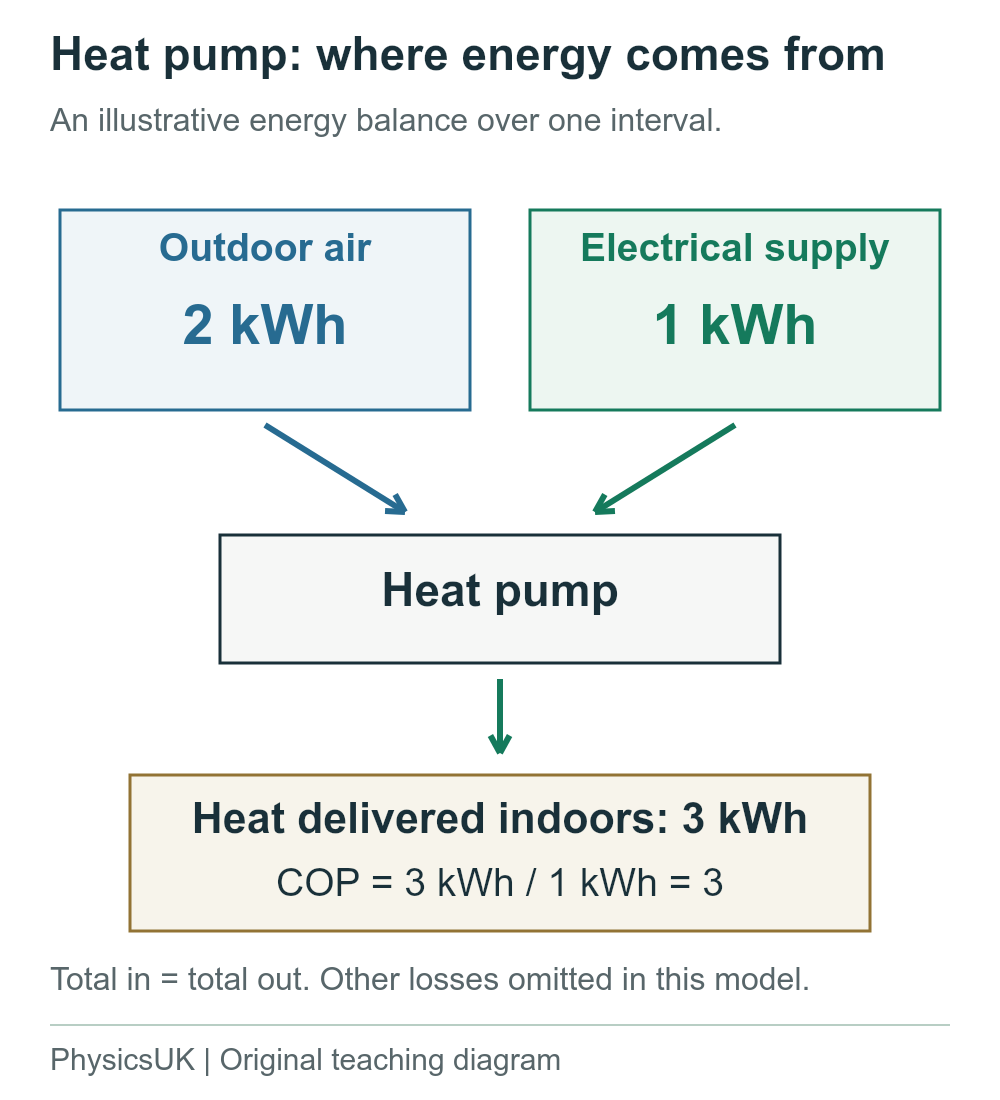
Take a deliberately simple example over one operating interval. The heat pump uses 1 kilowatt-hour of electrical energy and takes 2 kilowatt-hours from the outdoor air. It delivers 3 kilowatt-hours as heat indoors. The total input is 3, and the total output is 3: the energy account balances.
The coefficient of performance, or COP, compares heat delivered with electrical energy used. In that example, 3 divided by 1 gives a COP of 3. That is the origin of descriptions such as "300% efficient".
It is not a machine producing three times all the energy put into it. The comparison counts electricity in the denominator but not the energy taken from the surroundings. If you include both inputs in the simplified example, you do not get more energy out than went in.
A resistance heater is a useful comparison. It converts supplied electrical energy into heating in the room. A heat pump also moves energy from an external source, so it can deliver more heating for each unit of electricity. Neither device breaks conservation of energy.
Real COP changes with conditions. A quoted value measured at one outdoor and water temperature is not automatically the average over a year. Seasonal performance uses energy totals across a longer period and needs a clear statement of which equipment is included.
What this has to do with GCSE energy and insulation
This is why energy stores and changes are more useful than memorising that a device is "efficient". Draw a boundary around the heat pump and identify every way energy crosses it. Leaving out the outdoor input creates the apparent mystery.
The revision page on efficiency and unwanted transfers helps separate useful output from total input. Always ask what the denominator means. A percentage without that definition can sound impressive while answering a different question from the one you had in mind.
A house also loses energy to its surroundings. Better insulation reduces the rate of that transfer for a given temperature difference. The thermal insulation required practical is a small-scale version of the same problem: compare cooling while controlling the starting temperature, amount of water and other conditions.
A kilowatt is a unit of power, the rate of energy transfer. A kilowatt-hour is a unit of energy. Our energy calculations and power page works through that distinction. In the diagram all three energy amounts refer to the same interval; they are not unexplained ratings for three different machines.
A Level stretch: why a bigger temperature lift is harder
The more demanding task is transferring energy across a larger temperature difference. If the outdoor source is colder, or the required heating-water temperature is higher, a real heat pump generally needs more electrical work for each unit of heat delivered. COP tends to fall.
That is one reason larger radiators or underfloor heating can be helpful in an appropriately designed system: a larger emitting area can supply the required room heating with cooler water. It does not follow that everyone should turn settings down without advice. Heating capacity, hot water and system controls all need to be considered.
In cold, damp weather frost can form on the outdoor heat exchanger. Defrosting uses energy and interrupts normal heat collection, so a fair performance assessment must include it rather than choosing only the best few minutes of operation.
A mechanical engineer works with these trade-offs: heat transfer, fluid flow, electricity use and the needs of the building. This is an application of school physics that involves careful measurement as much as new hardware. Ask an appropriately qualified installer about an individual system; a COP example cannot predict a household bill.
Key words
Quick pupil questions
Do air-source heat pumps work below freezing?
They can. Outdoor air still has internal energy below zero degrees Celsius. Performance and heating capacity depend on the equipment, weather and system design.
How can a heat pump be 300% efficient?
That usually describes a COP of 3: three units of heat delivered for each unit of electrical energy used. The extra energy is transferred from outdoors, so it is not created from nothing.
Is heat pump COP the same as efficiency?
Not in the usual GCSE all-inputs energy calculation. COP compares delivered heat with the electrical input, while the heat pump also takes in energy from its surroundings.
Does a heat pump blow cold air into the house?
An air-to-water heat pump transfers energy through a refrigerant circuit and heat exchangers to heating water. It does not blow outdoor air through the radiators.