A fair cooling comparison starts with the same water and surroundings. The best insulator gives the smallest temperature fall over the same time.
AQA 8463GCSE PhysicsFoundationHigher
Learn · practise · improve
Start here
The revision snapshot
A fair cooling comparison starts with the same water and surroundings. The best insulator gives the smallest temperature fall over the same time.
By the end, you should be able to:
Plan a controlled comparison of insulation.
Compare cooling data over equal intervals.
Identify a measurement limitation and practical improvement.
Before you revise
Diagnostic question
Choose an answer from memory. Your result tells you what to watch for in the guide.
Core revision guide
Learn the model, then use it
A fair cooling comparison starts with the same water and surroundings. The best insulator gives the smallest temperature fall over the same time.
01
Compare one variable
Scope: 8463 Physics only · Foundation and Higher
Use identical containers with equal water volumes, starting temperatures, lids and exposed areas. Change insulation material at equal thickness, or change thickness for one material, not both together. Place probes at the same depth away from container walls. Start timing at a common target temperature and record every minute in the same room.
02
Obtain evidence for a conclusion
Scope: 8463 Physics only · Foundation and Higher
Compare temperature drops in the same time or gradients near the same water temperature. Cooling is faster when water is much warmer than the room, so unequal initial temperatures confound the test. Repeat each condition, calculate mean drops, and inspect anomalous readings before excluding any.
03
Connect insulation to the mechanism
Scope: 8463 Physics only · Foundation and Higher
Trapped air reduces conduction; restricting air movement reduces convection. A shiny surface reduces infrared emission. Lids reduce convection and evaporation at the water surface. Handle hot water carefully on a stable bench; use temperatures and apparatus approved for classroom use.
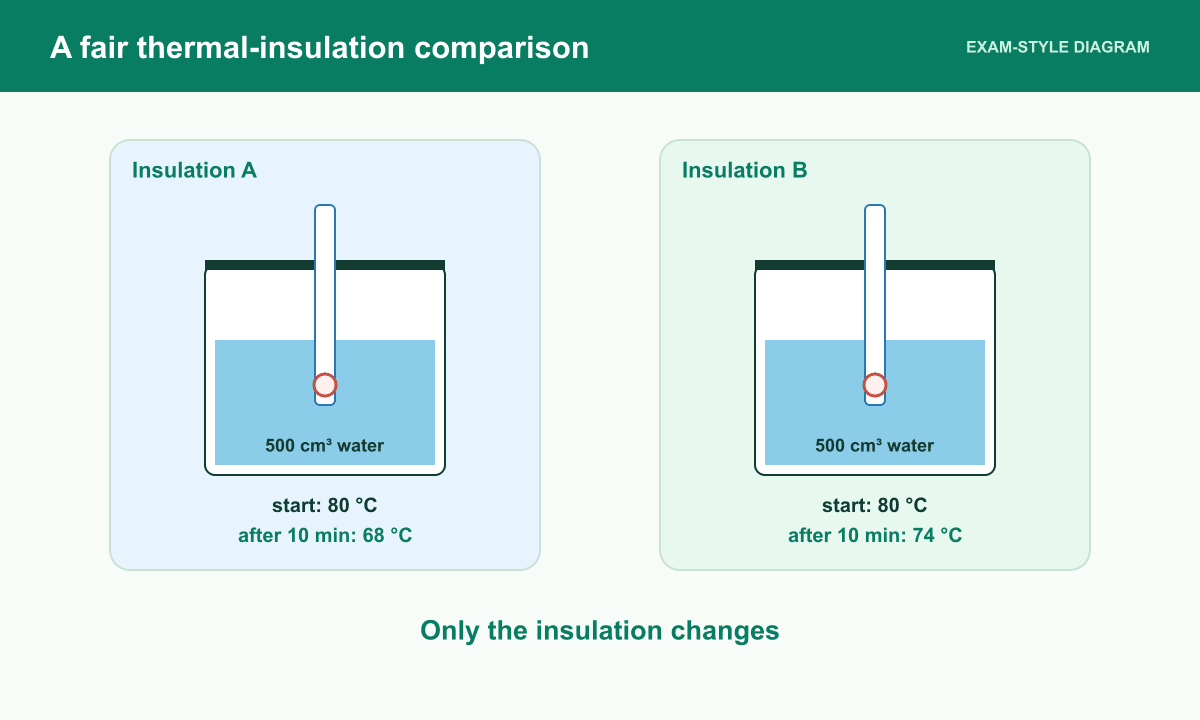
Keep the container, water volume, starting temperature and timing equal so insulation is the only changed variable.Open the full-size exam diagram
Misconception clinic
Replace the tempting answer
Read each belief, say what is wrong with it, then compare your correction.
Tempting idea: Warmer water always has lower mass.
Use instead: Temperature does not set the water mass. The starting temperature is a control variable.
Tempting idea: Use different cups and different materials.
Use instead: This changes two variables. It isolates the intended independent variable.
Retrieval practice
Quick checks
Worked examples
See the method being built
Apply compare one variable in the worked reasoning, then try the changed-context questions below.
Example 1 · Read a cooling graph
Scope: 8463 Physics only · Foundation and Higher
Cup A falls by 12 °C in 10 min; Cup B falls by 5 °C in 10 min. Which has better insulation?
Compare equal time intervals.
Identify the smaller temperature decrease.
Link it to rate of transfer.
Show the answer
Cup B has better insulation because its temperature falls more slowly, so energy is transferred to the surroundings at a lower rate.
Example 2 · Fair method
Scope: 8463 Physics only · Foundation and Higher
Plan a comparison of two insulating materials.
Change only the insulation material.
Keep container, water volume, starting temperature and room conditions the same.
Measure temperature at regular intervals and repeat.
Show the answer
Use identical lidded containers with equal water volumes and starting temperatures, record temperature every minute, repeat each material and compare graph gradients.
Example 3 · Evaluate an unfair test
Scope: 8463 Physics only · Foundation and Higher
One cup begins at 80 °C and another at 60 °C. Explain the problem.
Identify the uncontrolled variable.
Link it to cooling rate.
State how to correct it.
Show the answer
Starting temperature affects the rate of energy transfer, so the test is not fair. Begin every trial at the same temperature.
Exam precision
Use the physics precisely
Do this: State the changed insulation factor and controlled starting conditions. Compare temperature drops over the same interval and justify an improvement from a specific limitation.
Independent practice
Exam-style questions
Write an answer before opening the marking guidance. Then edit the exact phrase or step that would gain the next mark.
1. Plan a fair test of how insulation thickness affects cooling.
[4 marks]
Scope: 8463 Physics only · Foundation and Higher
Show marking guidance and model answer
Original PhysicsUK mark scheme: Point 1 (1 mark): Use identical cups, same water volume and same material with several thicknesses. Point 2 (1 mark): Use the same starting temperature, lids, probe positions and room conditions. Point 3 (1 mark): Record temperature at equal time intervals for the same duration. Point 4 (1 mark): Repeat each thickness and compare mean temperature drops or cooling curves. Award each distinct point once. Accept equivalent scientifically correct wording. No half marks.
Use identical cups, same water volume and same material with several thicknesses. (1 mark)
Use the same starting temperature, lids, probe positions and room conditions. (1 mark)
Record temperature at equal time intervals for the same duration. (1 mark)
Repeat each thickness and compare mean temperature drops or cooling curves. (1 mark)
Model answer: Wrap identical cups with different thicknesses of the same material. Keep volume, starting temperature, lids and surroundings equal. Record temperature at equal intervals for each run, repeat, and compare mean drops over the same duration.
2. Explain why trapped air can reduce energy transfer through insulation.
[2 marks]
Scope: 8463 Physics only · Foundation and Higher
Show marking guidance and model answer
Original PhysicsUK mark scheme: Point 1 (1 mark): Air is a poor thermal conductor. Point 2 (1 mark): Trapping it limits bulk air movement and therefore convection. Award each distinct point once. Accept equivalent scientifically correct wording. No half marks.
Air is a poor thermal conductor. (1 mark)
Trapping it limits bulk air movement and therefore convection. (1 mark)
Model answer: Air conducts poorly, and trapping it prevents circulating air transferring energy by convection.
Questions pupils ask
Thermal Insulation Required Practical FAQs
Should an insulation comparison start with hotter water for the thicker wrap?
No. Different initial temperature differences from the room change cooling rates and prevent a fair comparison.