A resource is a source available for an energy transfer, rather than another name for an energy store. Electricity, transport and heating impose different constraints.
A resource is a source available for an energy transfer, rather than another name for an energy store. Electricity, transport and heating impose different constraints.
By the end, you should be able to:
Distinguish energy resources from energy stores.
Compare renewable and finite resources.
Justify a resource choice using demand and environmental data.
Before you revise
Diagnostic question
Choose an answer from memory. Your result tells you what to watch for in the guide.
Core revision guide
Learn the model, then use it
A resource is a source available for an energy transfer, rather than another name for an energy store. Electricity, transport and heating impose different constraints.
01
Non-renewable resources
Scope: 8463 and 8464 · Foundation and Higher
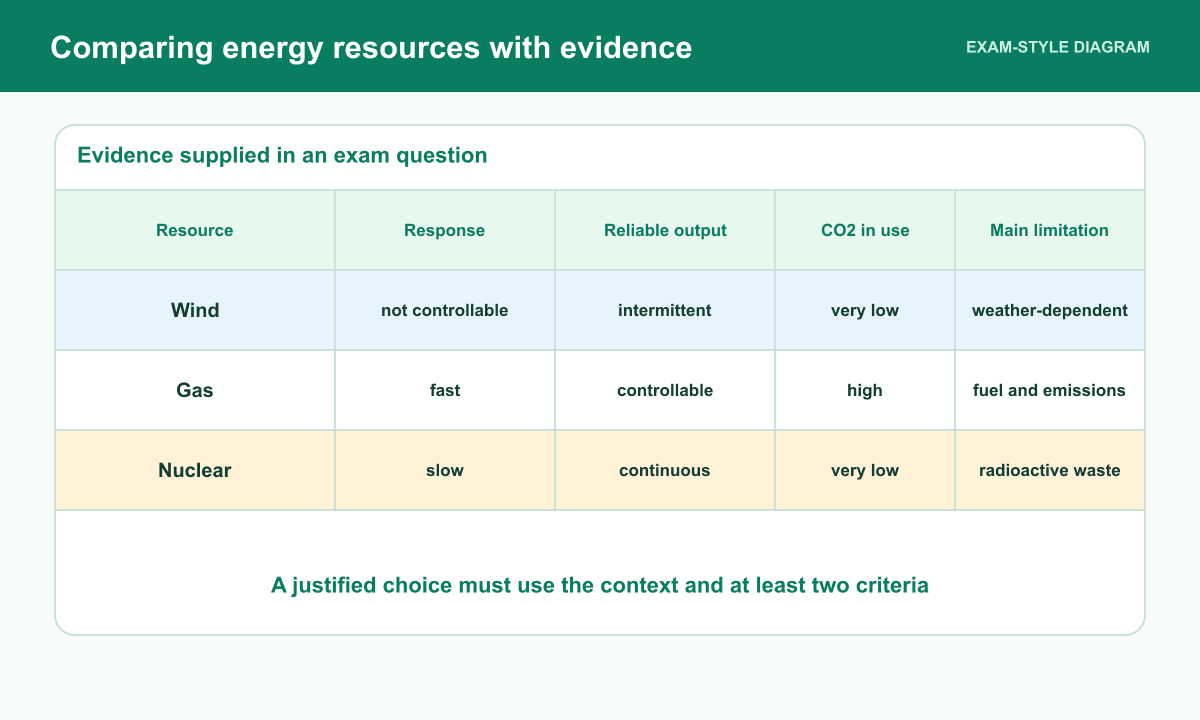
Coal, oil and natural gas release chemical energy by combustion; heated water produces steam to turn a turbine and generator in many power stations. Combustion releases carbon dioxide; coal and some oil use also release sulfur dioxide and particulates. Gas turbines can respond relatively quickly to demand. Nuclear fuel releases nuclear energy to heat coolant, producing steam for a turbine. It gives steady large output with low operational carbon emissions, but waste management and construction/decommissioning matter.
02
Renewable resources
Scope: 8463 and 8464 · Foundation and Higher
Wind and waves drive turbines but vary with weather. Solar cells produce electricity from radiation; solar heating warms water, and output varies with sunlight. Hydroelectricity uses falling stored water to drive turbines and can respond quickly if a reservoir has water; dams alter habitats and may displace communities. Tides are predictable but vary over a cycle and require suitable coasts. Geothermal draws on internal thermal energy and can be steady in suitable locations. Biofuel is replenishable if crops regrow; combustion still emits pollutants, and land use may compete with food or habitats.
03
Make a decision for the stated context
Scope: 8463 and 8464 · Foundation and Higher
A national mix needs reliable output and ways to meet rapid demand changes. Wind’s variable output may require storage, interconnection or controllable backup. An isolated sunny home may benefit from solar plus a battery; a factory with continuous demand needs dependable supply. Compare capital and operating costs, construction time, response time, site, emissions and waste. “Renewable” does not imply zero environmental impact.
Use the supplied evidence and the question context: no resource is best against every criterion.Open the full-size exam diagram
Misconception clinic
Replace the tempting answer
Read each belief, say what is wrong with it, then compare your correction.
Tempting idea: Wind can always match demand exactly.
Use instead: Weather varies independently of demand. This links reliability and controllability to demand.
Tempting idea: Wind.
Use instead: Wind changes with weather. Tides follow predictable cycles.
Retrieval practice
Quick checks
Worked examples
See the method being built
Apply non-renewable resources in the worked reasoning, then try the changed-context questions below.
Example 1 · Choose for a remote island
Scope: 8463 and 8464 · Foundation and Higher
Evaluate wind and diesel generation for an island with strong wind but variable demand.
Give a benefit and limitation of wind.
Give a benefit and limitation of diesel.
Reach a conditional conclusion.
Show the answer
Wind has no fuel cost and low running emissions but is intermittent. Diesel is controllable but needs fuel and releases CO₂. A mix with storage or backup is more reliable.
Example 2 · Explain reliability
Scope: 8463 and 8464 · Foundation and Higher
Why cannot solar power alone supply every evening peak?
Link output to daylight.
Compare timing with demand.
Suggest a system response.
Show the answer
Solar output falls after sunset while demand can remain high, so storage, another generator or demand management is needed.
Example 3 · Compare impacts
Scope: 8463 and 8464 · Foundation and Higher
Compare a gas station and a tidal scheme.
Use at least two criteria.
Avoid saying one is simply best.
Apply the conclusion to a stated need.
Show the answer
Gas is responsive but releases CO₂; tidal power is predictable with low running emissions but can affect estuaries and has limited suitable sites.
Exam precision
Use the physics precisely
Do this: Compare the resources against the stated demand, reliability and environmental constraints. Support the final choice with supplied evidence rather than a universal ranking.
Independent practice
Exam-style questions
Write an answer before opening the marking guidance. Then edit the exact phrase or step that would gain the next mark.
1. A remote windy island needs electricity overnight and in calm weather. Evaluate relying on wind alone.
[4 marks]
Scope: 8463 and 8464 · Foundation and Higher
Show marking guidance and model answer
Original PhysicsUK mark scheme: Point 1 (1 mark): Wind is renewable and avoids operational combustion emissions. Point 2 (1 mark): Its output varies with wind and can be low during calm weather. Point 3 (1 mark): Continuous demand therefore needs storage, backup or an interconnection. Point 4 (1 mark): A justified decision: wind alone is unsuitable unless reliable backup/storage can meet the required duration and demand. Award each distinct point once. Accept equivalent scientifically correct wording. No half marks.
Wind is renewable and avoids operational combustion emissions. (1 mark)
Its output varies with wind and can be low during calm weather. (1 mark)
Continuous demand therefore needs storage, backup or an interconnection. (1 mark)
A justified decision: wind alone is unsuitable unless reliable backup/storage can meet the required duration and demand. (1 mark)
Model answer: Wind offers renewable generation with low operational emissions, but calm periods can coincide with demand. The island should use wind as part of a system with adequately sized storage or dependable backup. Wind alone cannot guarantee supply.
Marking notes: Accept another conditional judgement if it addresses calm periods and supply reliability. Award a distinct limitation and an evidence-based decision separately.
2. Explain how a hydroelectric power station transfers stored energy into electrical output.
[2 marks]
Scope: 8463 and 8464 · Foundation and Higher
Show marking guidance and model answer
Original PhysicsUK mark scheme: Point 1 (1 mark): Water’s gravitational potential store decreases as it falls. Point 2 (1 mark): Water drives a turbine, turning a generator that transfers energy electrically. Award each distinct point once. Accept equivalent scientifically correct wording. No half marks.
Water’s gravitational potential store decreases as it falls. (1 mark)
Water drives a turbine, turning a generator that transfers energy electrically. (1 mark)
Model answer: Falling water transfers energy from its gravitational potential store mechanically to a turbine and generator, which supplies electrical output.
Questions pupils ask
National and Global Energy Resources FAQs
Is a renewable resource automatically reliable?
No. Replenishment and availability are different properties: wind and sunlight vary, whereas tides are predictable and reservoirs can store water.