A bouncing ball redistributes energy even when each bounce reaches a lower height. Choose the ball, Earth and surroundings as the system, then account for every changing store.
A bouncing ball redistributes energy even when each bounce reaches a lower height. Choose the ball, Earth and surroundings as the system, then account for every changing store.
By the end, you should be able to:
Identify the changing stores in a bounce.
Distinguish the four transfer pathways from stores.
State a system boundary and account for kettle heating.
Before you revise
Diagnostic question
Choose an answer from memory. Your result tells you what to watch for in the guide.
Core revision guide
Learn the model, then use it
A bouncing ball redistributes energy even when each bounce reaches a lower height. Choose the ball, Earth and surroundings as the system, then account for every changing store.
01
Eight stores, four pathways
Scope: 8463 and 8464 · Foundation and Higher
Kinetic: a moving object. Thermal: hot matter. Chemical: fuels, food and batteries. Gravitational potential: separated masses such as an object and Earth. Elastic potential: a stretched or compressed object. Magnetic: interacting magnets. Electrostatic: separated charges. Nuclear: atomic nuclei. The transfer pathways are mechanically (a force doing work), electrically (moving charge), by heating and by radiation. A pathway is not a store.
02
Follow the ball through one bounce
Scope: 8463 and 8464 · Foundation and Higher
As the ball falls, its gravitational potential store decreases and its kinetic store increases. On impact, deformation briefly increases elastic energy; motion also increases thermal stores in the ball and floor, and sound carries energy away. On rebound, less energy returns to the gravitational store, so the next peak is lower. Energy has become less useful for lifting the ball, but the closed system has conserved it.
03
System boundaries change the account
Scope: 8463 and 8464 · Foundation and Higher
For the whole kettle, energy enters electrically from the supply and increases internal energy in the heating element and water, with some transfer to the room. For water alone, energy crosses its boundary by heating from the hotter element; its internal energy increases. Choose and state the boundary before naming a pathway. Never invent an “electricity store”: moving charge transfers energy electrically, while hotter matter can transfer energy by heating.
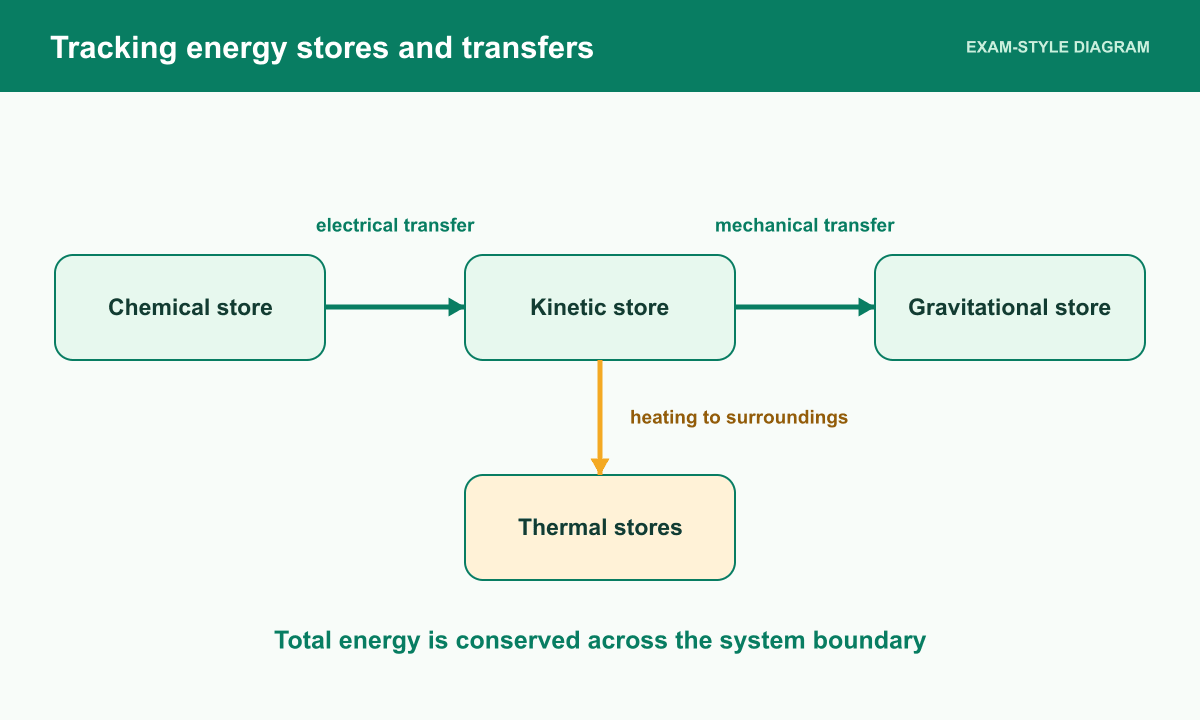
Follow each arrow from the initial chemical store to the useful gravitational store and the dissipated thermal stores.Open the full-size exam diagram
Misconception clinic
Replace the tempting answer
Read each belief, say what is wrong with it, then compare your correction.
Tempting idea: The battery’s electrical store becomes the car’s motion store.
Use instead: Electricity is a transfer pathway; motion is described by a kinetic store. Chemical energy is transferred electrically, with useful motion and unwanted heating.
Tempting idea: Into a new gravitational store.
Use instead: No height gain is described. Friction does mechanical work and warms matter.
Retrieval practice
Quick checks
Worked examples
See the method being built
Apply eight stores, four pathways in the worked reasoning, then try the changed-context questions below.
Example 1 · Falling object
Scope: 8463 and 8464 · Foundation and Higher
A 0.50 kg book falls from a shelf. Describe the energy changes before it hits the floor.
Define the system as book and Earth.
Name the store that decreases and the store that increases.
Include an unwanted transfer if air resistance matters.
Show the answer
The gravitational potential store decreases and the book’s kinetic store increases through mechanical work. Some energy is transferred by heating the air.
Example 2 · Battery motor chain
Scope: 8463 and 8464 · Foundation and Higher
A battery-powered toy car starts moving. Write a precise energy-transfer description.
Start with the battery store.
Name the electrical pathway.
Separate useful motion from unwanted heating and sound.
Show the answer
Energy is transferred electrically from the chemical store of the battery to the car’s kinetic store, with some transferred to thermal stores and by sound.
Example 3 · System boundary
Scope: 8463 and 8464 · Foundation and Higher
A student writes “the energy is lost”. Improve the sentence for a braking bicycle.
Identify the objects included in the system.
Name the changing stores.
Say where dissipated energy goes.
Show the answer
Energy is transferred mechanically from the bicycle’s kinetic store to the thermal stores of the brakes, tyres, road and surroundings.
Exam precision
Use the physics precisely
Do this: State the system boundary, name the changing stores, and connect each change to a transfer pathway. Include surroundings when explaining a lower rebound.
Independent practice
Exam-style questions
Write an answer before opening the marking guidance. Then edit the exact phrase or step that would gain the next mark.
1. Describe the main energy transfers as a falling ball hits the floor and rebounds to a lower height.
[4 marks]
Scope: 8463 and 8464 · Foundation and Higher
Show marking guidance and model answer
Original PhysicsUK mark scheme: Point 1 (1 mark): Gravitational potential decreases and kinetic increases during falling. Point 2 (1 mark): Impact temporarily increases the elastic store as the ball deforms. Point 3 (1 mark): Thermal stores of ball/floor/surroundings increase (accept sound transferring energy away). Point 4 (1 mark): Less energy returns to the gravitational store, giving a lower rebound; total closed-system energy is conserved. Award each distinct point once. Accept equivalent scientifically correct wording. No half marks.
Gravitational potential decreases and kinetic increases during falling. (1 mark)
Impact temporarily increases the elastic store as the ball deforms. (1 mark)
Thermal stores of ball/floor/surroundings increase (accept sound transferring energy away). (1 mark)
Less energy returns to the gravitational store, giving a lower rebound; total closed-system energy is conserved. (1 mark)
Model answer: The falling ball gains kinetic energy from its gravitational potential store. Impact deforms it, storing some energy elastically. Some energy warms the ball, floor and surroundings or is carried away by sound. Less returns to gravitational potential energy, so the rebound is lower, while total energy is conserved.
2. For water alone as the system, describe the useful energy transfer in an electric kettle. Then state how energy enters the whole kettle.
[3 marks]
Scope: 8463 and 8464 · Foundation and Higher
Show marking guidance and model answer
Original PhysicsUK mark scheme: Point 1 (1 mark): Energy enters the water by heating from the hotter element. Point 2 (1 mark): The water’s internal/thermal energy store increases. Point 3 (1 mark): Energy enters the whole kettle electrically from the supply. Award each distinct point once. Accept equivalent scientifically correct wording. No half marks.
Energy enters the water by heating from the hotter element. (1 mark)
The water’s internal/thermal energy store increases. (1 mark)
Energy enters the whole kettle electrically from the supply. (1 mark)
Model answer: Energy enters the water by heating from the hotter element and increases the water’s internal energy store. For the whole kettle, energy enters electrically from the supply.
Marking notes: Respect the stated boundary. Award equivalent internal or thermal store wording. An electrical transfer into the whole kettle is correct, but does not answer the water-only pathway point.
Questions pupils ask
Energy Stores and Changes FAQs
Can a system gain energy if energy is conserved?
Yes. An open system can receive energy across its boundary. Conservation applies when all transfers and the wider closed system are accounted for.