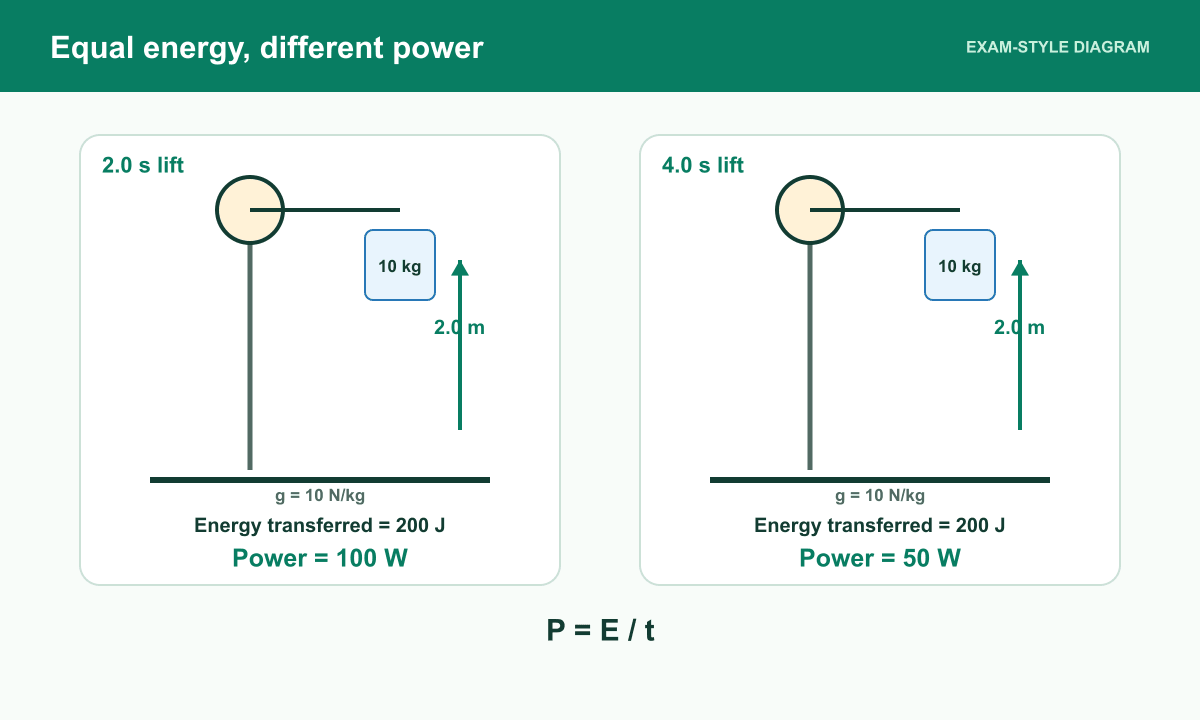
The changing quantity chooses the energy equation: speed, height, extension, displacement or time. A faster transfer and a larger transfer are different claims.
The changing quantity chooses the energy equation: speed, height, extension, displacement or time. A faster transfer and a larger transfer are different claims.
By the end, you should be able to:
Select an energy equation from the described change.
Calculate energy or power in SI units.
Predict how changing speed changes kinetic energy.
Before you revise
Diagnostic question
Choose an answer from memory. Your result tells you what to watch for in the guide.
Core revision guide
Learn the model, then use it
The changing quantity chooses the energy equation: speed, height, extension, displacement or time. A faster transfer and a larger transfer are different claims.
01
Match the change to its equation
Scope: 8463 and 8464 · Foundation and Higher
Use Eₖ = ½mv² for motion, Eₚ = mgh for a height change near Earth, and Eₑ = ½ke² for a spring in its proportional region. In W = Fs, s is displacement along the force. The spring’s force rises during stretching, so multiplying the final force by extension overestimates its work; its graph area is ½Fe.
02
Power describes a rate
Scope: 8463 and 8464 · Foundation and Higher
P = E/t = W/t. A 400 W motor transfers 400 J each second. Two motors can transfer the same 12000 J while taking different times. Greater power does not alone show greater efficiency. At fixed mass, doubling speed gives four times the kinetic energy; doubling height gives twice the gravitational change.
03
Handle units before using the calculator
Scope: 8463 and 8464 · Foundation and Higher
Convert grams to kilograms, centimetres to metres and minutes to seconds. Square the converted speed or extension. Keep an unrounded intermediate value, then give a sensible final precision. A joule is a newton metre of work; a watt is a joule per second.
Read each belief, say what is wrong with it, then compare your correction.
Tempting idea: Twice as large.
Use instead: Speed is squared. (2v)² = 4v².
Tempting idea: 300000 s.
Use instead: This multiplies instead of dividing. t = E/P = 6000/50.
Retrieval practice
Quick checks
Worked examples
See the method being built
Apply match the change to its equation in the worked reasoning, then try the changed-context questions below.
Example 1 · Gravitational potential energy
Scope: 8463 and 8464 · Foundation and Higher
A 2.0 kg box is raised 4.0 m. Take g = 9.8 N/kg. Calculate the energy gained.
Choose E = mgh.
Substitute 2.0 × 9.8 × 4.0.
Give joules.
Show the answer
E = 78.4 J, so the box gains 78 J to two significant figures.
Example 2 · Kinetic energy
Scope: 8463 and 8464 · Foundation and Higher
A 0.80 kg football moves at 5.0 m/s. Calculate its kinetic energy.
Use Eₖ = ½mv².
Square the speed before multiplying.
Keep mass in kg.
Show the answer
Eₖ = 0.5 × 0.80 × 5.0² = 10 J.
Example 3 · Power
Scope: 8463 and 8464 · Foundation and Higher
A hoist transfers 12 000 J in 30 s. Calculate its power.
Use P = E ÷ t.
Substitute 12 000 ÷ 30.
Give watts.
Show the answer
P = 400 W.
Exam precision
Use the physics precisely
Do this: Identify the change, choose its equation, convert units and substitute. Keep energy in joules distinct from power in watts.
Independent practice
Exam-style questions
Write an answer before opening the marking guidance. Then edit the exact phrase or step that would gain the next mark.
1. A 0.60 kg trolley travels at 5.0 m/s. Calculate its kinetic energy.
[3 marks]
Scope: 8463 and 8464 · Foundation and Higher
Show marking guidance and model answer
Original PhysicsUK mark scheme: Point 1 (1 mark): Eₖ = ½mv². Point 2 (1 mark): Eₖ = 0.5 × 0.60 × 5.0². Point 3 (1 mark): Eₖ = 7.5 J. Award each distinct point once. Accept equivalent scientifically correct wording. No half marks.
Eₖ = ½mv². (1 mark)
Eₖ = 0.5 × 0.60 × 5.0². (1 mark)
Eₖ = 7.5 J. (1 mark)
Model answer: Eₖ = ½mv². Eₖ = 0.5 × 0.60 × 5.0². Eₖ = 7.5 J.
Acceptable answers: Expected result: Eₖ = 7.5 J. Accept the unrounded value or a correctly rounded equivalent to two or more significant figures; accept equivalent units if converted correctly. No additional measurement interval is implied.
Marking notes: Method marks remain available after an arithmetic error. Carry an earlier numerical error into a later valid step; award that method point if the unit conversion and physics are correct. A fully correct answer with unit earns all marks unless working is expressly requested.
2. A 120 W hoist transfers 18000 J. Calculate the operating time.
[3 marks]
Scope: 8463 and 8464 · Foundation and Higher
Show marking guidance and model answer
Original PhysicsUK mark scheme: Point 1 (1 mark): t = E/P. Point 2 (1 mark): t = 18000/120. Point 3 (1 mark): t = 150 s. Award each distinct point once. Accept equivalent scientifically correct wording. No half marks.
t = E/P. (1 mark)
t = 18000/120. (1 mark)
t = 150 s. (1 mark)
Model answer: t = E/P. t = 18000/120. t = 150 s.
Acceptable answers: Expected result: t = 150 s. Accept the unrounded value or a correctly rounded equivalent to two or more significant figures; accept equivalent units if converted correctly. No additional measurement interval is implied.
Marking notes: Method marks remain available after an arithmetic error. Carry an earlier numerical error into a later valid step; award that method point if the unit conversion and physics are correct. A fully correct answer with unit earns all marks unless working is expressly requested.
Questions pupils ask
Energy Calculations and Power FAQs
Does doubling speed double the energy a vehicle must lose?
No. At fixed mass its kinetic energy increases fourfold because speed is squared.