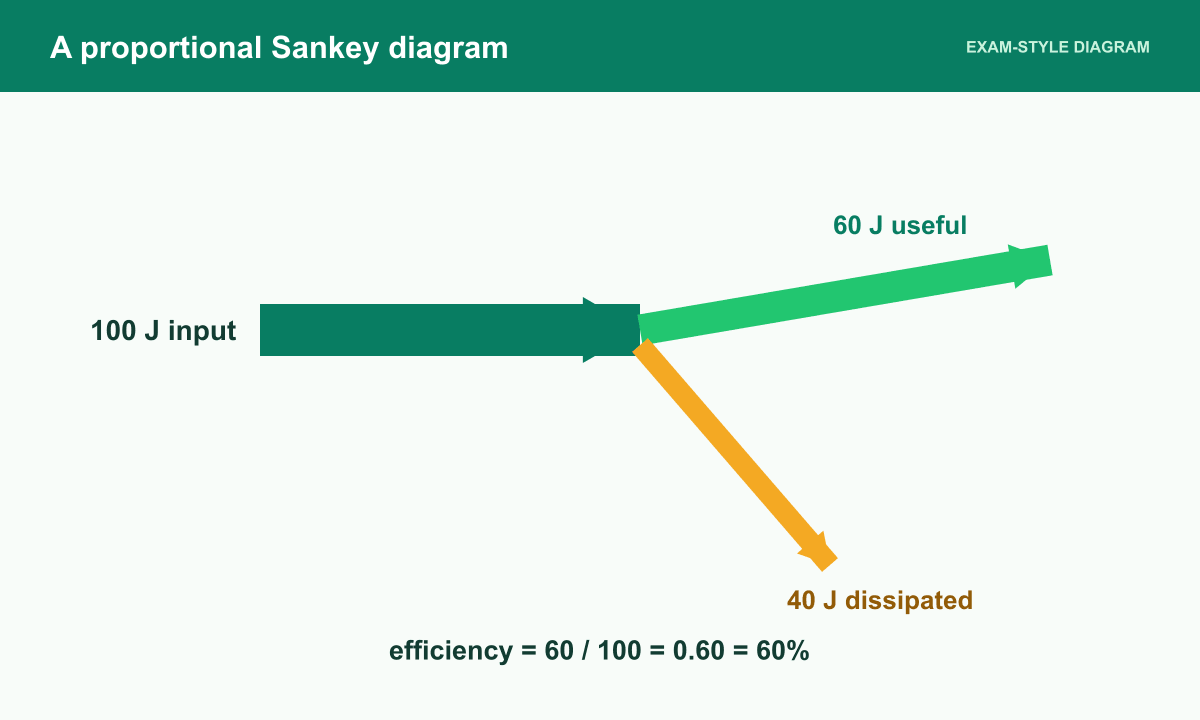
Useful output is chosen by the purpose of the device. The “wasted” part is still present in the full energy account, usually spread through thermal stores.
Useful output is chosen by the purpose of the device. The “wasted” part is still present in the full energy account, usually spread through thermal stores.
By the end, you should be able to:
Calculate efficiency from energy or power.
Account for useful and unwanted outputs.
Explain how an improvement reduces an unwanted transfer.
Before you revise
Diagnostic question
Choose an answer from memory. Your result tells you what to watch for in the guide.
Core revision guide
Learn the model, then use it
Useful output is chosen by the purpose of the device. The “wasted” part is still present in the full energy account, usually spread through thermal stores.
01
Use the same kind of quantity in the ratio
Scope: 8463 and 8464 · Foundation and Higher
Efficiency is useful output energy / total input energy, or useful output power / total input power. Do not divide joules by watts. The result has no unit; multiply by 100 for a percentage. A 200 W motor delivering 150 W mechanically has efficiency 0.75 = 75% and an unwanted rate of 50 W.
02
Explain an improvement causally
Scope: 8463 and 8464 · Foundation and Higher
Lubrication reduces friction between moving parts, reducing mechanical work that warms the machine. Insulation lowers the rate of heating the surroundings. Thicker walls and smaller thermal conductivity reduce conduction. An improvement reduces a specified unwanted transfer; it cannot recover energy that has already dispersed spontaneously.
03
Read an energy-flow diagram
Scope: 8463 and 8464 · Foundation and Higher
Input = useful output + unwanted output. Arrow widths in a Sankey diagram represent energy or power in one consistent scale. A shorter unwanted arrow with the same input means a larger useful output and greater efficiency.
Efficiencyefficiency = useful output ÷ total inputdecimal or percentage
Misconception clinic
Replace the tempting answer
Read each belief, say what is wrong with it, then compare your correction.
Tempting idea: 400%.
Use instead: Input/output reverses the ratio. 20/80 × 100 = 25%.
Tempting idea: Oil creates extra input energy.
Use instead: Oil reduces loss, not creates energy. This identifies the pathway and mechanism.
Retrieval practice
Quick checks
Explore the relationship
Efficiency and dissipation explorer
Change the efficiency or total input. The bar length represents the total input, and its sections show useful and unwanted transfers.
Model scope: 8463 and 8464 · Foundation and Higher
What to notice: use the readout to describe how one variable changes when the other is controlled.
Worked examples
See the method being built
Apply use the same kind of quantity in the ratio in the worked reasoning, then try the changed-context questions below.
Example 1 · Efficiency from energy
Scope: 8463 and 8464 · Foundation and Higher
A motor receives 500 J and gives 350 J of useful kinetic energy. Calculate efficiency.
Write useful output ÷ total input.
Calculate 350 ÷ 500.
Convert if a percentage is requested.
Show the answer
Efficiency = 0.70 = 70%.
Example 2 · Improving a house
Scope: 8463 and 8464 · Foundation and Higher
Explain how loft insulation reduces unwanted energy transfer.
Name the unwanted pathway.
State what the insulation changes.
Link to the thermal store of the surroundings.
Show the answer
Insulation reduces energy transfer by heating through the roof, so the house’s thermal energy is transferred to the surroundings more slowly.
Example 3 · Power efficiency
Scope: 8463 and 8464 · Foundation and Higher
A pump takes 200 W and provides 150 W of useful output. Calculate its efficiency.
Use powers because both values are rates.
Calculate 150 ÷ 200.
Give decimal or percentage.
Show the answer
Efficiency = 0.75, or 75%.
Exam precision
Use the physics precisely
Do this: Use the same kind of quantity in numerator and denominator. Explain an improvement by naming the unwanted transfer it reduces.
Independent practice
Exam-style questions
Write an answer before opening the marking guidance. Then edit the exact phrase or step that would gain the next mark.
1. A pump takes 240 W and delivers 180 W usefully. Calculate its efficiency as a percentage.
[3 marks]
Scope: 8463 and 8464 · Foundation and Higher
Show marking guidance and model answer
Original PhysicsUK mark scheme: Point 1 (1 mark): Efficiency = useful power/total power × 100. Point 2 (1 mark): Efficiency = 180/240 × 100. Point 3 (1 mark): Efficiency = 75% (no physical unit). Award each distinct point once. Accept equivalent scientifically correct wording. No half marks.
Efficiency = useful power/total power × 100. (1 mark)
Efficiency = 180/240 × 100. (1 mark)
Efficiency = 75% (no physical unit). (1 mark)
Model answer: Efficiency = useful power/total power × 100. Efficiency = 180/240 × 100. Efficiency = 75% (no physical unit).
Acceptable answers: Expected result: Efficiency = 75% (no physical unit). Accept the unrounded value or a correctly rounded equivalent to two or more significant figures; accept equivalent units if converted correctly. No additional measurement interval is implied.
Marking notes: Method marks remain available after an arithmetic error. Carry an earlier numerical error into a later valid step; award that method point if the unit conversion and physics are correct. A fully correct answer with unit earns all marks unless working is expressly requested.
2. Explain how lubrication can improve a motor’s efficiency.
[3 marks]
Scope: 8463 and 8464 · Foundation and Higher
Show marking guidance and model answer
Original PhysicsUK mark scheme: Point 1 (1 mark): Lubrication reduces friction. Point 2 (1 mark): Less input energy is transferred to thermal stores through friction. Point 3 (1 mark): A greater fraction of the same total input becomes useful mechanical output. Award each distinct point once. Accept equivalent scientifically correct wording. No half marks.
Lubrication reduces friction. (1 mark)
Less input energy is transferred to thermal stores through friction. (1 mark)
A greater fraction of the same total input becomes useful mechanical output. (1 mark)
Model answer: Lubrication reduces friction and therefore the heating of moving parts. A greater fraction of input energy becomes useful mechanical output.
Questions pupils ask
Efficiency and Unwanted Energy Transfers FAQs
Can a useful output be thermal energy?
Yes. Heating water is the useful purpose of a kettle; heating the room is usually unwanted for that task.