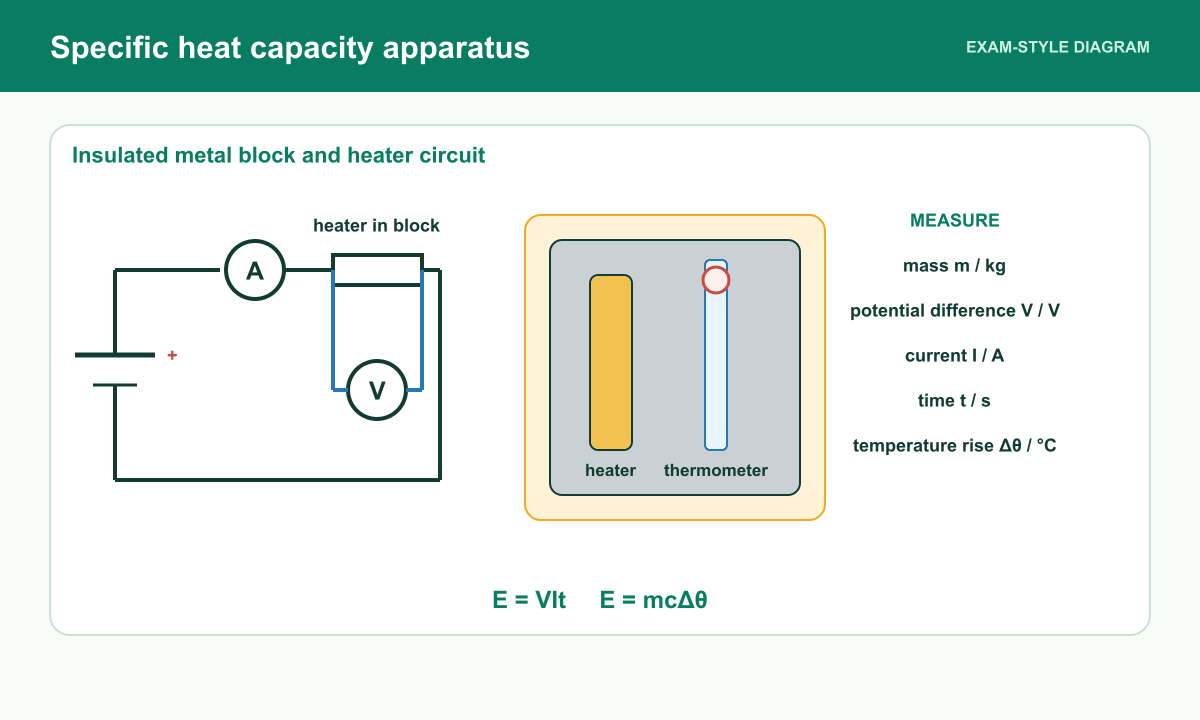
The experiment estimates energy needed per kilogram per degree. Measure the electrical input and temperature rise, then examine the assumption that all input heats the block.
The experiment estimates energy needed per kilogram per degree. Measure the electrical input and temperature rise, then examine the assumption that all input heats the block.
By the end, you should be able to:
Describe the measurements for specific heat capacity.
Calculate c from electrical input and temperature rise.
Explain the effect of heat loss on the estimate.
Before you revise
Diagnostic question
Choose an answer from memory. Your result tells you what to watch for in the guide.
Core revision guide
Learn the model, then use it
The experiment estimates energy needed per kilogram per degree. Measure the electrical input and temperature rise, then examine the assumption that all input heats the block.
01
Apparatus and measurement sequence
Scope: 8463 and 8464 · Foundation and Higher
Measure the dry block mass on a balance. Fit a low-voltage immersion heater and thermometer into its holes with good thermal contact, using a small amount of suitable oil if the apparatus allows. Insulate the sides/top while leaving access. Record the starting temperature. Connect an ammeter in series and a voltmeter across the heater, then switch on and start timing together. Record V, I, t and temperature at equal intervals.
02
Process the observations
Scope: 8463 and 8464 · Foundation and Higher
For nearly constant readings, E = VIt. Otherwise sum VIΔt over intervals or use a joulemeter. Use Δθ = final − initial temperature and c = E/(mΔθ). Alternatively plot E on y against Δθ on x: the straight-line gradient is mc, so c = gradient/m. Allow the thermometer to respond and use the section where contact has stabilised.
03
Interpret systematic error and work safely
Scope: 8463 and 8464 · Foundation and Higher
Some input warms the heater and surroundings. Treating it all as block energy makes E too large for the measured rise and usually overestimates c. Insulation and better contact reduce this systematic error; repeating alone does not remove it. Use a stable block, low-voltage supply, and heat-resistant handling; switch off before moving the heater and allow it to cool.
Measure mass and temperature change, then use V, I and time to calculate the electrical energy supplied.Open the full-size exam diagram
Electrical energy suppliedE = VItJ, V, A, sSpecific heat capacityE = mcΔθJ, kg, J/(kg °C), °C
Misconception clinic
Replace the tempting answer
Read each belief, say what is wrong with it, then compare your correction.
Tempting idea: A c that is too small.
Use instead: The numerator has been overestimated. The measured rise came from only part of the assumed input.
Tempting idea: c alone.
Use instead: Mass also multiplies c in E = mcΔθ. The gradient is ΔE/Δθ = mc.
Retrieval practice
Quick checks
Worked examples
See the method being built
Apply apparatus and measurement sequence in the worked reasoning, then try the changed-context questions below.
Example 1 · Calculate energy input
Scope: 8463 and 8464 · Foundation and Higher
A heater is supplied with 12 V and 2.0 A for 180 s. Calculate the electrical energy supplied.
Use E = VIt.
Substitute 12 × 2.0 × 180.
Give joules.
Show the answer
E = 4320 J.
Example 2 · Calculate SHC
Scope: 8463 and 8464 · Foundation and Higher
A 0.50 kg block receives 6000 J and warms by 20 °C. Calculate its specific heat capacity.
Rearrange E = mcΔθ to c = E ÷ (mΔθ).
Substitute 6000 ÷ (0.50 × 20).
State J/kg °C.
Show the answer
c = 600 J/kg °C.
Example 3 · Evaluate heat loss
Scope: 8463 and 8464 · Foundation and Higher
A student leaves gaps around the heater. Explain the effect.
Identify the assumption in the calculation.
State where some supplied energy goes.
Predict the direction of the error.
Show the answer
More energy warms the surroundings, so less reaches the block and the calculated SHC is likely too large.
Exam precision
Use the physics precisely
Do this: Specify mass, V, I, time and temperature measurements. Connect insulation and thermal contact to the assumption that measured input heats the block.
Independent practice
Exam-style questions
Write an answer before opening the marking guidance. Then edit the exact phrase or step that would gain the next mark.
1. A 1.0 kg block warms by 12 °C after a 12 V, 2.0 A heater runs for 240 s. Estimate c assuming no losses.
[3 marks]
Scope: 8463 and 8464 · Foundation and Higher
Show marking guidance and model answer
Original PhysicsUK mark scheme: Point 1 (1 mark): E = VIt and c = E/(mΔθ). Point 2 (1 mark): E = 12 × 2.0 × 240 = 5760 J; c = 5760/(1.0 × 12). Point 3 (1 mark): c = 480 J/(kg °C). Award each distinct point once. Accept equivalent scientifically correct wording. No half marks.
E = VIt and c = E/(mΔθ). (1 mark)
E = 12 × 2.0 × 240 = 5760 J; c = 5760/(1.0 × 12). (1 mark)
c = 480 J/(kg °C). (1 mark)
Model answer: E = VIt and c = E/(mΔθ). E = 12 × 2.0 × 240 = 5760 J; c = 5760/(1.0 × 12). c = 480 J/(kg °C).
Acceptable answers: Expected result: c = 480 J/(kg °C). Accept the unrounded value or a correctly rounded equivalent to two or more significant figures; accept equivalent units if converted correctly. No additional measurement interval is implied.
Marking notes: Method marks remain available after an arithmetic error. Carry an earlier numerical error into a later valid step; award that method point if the unit conversion and physics are correct. A fully correct answer with unit earns all marks unless working is expressly requested.
2. Explain why insulation improves this measurement and why repeats do not remove heat-loss error.
[3 marks]
Scope: 8463 and 8464 · Foundation and Higher
Show marking guidance and model answer
Original PhysicsUK mark scheme: Point 1 (1 mark): Insulation reduces the energy escaping to the surroundings. Point 2 (1 mark): More of the measured electrical input then raises the block’s internal energy. Point 3 (1 mark): Repeats average random variation but do not remove a consistent loss. Award each distinct point once. Accept equivalent scientifically correct wording. No half marks.
Insulation reduces the energy escaping to the surroundings. (1 mark)
More of the measured electrical input then raises the block’s internal energy. (1 mark)
Repeats average random variation but do not remove a consistent loss. (1 mark)
Model answer: Insulation reduces energy escaping, so the electrical input better represents the block’s energy increase. Repeats reduce random scatter; the heat-loss bias remains in every run.
Questions pupils ask
Specific Heat Capacity Required Practical FAQs
Why is the block mass needed in a specific-heat experiment?
Specific heat capacity describes energy per kilogram per degree, so the measured block energy must be divided by mass and temperature rise.