
Free worksheet and solutions · AQA GCSE · 8463
AQA GCSE Physics Energy Changes and Thermal Stores Worksheet
Download a free AQA GCSE Physics worksheet on energy changes in systems, specific heat capacity and the required practical, with complete worked solutions.
What is covered
Questions and skills covered
The worksheet contains 3 pages of printable questions. A separate 2-page solutions PDF makes it easy to mark, review or share answers after the activity.
- Energy changes in systems and thermal energy stores
- Specific heat capacity calculations using change in thermal energy
- Required practical data, repeat measurements and anomalous results
- Directional energy-transfer reasoning and complete energy accounts
About this activity
Thermal-store blocks provide the context for specific heat capacity calculations and the heated-block required practical. Later questions ask pupils to handle anomalous results, compare materials and explain the direction of a measurement error, rather than simply naming heat loss.
Before you start
Calculate a temperature change, convert between joules and kilojoules, and substitute into energy = mass x specific heat capacity x temperature change.
A question from the worksheet
Question 2, worksheet page 1
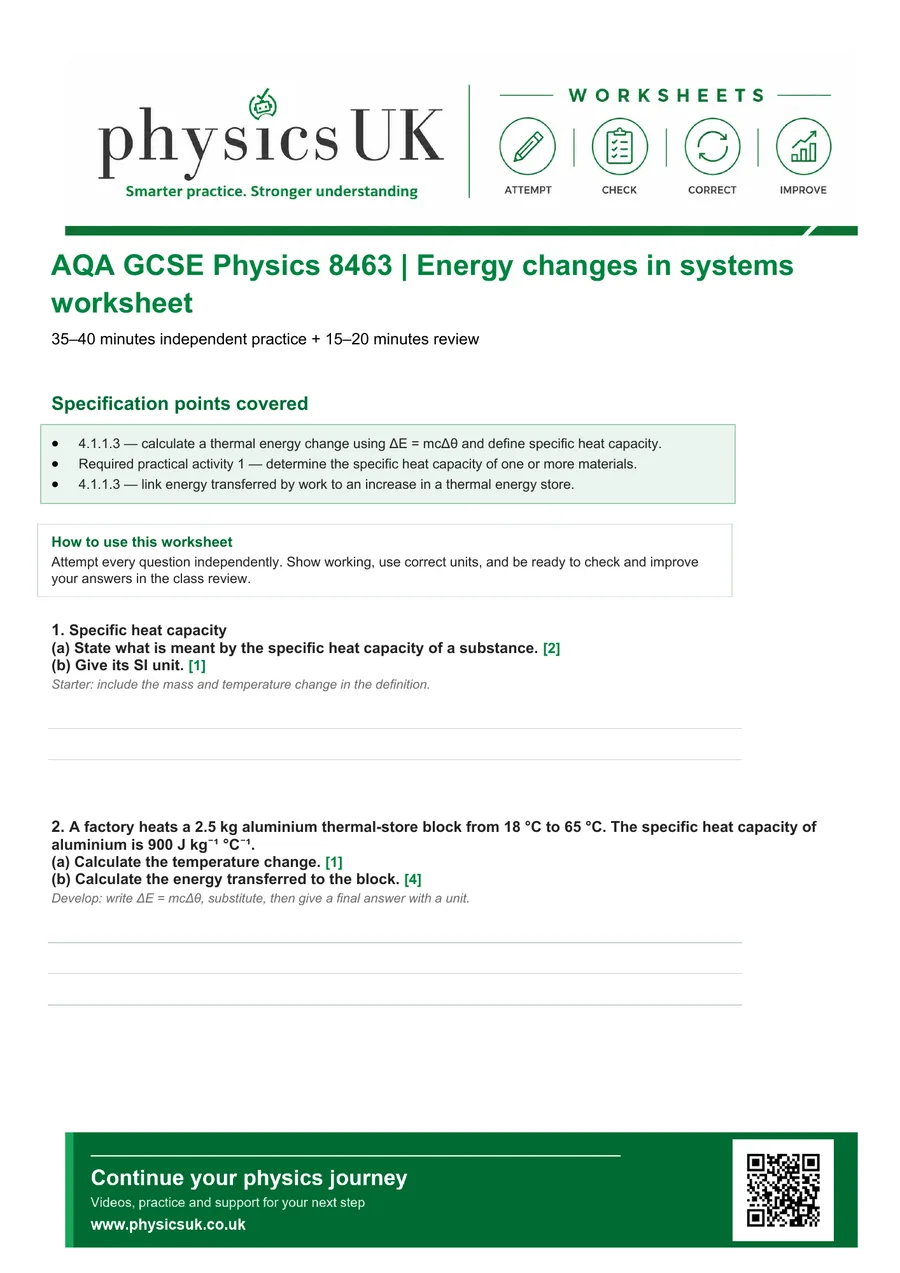
A factory heats a 2.5 kg aluminium thermal-store block from 18 degrees C to 65 degrees C. Its specific heat capacity is 900 J/(kg degrees C). Calculate the temperature change and the energy transferred to the block.
Show the answer
Temperature change = 65 - 18 = 47 degrees C. Energy transferred = 2.5 x 900 x 47 = 105,750 J, approximately 106 kJ.
Common error: Use the temperature rise of 47 degrees C, not the final temperature of 65 degrees C.
Revise the physics
Specification fit
AQA GCSE Physics Worksheets
8463 · 4.1.1.3
Classroom use
Use the worksheet for class practice, homework, intervention, cover work or revision. Keep the PhysicsUK attribution intact when sharing copies with pupils.