

Should heating be left on low all day?
The claim that heating on low all day must be cheaper sounds plausible: surely warming a cold house takes more energy than maintaining a warm one? The missing detail is the energy that keeps leaving the building while it is being kept warm.
For an otherwise unchanged building, holding a larger temperature difference from outside usually increases the rate of heat loss. A cooler period can reduce that transfer. But the energy needed by the building and the cost of supplying it are not exactly the same question.
Efficiency can change with operating conditions, and electricity prices can vary with the tariff and time. A blanket rule for every boiler, heat pump and storage heater therefore goes further than the physics supports. The useful starting point is to follow the energy.
Where does energy go when a house cools?
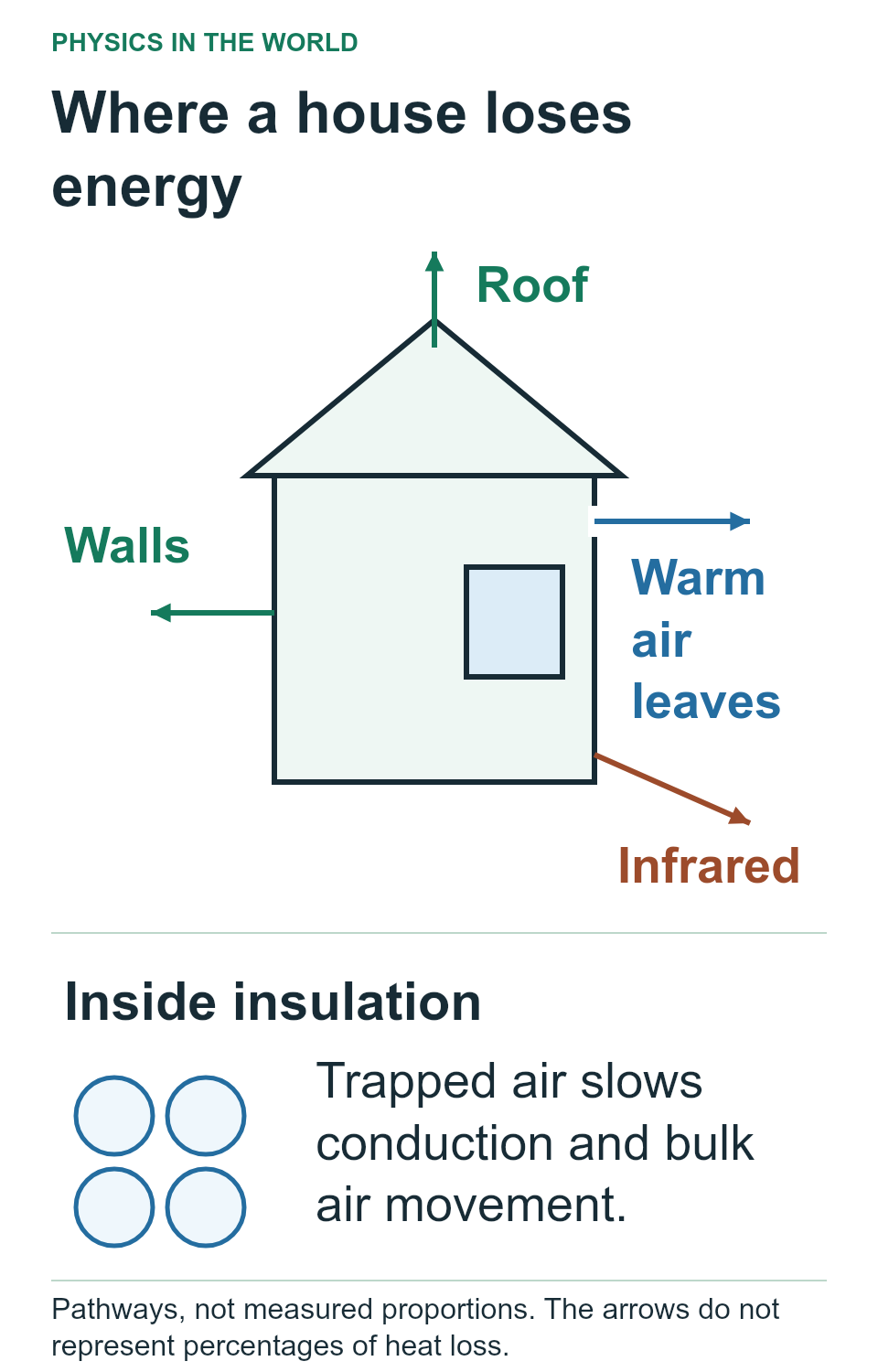
A warm house transfers energy to colder surroundings. Through a solid wall or roof layer, conduction transfers energy through the material. At surfaces, moving air can carry energy by convection. The surfaces also exchange infrared radiation with their surroundings.
Air escaping through a gap is another pathway. Energy moves with the warmer air leaving the building, while replacement air may be colder. Air circulating inside a closed room is not the same as air crossing the building boundary.
Insulation makes some pathways slower. Many insulating materials trap air in small spaces. Air conducts poorly compared with many solids, and limiting its bulk movement reduces convection within those spaces. The air is not a vacuum and the insulation is not generating warmth.
Picture two otherwise identical houses on the same still evening. Keeping one at a higher temperature creates a greater temperature difference from outside. Other conditions being equal, it transfers energy out faster. The heating has to replace that energy to hold the temperature steady.
Steady temperature does not mean no energy is moving. It can mean that the rate supplied by the heating balances the rate transferred to the surroundings. The thermal insulation practical makes this distinction easier to see in a controlled cooling investigation.
Worked equations
A simple model for heat-loss power
Here H is a whole-building heat-loss coefficient in watts per kelvin. This approximate model holds H and outside conditions fixed. It is an A-level extension to explain a graph, not an extra equation GCSE pupils must memorise.
Does reheating the house cancel the saving?
When heating is reduced, the building does not instantly become the outdoor temperature. Air, walls, floors, furniture and other materials store internal energy. As energy is transferred out, their temperatures can fall.
Reheating later restores some of that internal energy. That is a real energy requirement, but it does not erase the smaller transfer to the surroundings while the building was cooler. A fair comparison has to consider the entire period, with comparable starting and finishing conditions.
The supply system adds another layer. A heat pump often works efficiently when it delivers lower-temperature water steadily. A deep setback followed by a high-temperature recovery can alter efficiency or bring other heating into use. Its best schedule depends on the installation and conditions, not just the word on or off.
Our heat-pump explanation shows why electrical input and heat delivered are different quantities. A gas boiler and a heat pump have different operating characteristics, so one piece of scheduling advice cannot automatically be transferred between them.
A bill adds the price of energy as well. Two schedules with similar energy demand can cost different amounts on a time-varying tariff. This article does not calculate a household saving or prescribe a universal timetable: that would require details of the building, installation, weather and tariff.
Insulation, power and the physics you know
Power is a rate of energy transfer. A heater rated at a particular power is not automatically using that power continuously: controls may cycle or modulate its output. You need both power and operating time to compare transferred energy.
The energy-transfer revision page is useful here. Energy has not vanished when a room cools; internal energy in the building decreases while energy is transferred to its surroundings. Whether we call that transfer unwanted depends on the purpose of the system.
Temperature and energy are not interchangeable either. Two objects can have the same temperature while storing different amounts of internal energy. Their masses, materials and states matter. The AQA thermal physics notes develop that distinction.
A room thermostat sets a target temperature, not a universal heating speed. Turning it higher does not generally make a basic on-off system heat faster; it makes the system aim for a higher final temperature. Modern modulating or weather-compensated controls can behave differently, which is another reason to follow the installation instructions.
Cold surfaces also help explain window condensation. Our window condensation guide connects surface temperature with water vapour, but it is not a reason to block ventilation. Keeping a building healthy involves more than minimising one energy-transfer pathway.
A mechanical engineer designing a heating system has to consider the building's demand, the heating capacity, the controls and comfort together. Choosing a larger power rating alone does not answer all of those questions.
A Level stretch: what a cooling curve can tell us
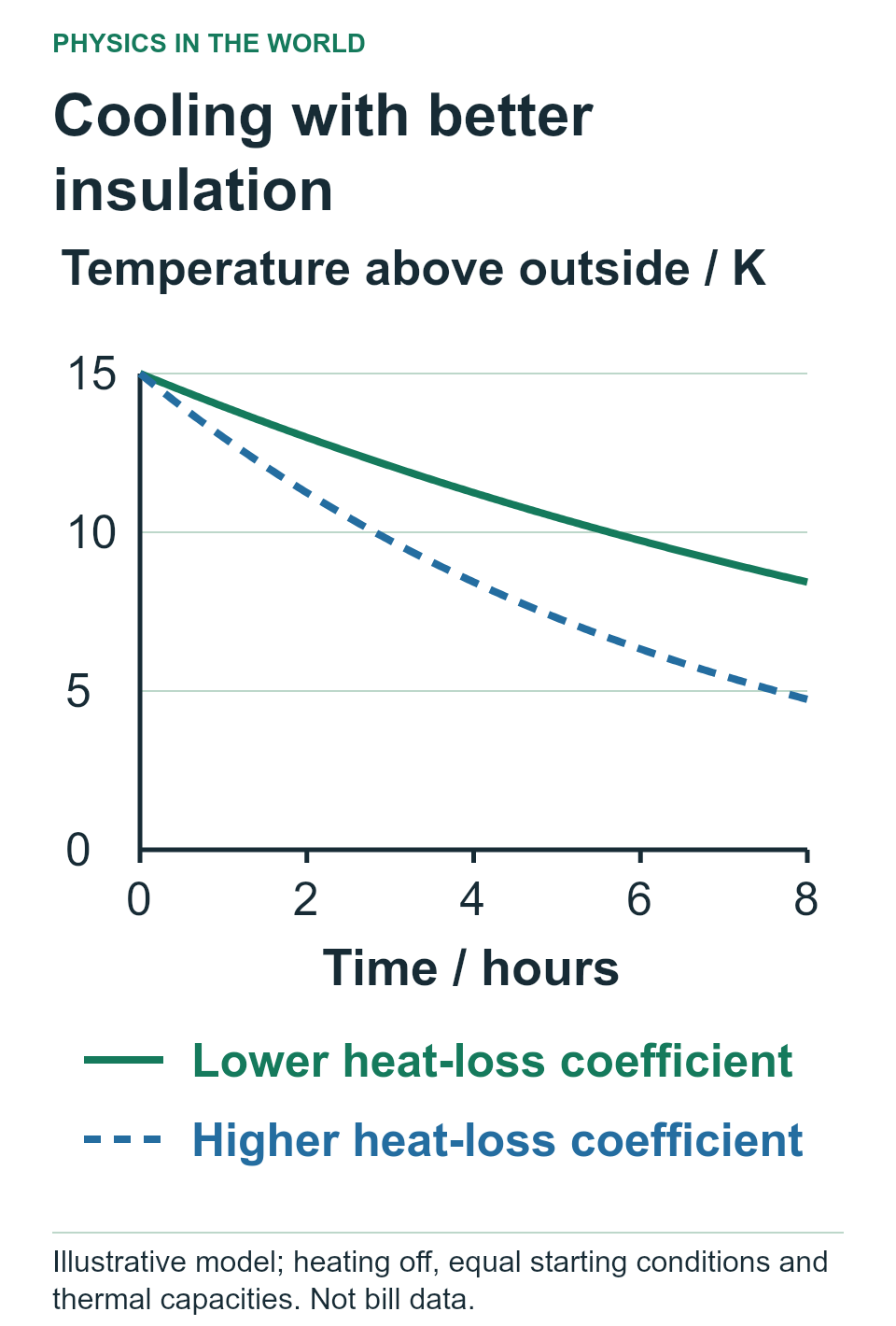
The cooling curves use that model with the heating off. Both buildings begin at the same temperature above outside and have the same effective thermal capacity. Only the heat-loss coefficient changes. The curve for the lower coefficient falls more slowly.
The vertical axis shows temperature above outside, not the absolute indoor temperature. A difference of one kelvin is the same size as a difference of one degree Celsius. This avoids confusing a temperature difference with a temperature measured from absolute zero.
As the difference becomes smaller, this model predicts a smaller heat-loss power, so the curve becomes less steep. The thermal capacity connects the net energy change to the temperature change. A steep curve would not by itself prove poor insulation if the buildings had different thermal capacities.
Real houses have changing outdoor temperatures, wind, sunlight, occupants and several materials at different temperatures. The graph deliberately leaves these out. It teaches how insulation affects cooling; it does not directly compare heating schedules or predict what someone should pay.
Key words
Quick pupil questions
Is it always cheaper to leave heating on low all day?
No. Keeping a building warmer for longer usually increases the heat that must be replaced, but running cost also depends on system efficiency, controls and tariff. Gas-boiler advice cannot simply be copied onto every heat-pump installation.
Does reheating a house cancel the energy saved while it was cooler?
Not automatically. Reheating restores internal energy, but the building transferred less energy out while its inside-outside temperature difference was smaller. A whole-period comparison must also consider efficiency and equivalent starting and finishing conditions.
Does turning up the thermostat heat a room faster?
A basic room thermostat sets a target, rather than a heating speed. A higher setting generally means aiming for a higher final temperature. More sophisticated controls can behave differently, so use the instructions for the actual installation.
Does insulation stop a house losing heat?
No. It reduces some rates of energy transfer for a given temperature difference. Ventilation and other transfer pathways remain, and essential ventilation should not be blocked.