

Why are my windows wet on the inside?
You open the curtains and find water along the bottom of the glass. It may not have rained. The liquid can have come from invisible water vapour already present in the room.
Cooking, showers, drying washing and breathing add moisture to indoor air. In cold weather, a window can be much colder than the room around it. That combination makes the glass a likely place for droplets to form.
First check which surface is wet. This explanation concerns condensation on the room-facing surface. Moisture outside the window is a different location, and persistent mist trapped between sealed panes needs separate investigation. A wet patch elsewhere could also have another cause, such as a leak.
What happens when water vapour meets cold glass?
Water vapour is water in the gas state. Its molecules move around among the other molecules in the air. You cannot see the vapour itself; a visible mist contains tiny liquid droplets.
Near a cold window, energy is transferred towards the colder glass. Under the right conditions, water molecules join the liquid on the surface faster than molecules leave it. Droplets grow. This is condensation, the change from gas to liquid.
The dew point is the temperature at which cooling the air allows water vapour to start condensing. A surface at or below that temperature can collect droplets. More water vapour generally means a higher dew point, so the surface does not need to be as cold for droplets to form.
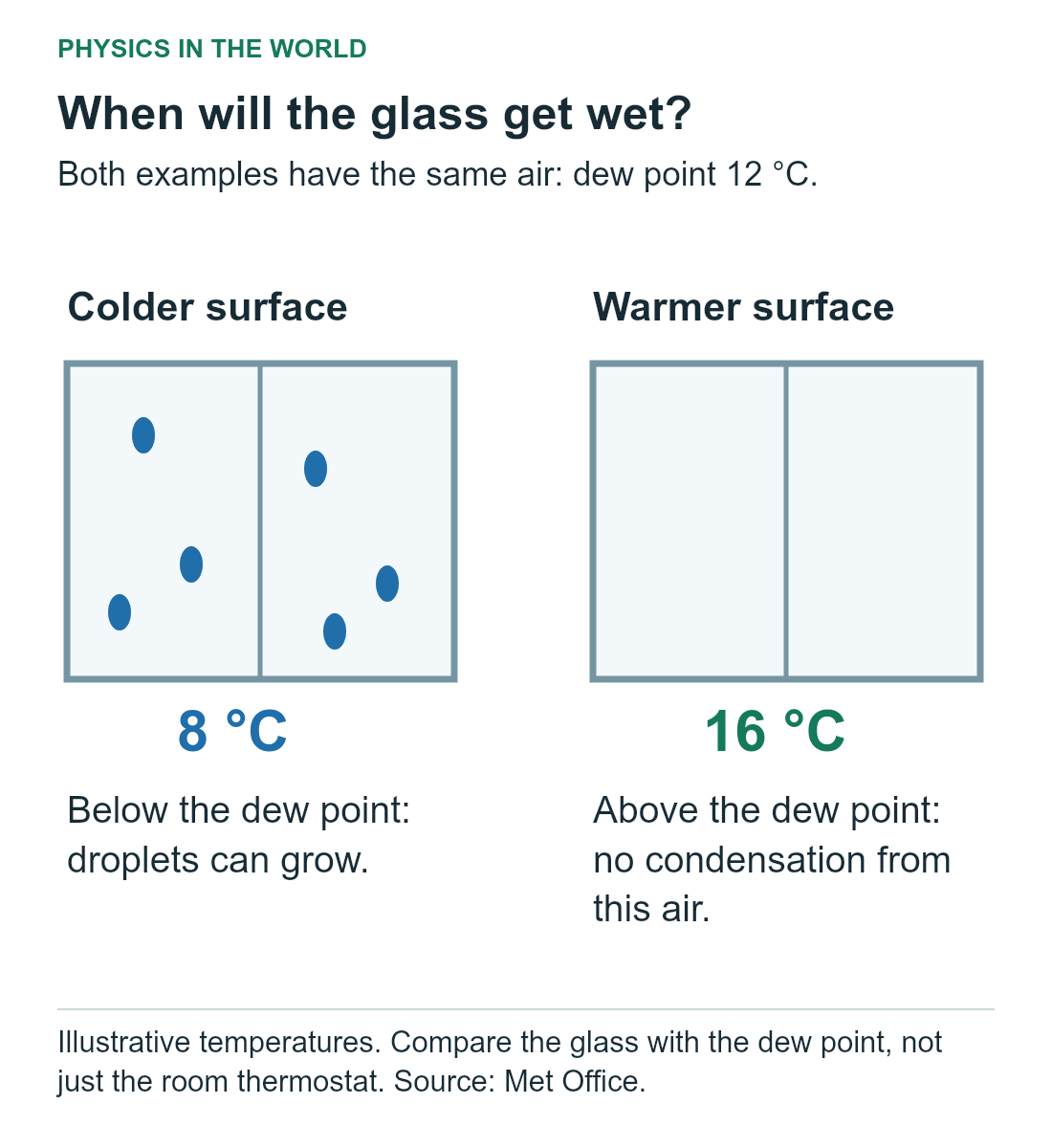
Use the example below. Suppose the dew point is 12 degrees Celsius. Glass at 8 degrees is cold enough for condensation; glass at 16 degrees is not, for the same surrounding air. The important measurement is the surface temperature, not just the thermostat reading.
People often say warm air "holds more water". That can be useful shorthand, but air is not a sponge. Water molecules are continually leaving liquid and rejoining it. Cooling changes that balance, allowing liquid droplets to grow. The A-level section below gives a more precise way to describe the balance.
What reduces condensation, and why?
There are three useful ways to think about prevention. Reduce the moisture entering the room, remove moist air through suitable ventilation, or raise the temperature of the cold surface. They change different quantities, so one measure does not automatically replace the others.
The government home ventilation guide explains how household moisture can accumulate and recommends keeping trickle vents clear and using ventilation systems as instructed. Follow the arrangements for the building. Blocking a vent to make a room feel warmer can allow more moisture to accumulate.
Insulation and effective glazing reduce heat transfer to the colder outdoors. The room-facing surface can then stay warmer. But insulation does not remove water vapour, and a warmer room still needs suitable ventilation.
Wiping away droplets removes that liquid for the moment; it does not identify why they formed. Persistent damp, water between sealed panes or signs of a leak deserve advice about the building rather than a guess based on one physics explanation.
The GCSE and A-level physics in a wet window
At GCSE, describe both the state change and the energy transfer. Condensing water transfers energy to its surroundings. The molecules remain water molecules: this is a physical change, not a chemical reaction that makes a different substance.
At A level, internal energy includes the kinetic energy of moving particles and the potential energy associated with their arrangement and interactions. It is not the same as temperature. For example, boiling water can keep receiving energy without getting hotter while it changes from liquid to gas. Condensation transfers energy in the opposite direction.
The thermal physics worksheet develops that distinction. It also helps explain why a surface thermometer and a room thermometer can give different readings without either instrument being faulty: they are measuring different parts of a system that is transferring energy.
Double glazing adds thermal resistance between inside and outside. Its gas-filled gap reduces conduction compared with a solid glass bridge, while a suitably narrow gap limits convection. Coatings can also reduce radiative transfer. The result is a lower rate of heat loss for a given temperature difference.
For AQA, use the thermal physics and gas laws resource to practise explaining changes in terms of particles. Then try the heat-pump explainer: its refrigerant deliberately evaporates and condenses as part of a controlled energy-transfer cycle.
A Level stretch: relative humidity and dew point
Water vapour contributes to the pressure of the air. Saturation vapour pressure is the value at which evaporation and condensation balance at a particular temperature. Relative humidity compares the actual water-vapour pressure with that value, as a percentage. At 100%, the air is saturated.
The saturation value rises with temperature. That means two air samples with the same relative humidity can contain different amounts of water vapour if their temperatures differ. A percentage alone does not tell you the total moisture content.
Warming air without adding moisture usually lowers its relative humidity. That does not mean the water has vanished. If that air later meets a sufficiently cold surface, condensation can still occur.
A useful investigation would record room temperature, humidity and window-surface temperature together. Repeat the readings before and after an ordinary activity such as cooking, keeping the measurement positions consistent. A single room-temperature reading cannot explain the whole result.
A mechanical engineer working on heating or ventilation has to consider these interactions. Keeping a building comfortable involves energy transfer, moisture and air movement together. The droplets on a window show why a system needs more than one measurement.
Key words
Quick pupil questions
Why is there condensation inside my windows in winter?
Moist indoor air can meet glass cold enough to be at or below its dew point. Water vapour then condenses into liquid droplets on the room-facing surface.
Does condensation mean my double glazing is faulty?
Room-side condensation alone does not establish a glazing fault. It depends on surface temperature, moisture and ventilation. Persistent mist between sealed panes is a different issue and should be checked.
Why do I get condensation even when the heating is on?
The window can remain colder than the air in the room. Heating the room does not automatically remove its moisture or ensure that every surface is above the dew point.
Does condensation release or absorb energy?
Condensation releases energy to the surroundings as water changes from gas to liquid. Evaporation is the reverse process and requires an energy transfer to the water.