Subsection scope: Stopping distance, reaction-time factors and braking conditions: both courses and tiers. Braking-force/work estimates: Higher. Stopping-distance graph interpretation: Physics only.
Learn · practise · improve
Start here
The revision snapshot
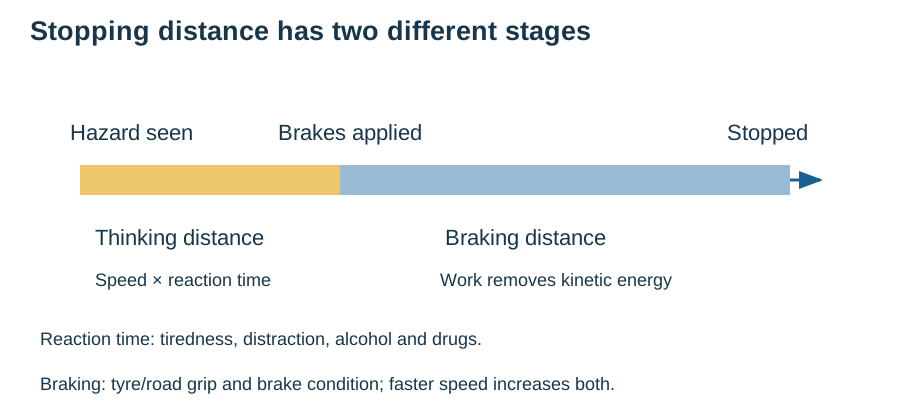
Stopping distance has a reaction stage and a braking stage. Different factors affect each, so name the stage before explaining a change.
By the end, you should be able to:
Calculate thinking and stopping distances.
Explain reaction-time and road-condition effects.
Higher: connect work, braking force and speed.
Before you revise
Diagnostic question
Choose an answer from memory. Your result tells you what to watch for in the guide.
Core revision guide
Learn the model, then use it
Stopping distance has a reaction stage and a braking stage. Different factors affect each, so name the stage before explaining a change.
01
Reaction time and thinking distance
Scope: 8463 and 8464 · Foundation and Higher
Thinking distance = speed × reaction time. At 20 m/s and 0.70 s it is 14 m. Tiredness, distraction, drugs and alcohol can lengthen reaction time. Typical reaction times are around 0.2–0.9 s. An electronic reaction test measures elapsed time directly; a ruler-drop test compares catch distance, with repeated trials and a common release procedure. Learning and anticipation are limitations to control.
02
Braking distance and energy
Scope: 8463 and 8464 · Foundation and Higher
Braking distance starts when braking force acts. Friction does work, reducing kinetic energy and increasing thermal stores in brakes, tyres, road and surroundings. Wet/icy roads, worn tyres or faulty brakes can reduce the available braking force and increase distance. The speed effect is common to both tiers. Higher: with fixed mass and braking force, Fs = ½mv² predicts braking distance proportional to v², so doubling speed requires four times the distance in this model.
03
Put the stages together
Scope: 8463 and 8464 · Foundation and Higher
Stopping distance = thinking + braking distance. Faster speed increases both; longer reaction time only directly increases the thinking stage in an otherwise equal comparison. Physics-only stopping-distance graph tasks and Higher braking-force estimates need their labels. Large deceleration can overheat brakes and increase loss-of-control risk. Road predictions depend on actual conditions rather than a universal memorised distance.
Model answer: Thinking distance = vt; stopping = thinking + braking. Thinking = 18 × 0.75 = 13.5 m; stopping = 13.5 + 24. Stopping distance = 37.5 m.
Acceptable answers: Expected result: Stopping distance = 37.5 m. Accept the unrounded value or a correctly rounded equivalent to two or more significant figures; accept equivalent units if converted correctly. No additional measurement interval is implied.
Marking notes: Method marks remain available after an arithmetic error. Carry an earlier numerical error into a later valid step; award that method point if the unit conversion and physics are correct. A fully correct answer with unit earns all marks unless working is expressly requested.
2. Higher: explain why doubling speed may quadruple braking distance if braking force and mass are unchanged.
[2 marks]
Scope: 8463 and 8464 · Higher only
Show marking guidance and model answer
Original PhysicsUK mark scheme: Point 1 (1 mark): Kinetic energy ½mv² becomes four times as large. Point 2 (1 mark): Work done by the same force is Fs, so four times the energy needs four times the distance. Award each distinct point once. Accept equivalent scientifically correct wording. No half marks.
Kinetic energy ½mv² becomes four times as large. (1 mark)
Work done by the same force is Fs, so four times the energy needs four times the distance. (1 mark)
Model answer: Doubling speed quadruples kinetic energy. The same braking force must act through four times the distance to remove it.