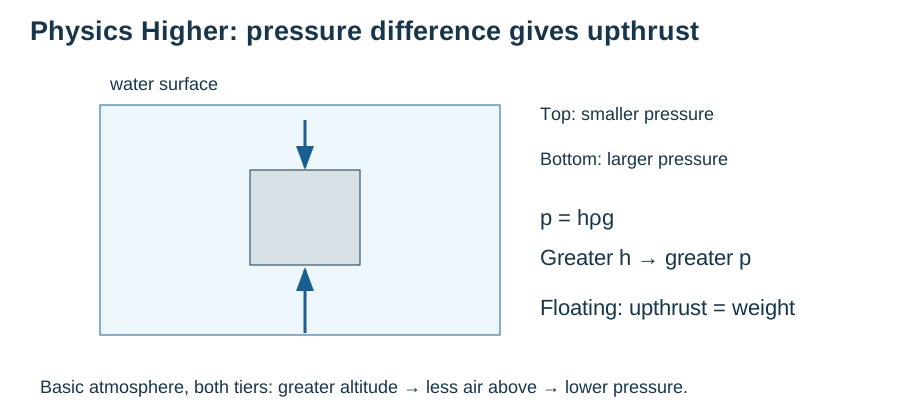
Fluid pressure produces normal forces. A pressure difference between the bottom and top of an immersed body produces upthrust.
AQA 8463GCSE PhysicsFoundationHigher
Subsection scope: Basic fluid/atmospheric pressure: Physics both tiers. Liquid-depth equation and upthrust: Physics Higher.
Learn · practise · improve
Start here
The revision snapshot
Fluid pressure produces normal forces. A pressure difference between the bottom and top of an immersed body produces upthrust.
By the end, you should be able to:
Calculate basic pressure and explain atmospheric variation.
Higher: calculate pressure due to a liquid column.
Higher: explain upthrust, floating and sinking.
Before you revise
Diagnostic question
Choose an answer from memory. Your result tells you what to watch for in the guide.
Core revision guide
Learn the model, then use it
Fluid pressure produces normal forces. A pressure difference between the bottom and top of an immersed body produces upthrust.
01
Basic fluid and atmospheric pressure
Scope: 8463 Physics only · Foundation and Higher
Liquids and gases are fluids. Their pressure acts perpendicular to a surface and produces force F = pA. Atmospheric gas collisions exert pressure; greater altitude generally leaves less air above and lower air density, so atmospheric pressure falls.
02
Depth and density
Scope: 8463 Physics only · Higher only
For liquid depth h, pressure due to the liquid is p = hρg. At h = 0.50 m in water with ρ = 1000 kg/m³ and g = 10 N/kg, it is 5000 Pa. This is the liquid’s contribution; total absolute pressure in an open vessel also includes atmospheric pressure. Compare different depths using Δp = Δhρg.
03
Upthrust, floating and sinking
Scope: 8463 Physics only · Higher only
The bottom surface is deeper and has greater pressure than the top, giving an upward resultant. Side forces cancel in symmetric situations. A body floats when it can displace enough fluid for upthrust to equal weight; a floating body’s vertical resultant is zero. If fully submerged upthrust is less than weight it sinks. Changing body volume or fluid density changes available upthrust. Displacement-volume reasoning is a useful extension of the pressure model.
Physics both tiers: basic pressurep = F/APa, N, m²Physics Higher: liquid pressurep = hρgPa, m, kg/m³, N/kg
Misconception clinic
Replace the tempting answer
Read each belief, say what is wrong with it, then compare your correction.
Tempting idea: All liquid pressure acts downwards.
Use instead: Pressure acts normally in all directions. p = hρg increases with depth.
Tempting idea: 0 N.
Use instead: It must support the weight. Floating equilibrium requires balance.
Retrieval practice
Quick checks
Worked examples
See the method being built
Apply basic fluid and atmospheric pressure in the worked reasoning, then try the changed-context questions below.
Example 1 · Liquid contribution only
Scope: 8463 Physics only · Higher only
Find pressure due to 0.60 m of water, with density 1000 kg/m³ and g = 10 N/kg.
Use p = hρg.
Substitute 0.60 × 1000 × 10.
Distinguish liquid pressure from total absolute pressure.
Show the answer
6000 Pa due to the liquid. An open vessel also has atmospheric pressure at its surface.
Exam precision
Use the physics precisely
Do this: Distinguish liquid-column pressure from total absolute pressure. For floating, compare upthrust and weight and connect upthrust to the pressure difference.
Independent practice
Exam-style questions
Write an answer before opening the marking guidance. Then edit the exact phrase or step that would gain the next mark.
1. Physics Higher: calculate water pressure due to a 0.80 m depth. ρ = 1000 kg/m³ and g = 10 N/kg.
[3 marks]
Scope: 8463 Physics only · Higher only
Show marking guidance and model answer
Original PhysicsUK mark scheme: Point 1 (1 mark): p = hρg. Point 2 (1 mark): p = 0.80 × 1000 × 10. Point 3 (1 mark): p = 8000 Pa (liquid contribution). Award each distinct point once. Accept equivalent scientifically correct wording. No half marks.
p = hρg. (1 mark)
p = 0.80 × 1000 × 10. (1 mark)
p = 8000 Pa (liquid contribution). (1 mark)
Model answer: p = hρg. p = 0.80 × 1000 × 10. p = 8000 Pa (liquid contribution).
Acceptable answers: Expected result: p = 8000 Pa (liquid contribution). Accept the unrounded value or a correctly rounded equivalent to two or more significant figures; accept equivalent units if converted correctly. No additional measurement interval is implied.
Marking notes: Method marks remain available after an arithmetic error. Carry an earlier numerical error into a later valid step; award that method point if the unit conversion and physics are correct. A fully correct answer with unit earns all marks unless working is expressly requested.
2. Explain why atmospheric pressure generally decreases with altitude.
[2 marks]
Scope: 8463 Physics only · Foundation and Higher
Show marking guidance and model answer
Original PhysicsUK mark scheme: Point 1 (1 mark): There is less air above at greater altitude. Point 2 (1 mark): The weight of overlying air/air density is lower, reducing pressure. Award each distinct point once. Accept equivalent scientifically correct wording. No half marks.
There is less air above at greater altitude. (1 mark)
The weight of overlying air/air density is lower, reducing pressure. (1 mark)
Model answer: Less air lies above higher locations, so overlying air weight and pressure are smaller.