Choose one object before drawing any arrows. A force arrow identifies an interaction acting on that object, while a motion arrow describes its velocity.
Subsection scope: Scalars, vectors and collinear resultants are shared at both tiers. Free-body diagrams and resolving/vector constructions are Higher content.
Learn · practise · improve
Start here
The revision snapshot
Choose one object before drawing any arrows. A force arrow identifies an interaction acting on that object, while a motion arrow describes its velocity.
By the end, you should be able to:
Distinguish scalars and vectors and calculate weight.
Higher: construct a resultant and equilibrium force to scale.
Higher: resolve a force into perpendicular replacement components.
Before you revise
Diagnostic question
Choose an answer from memory. Your result tells you what to watch for in the guide.
Core revision guide
Learn the model, then use it
Choose one object before drawing any arrows. A force arrow identifies an interaction acting on that object, while a motion arrow describes its velocity.
01
Scalars, vectors and interactions
Scope: 8463 and 8464 · Foundation and Higher
Mass, time, distance, speed and energy have magnitude only. Displacement, velocity, acceleration, momentum and force have magnitude and direction. Forces arise from interactions: weight is gravitational, a support provides a contact force and air provides drag. For opposite collinear forces, subtract the smaller from the larger and state the larger force’s direction.
02
Construct a free-body diagram
Scope: 8463 and 8464 · Higher only
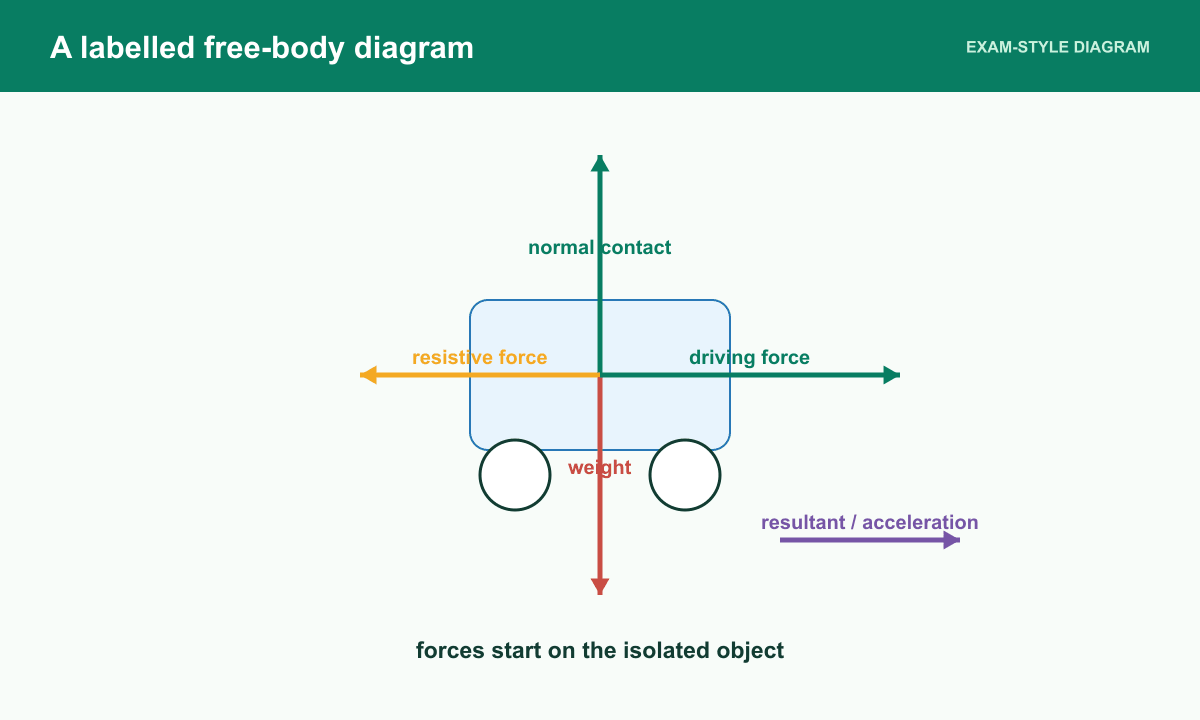
Isolate the chosen body, label weight vertically down and contact/tension/thrust/drag as appropriate. Arrow length represents magnitude. A book at rest on a horizontal table has equal upward contact force and downward weight. These two forces act on the book and balance, but are not a third-law pair: their reaction forces act on Earth and the table respectively.
03
Weight differs from mass
Scope: 8463 and 8464 · Foundation and Higher
Mass is measured in kg and remains the same when the gravitational field changes. Weight W = mg is a force in N. Zero resultant force implies zero acceleration: an object can be stationary or move with constant velocity. Balanced does not mean every force is zero.
04
Construct and resolve non-collinear vectors
Scope: 8463 and 8464 · Higher only
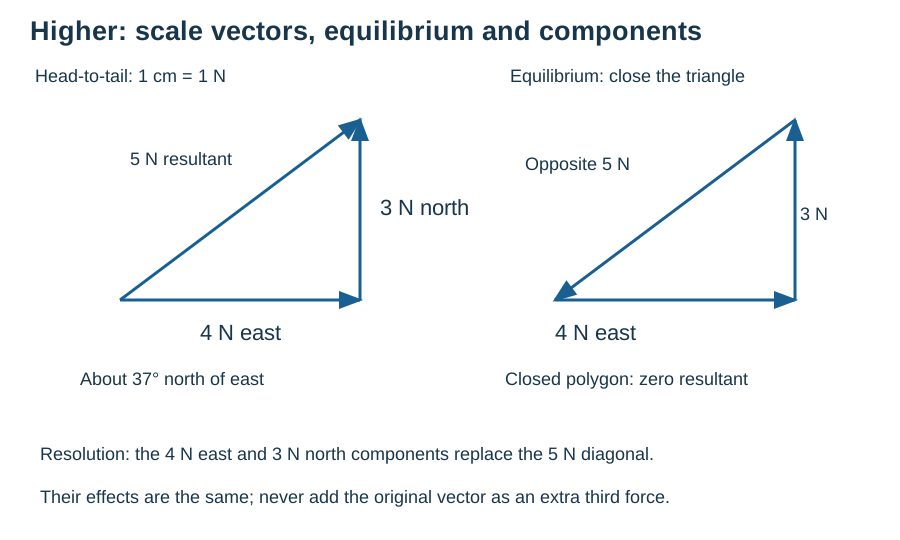
For a Higher scale construction, choose 1 cm = 1 N. Draw 4 N east as a 4 cm arrow, then from its head draw 3 N north as a 3 cm arrow. The resultant runs from the first tail to the last head: measuring gives 5 cm, hence 5 N, about 37° north of east. A parallelogram built from two arrows with a common tail gives the same diagonal. To represent equilibrium, add a 5 N arrow in the opposite direction to close the triangle: a closed head-to-tail polygon has zero resultant. Resolve the 5 N arrow by replacing it with perpendicular 4 N east and 3 N north components. Components represent the same effect as the original vector; do not add the original arrow as a third force. Use a ruler and protractor rather than requiring trigonometry.
Interaction forces are labelled on the isolated object; the separate resultant arrow shows the direction of acceleration.Open the full-size exam diagram
Both courses Higher: perpendicular components replace the diagonal vector; they are not additional forces.
WeightW = mgN, kg, N/kg
Misconception clinic
Replace the tempting answer
Read each belief, say what is wrong with it, then compare your correction.
Tempting idea: The book’s push on the table and the table’s push on the book.
Use instead: The book’s push acts on a different body. Both act on the chosen book and balance.
Tempting idea: 20 N right.
Use instead: Opposite forces subtract. 12 − 8 = 4 towards the larger force.
Retrieval practice
Quick checks
Worked examples
See the method being built
Apply scalars, vectors and interactions in the worked reasoning, then try the changed-context questions below.
Example 1 · Opposite collinear forces
Scope: 8463 and 8464 · Foundation and Higher
A vehicle has 900 N forward thrust and 300 N drag. Find the resultant.
The forces share a line and oppose.
Subtract 300 from 900 and keep the larger force direction.
Show the answer
600 N forwards.
Example 2 · A Higher scale construction
Scope: 8463 and 8464 · Higher only
Two forces act on one object: 4 N east and 3 N north. Draw the resultant at 1 cm = 1 N and an equilibrating force.
Draw 4 cm east then 3 cm north head-to-tail.
Join the first tail to the last head; measure 5 cm at about 37° north of east.
Reverse this resultant to close the force triangle.
Show the answer
Resultant 5 N at about 37° north of east; equilibrium requires 5 N in the opposite direction. Resolving this resultant gives the original 4 N and 3 N components.
Example 3 · Weight in a field
Scope: 8463 and 8464 · Foundation and Higher
Find the weight of a 2.0 kg mass when g = 9.8 N/kg.
W = mg.
W = 2.0 × 9.8.
Show the answer
19.6 N.
Exam precision
Use the physics precisely
Do this: For a vector construction, state the scale, measure resultant length and direction, and keep arrowheads consistent. Replace a vector with components without double-counting it.
Independent practice
Exam-style questions
Write an answer before opening the marking guidance. Then edit the exact phrase or step that would gain the next mark.
1. A vehicle travels straight at constant velocity. Describe its horizontal resultant and relate this to forces.
[2 marks]
Scope: 8463 and 8464 · Foundation and Higher
Show marking guidance and model answer
Original PhysicsUK mark scheme: Point 1 (1 mark): The horizontal resultant is zero. Point 2 (1 mark): Driving and total resistive forces are equal and opposite. Award each distinct point once. Accept equivalent scientifically correct wording. No half marks.
The horizontal resultant is zero. (1 mark)
Driving and total resistive forces are equal and opposite. (1 mark)
Model answer: At constant velocity, zero resultant means driving and resistive forces balance.
2. A 2.0 kg mass is in a gravitational field of 9.8 N/kg. Find its weight.
[3 marks]
Scope: 8463 and 8464 · Foundation and Higher
Show marking guidance and model answer
Original PhysicsUK mark scheme: Point 1 (1 mark): W = mg. Point 2 (1 mark): W = 2.0 × 9.8. Point 3 (1 mark): W = 19.6 N (20 N to two significant figures). Award each distinct point once. Accept equivalent scientifically correct wording. No half marks.
W = mg. (1 mark)
W = 2.0 × 9.8. (1 mark)
W = 19.6 N (20 N to two significant figures). (1 mark)
Model answer: W = mg. W = 2.0 × 9.8. W = 19.6 N (20 N to two significant figures).
Acceptable answers: Expected result: W = 19.6 N (20 N to two significant figures). Accept the unrounded value or a correctly rounded equivalent to two or more significant figures; accept equivalent units if converted correctly. No additional measurement interval is implied.
Marking notes: Method marks remain available after an arithmetic error. Carry an earlier numerical error into a later valid step; award that method point if the unit conversion and physics are correct. A fully correct answer with unit earns all marks unless working is expressly requested.
3. Higher: construct the resultant of 6 N east and 8 N north using 1 cm = 2 N. State magnitude and direction, draw a third force for equilibrium, and explain how the two perpendicular components replace the resultant.
[4 marks]
Scope: 8463 and 8464 · Higher only
Show marking guidance and model answer
Original PhysicsUK mark scheme: Point 1 (1 mark): Construct 3 cm east and 4 cm north head-to-tail (accept a correct scaled parallelogram). Point 2 (1 mark): Measure a 5 cm resultant: 10 N, about 53° north of east. Point 3 (1 mark): Draw an equal opposite 10 N vector closing the triangle, about 53° south of west. Point 4 (1 mark): The 6 N east and 8 N north components replace the resultant with the same effect; do not also add the original resultant as another force. Award each distinct point once. Accept equivalent scientifically correct wording. No half marks.
Construct 3 cm east and 4 cm north head-to-tail (accept a correct scaled parallelogram). (1 mark)
Measure a 5 cm resultant: 10 N, about 53° north of east. (1 mark)
Draw an equal opposite 10 N vector closing the triangle, about 53° south of west. (1 mark)
The 6 N east and 8 N north components replace the resultant with the same effect; do not also add the original resultant as another force. (1 mark)
Model answer: Draw 3 cm east and then 4 cm north. The arrow from the first tail to the final head is 5 cm long at about 53° north of east, representing 10 N. An equal opposite 10 N arrow closes the triangle for equilibrium. The perpendicular 6 N and 8 N components replace this vector with the same effect; they are not extra forces to add alongside it.
Acceptable answers: For the prescribed ruler/protractor construction accept 9.6–10.4 N and 50–56° north of east, or equivalent bearing. The equilibrium arrow must oppose the candidate’s correctly constructed resultant; allow a carried measurement error.
Marking notes: Award the construction point independently of small reading errors. Use the stated scale. Resolution is replacement, not double-counting the vector.
Questions pupils ask
Scalars, Vectors and Free-Body Diagrams FAQs
Can balanced forces act on a moving vehicle?
Yes. Zero resultant means zero acceleration, so straight motion at constant velocity can continue.