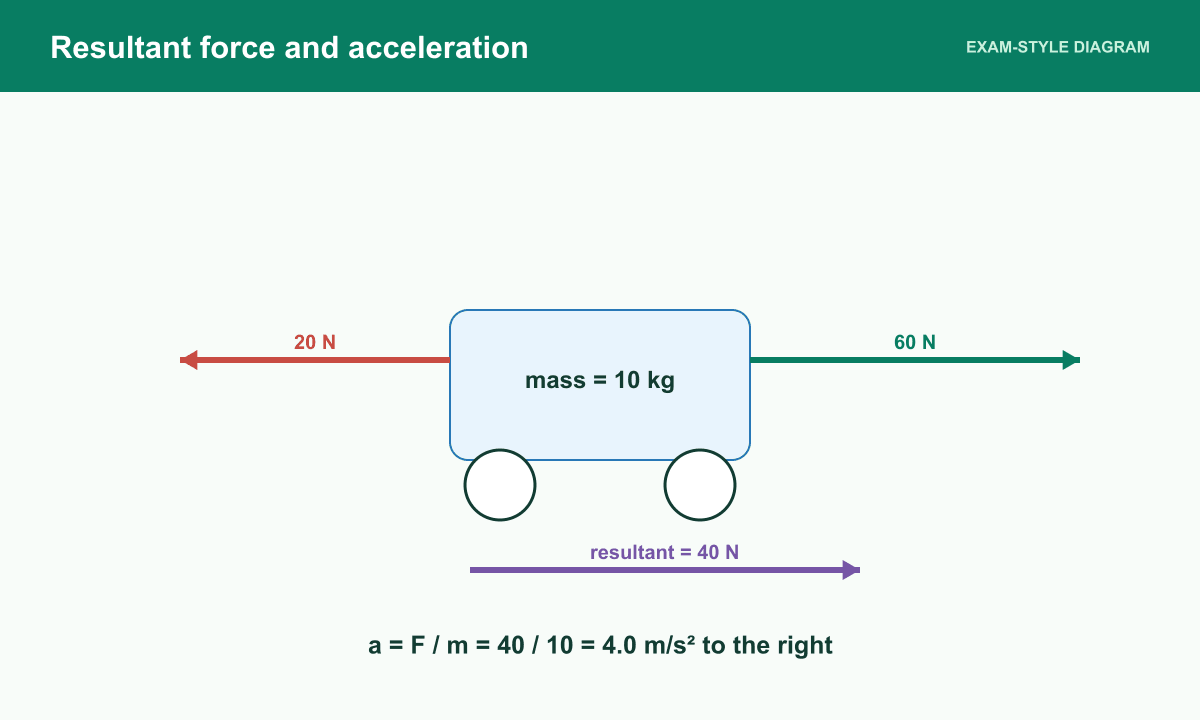
A resultant force causes acceleration, rather than being required to maintain velocity. Use the sum of forces in F = ma.
By the end, you should be able to:
Relate resultant force to acceleration.
Identify Newton’s third-law forces on different bodies.
Explain terminal velocity using changing drag.
Before you revise
Diagnostic question
Choose an answer from memory. Your result tells you what to watch for in the guide.
Core revision guide
Learn the model, then use it
A resultant force causes acceleration, rather than being required to maintain velocity. Use the sum of forces in F = ma.
01
First and second laws
Scope: 8463 and 8464 · Foundation and Higher
With zero resultant force an object remains at rest or continues at constant velocity. For fixed mass, acceleration is proportional to resultant force and inversely proportional to mass: Fresultant = ma. A 600 N driving force opposed by 200 N drag gives 400 N resultant, not 600 N. Acceleration points with the resultant, which may oppose velocity and slow the object.
02
Third law: identify two bodies
Scope: 8463 and 8464 · Foundation and Higher
If a swimmer pushes water backwards, water pushes the swimmer forwards with an equal force of the same type. The pair acts on different objects, so it does not cancel in the swimmer’s force equation. Weight and support acting on one resting book balance but are not a third-law pair.
A falling object initially has weight greater than drag and accelerates down. Increasing speed increases drag, reducing resultant force and acceleration. When drag equals weight, resultant and acceleration are zero; the object continues falling at terminal velocity. It does not stop. At Higher, inertial mass is the ratio resultant force/acceleration.
Read each belief, say what is wrong with it, then compare your correction.
Tempting idea: It must already move left.
Use instead: Force determines acceleration, not existing velocity. Acceleration opposite velocity decreases speed.
Tempting idea: Book weight and table support, both on book.
Use instead: Those balance on the same object. The same gravitational interaction acts on two objects.
Retrieval practice
Quick checks
Explore the relationship
Newton law model
Change the resultant force or mass, then calculate acceleration using F = ma.
Model scope: 8463 and 8464 · Foundation and Higher
What to notice: use the readout to describe how one variable changes when the other is controlled.
Worked examples
See the method being built
Apply first and second laws in the worked reasoning, then try the changed-context questions below.
Example 1 · Find acceleration
Scope: 8463 and 8464 · Foundation and Higher
A 3.0 kg trolley has resultant force 12 N right. Calculate acceleration.
Use F = ma.
Rearrange a = F/m.
State direction.
Show the answer
a = 12 ÷ 3.0 = 4.0 m/s² to the right.
Example 2 · Find resultant
Scope: 8463 and 8464 · Foundation and Higher
A car has 800 N driving force and 300 N resistance. Find resultant force.
Forces are opposite.
Subtract 300 from 800.
State direction of larger force.
Show the answer
Resultant = 500 N forwards.
Example 3 · Newton’s third law
Scope: 8463 and 8464 · Foundation and Higher
A swimmer pushes water backwards. State the paired force.
Name the second object.
Reverse direction.
Keep equal magnitude.
Show the answer
The water pushes the swimmer forwards with an equal and opposite force.
Exam precision
Use the physics precisely
Do this: Choose the object and draw its forces. Distinguish balanced forces on that object from the equal opposite forces acting on another body.
Independent practice
Exam-style questions
Write an answer before opening the marking guidance. Then edit the exact phrase or step that would gain the next mark.
1. A 1000 kg car has 1800 N driving force and 600 N resistance. Calculate its acceleration.
[3 marks]
Scope: 8463 and 8464 · Foundation and Higher
Show marking guidance and model answer
Original PhysicsUK mark scheme: Point 1 (1 mark): Resultant = 1800 − 600 = 1200 N forwards. Point 2 (1 mark): a = Fresultant/m = 1200/1000. Point 3 (1 mark): a = 1.2 m/s² forwards. Award each distinct point once. Accept equivalent scientifically correct wording. No half marks.
Model answer: The resultant is 1200 N forwards, giving a = 1.2 m/s² forwards.
Marking notes: Carry an arithmetic error in the resultant into correct division by mass for the later method point; direction must follow the stated resultant.
2. Explain how a falling object reaches terminal velocity.
[3 marks]
Scope: 8463 and 8464 · Foundation and Higher
Show marking guidance and model answer
Original PhysicsUK mark scheme: Point 1 (1 mark): As speed rises, drag rises. Point 2 (1 mark): Resultant weight minus drag and acceleration decrease. Point 3 (1 mark): When drag equals weight, resultant/acceleration is zero and velocity stays constant. Award each distinct point once. Accept equivalent scientifically correct wording. No half marks.
As speed rises, drag rises. (1 mark)
Resultant weight minus drag and acceleration decrease. (1 mark)
When drag equals weight, resultant/acceleration is zero and velocity stays constant. (1 mark)
Model answer: Rising speed increases drag. The resultant and acceleration fall until drag equals weight, when velocity becomes constant.
Questions pupils ask
Newton’s Laws, Resultant Force and Acceleration FAQs
Why do a third-law pair and balanced forces need different descriptions?
Third-law partners act on different bodies. Balanced forces act on the same chosen body and have zero resultant.