Extension is the change in length. A force–extension graph tells you whether proportionality holds, while unloading tells you whether deformation is reversible.
Extension is the change in length. A force–extension graph tells you whether proportionality holds, while unloading tells you whether deformation is reversible.
By the end, you should be able to:
Calculate extension and spring constant.
Distinguish proportional and elastic limits.
Calculate elastic energy within the stated model.
Before you revise
Diagnostic question
Choose an answer from memory. Your result tells you what to watch for in the guide.
Core revision guide
Learn the model, then use it
Extension is the change in length. A force–extension graph tells you whether proportionality holds, while unloading tells you whether deformation is reversible.
01
Calculate extension and spring constant
Scope: 8463 and 8464 · Foundation and Higher
Measure e = loaded length − unloaded length. Within the proportional region F = ke, so the gradient of F (y) against e (x) is k in N/m. Convert centimetres to metres before computing k. A larger k means more force for the same extension, describing a stiffer spring.
02
Two limits answer different questions
Scope: 8463 and 8464 · Foundation and Higher
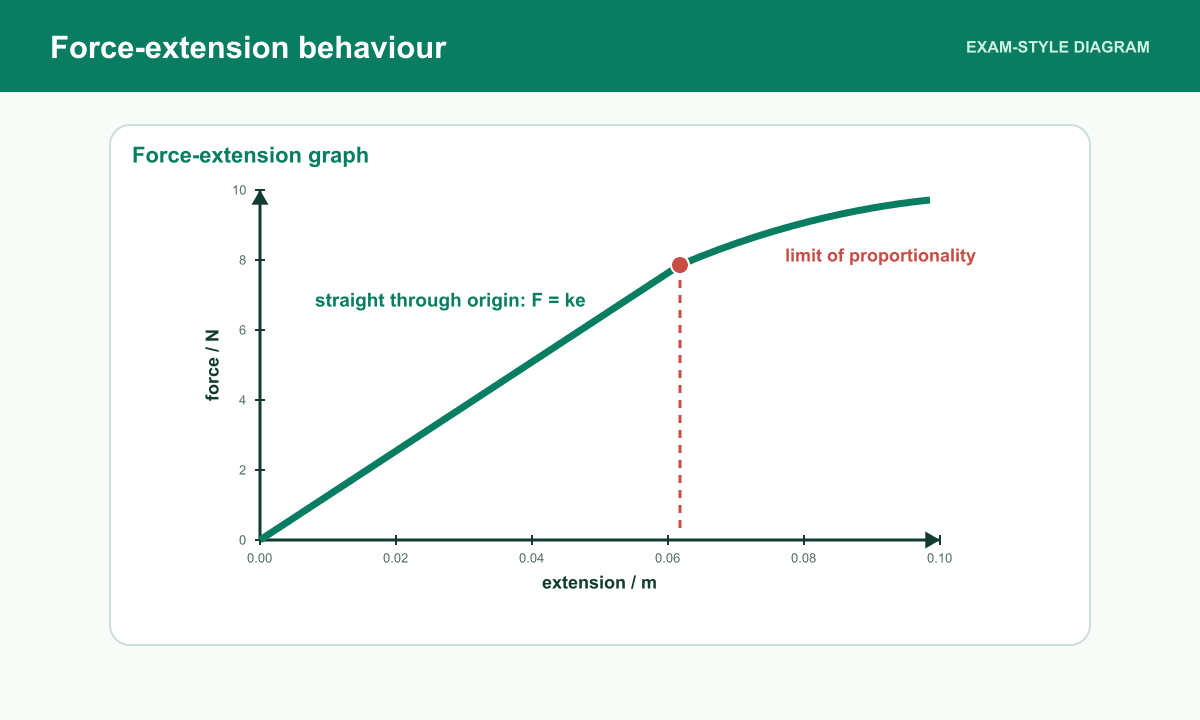
The limit of proportionality is where F is no longer proportional to e and the line begins to curve. Elastic deformation is reversed when the force is removed; inelastic deformation leaves a permanent change. A curved graph alone does not establish that the spring is permanently deformed: check the unloaded length.
03
Work done and stored energy
Scope: 8463 and 8464 · Foundation and Higher
Two opposing forces are needed to stretch a stationary object. Work done in stretching raises its elastic potential store. In the proportional region, Ee = ½ke² = ½Fe, equal to area under F–e. Force rises from zero to F, so using Fe would double the work for this linear case.
Use the straight section for Hooke's law; beyond the labelled limit, extension is no longer proportional to force.Open the full-size exam diagram
Read each belief, say what is wrong with it, then compare your correction.
Tempting idea: 13 m.
Use instead: Neither subtraction nor unit conversion is correct. (13 − 8) cm = 0.05 m.
Tempting idea: The spring must be permanently stretched.
Use instead: Permanent deformation requires an unloading check. The relationship is no longer proportional.
Retrieval practice
Quick checks
Explore the relationship
Force-extension explorer
Change the force or extension, then calculate spring constant in the proportional region using F = ke.
Model scope: 8463 and 8464 · Foundation and Higher
What to notice: use the readout to describe how one variable changes when the other is controlled.
Worked examples
See the method being built
Apply calculate extension and spring constant in the worked reasoning, then try the changed-context questions below.
Example 1 · Calculate extension
Scope: 8463 and 8464 · Foundation and Higher
A spring is 8.0 cm unloaded and 13.5 cm loaded. Find extension.
Use loaded minus unloaded length.
Calculate 13.5 − 8.0.
Keep cm or convert consistently.
Show the answer
Extension = 5.5 cm.
Example 2 · Use Hooke’s law
Scope: 8463 and 8464 · Foundation and Higher
A spring constant is 40 N/m and extension 0.15 m in the proportional region. Find force.
Use F = ke.
Substitute 40 × 0.15.
Give newtons.
Show the answer
F = 6.0 N.
Example 3 · Read graph region
Scope: 8463 and 8464 · Foundation and Higher
A force-extension graph begins to curve after 7 N. State the limit of proportionality.
Find the first departure from straight line.
Quote force.
Do not confuse with elastic limit.
Show the answer
The limit of proportionality is about 7 N.
Exam precision
Use the physics precisely
Do this: Use extension rather than total length. Check the proportional region before applying a constant k or the triangular work-area model.
Independent practice
Exam-style questions
Write an answer before opening the marking guidance. Then edit the exact phrase or step that would gain the next mark.
1. A spring extends by 4.0 cm under 8.0 N in its proportional region. Calculate k.
[3 marks]
Scope: 8463 and 8464 · Foundation and Higher
Show marking guidance and model answer
Original PhysicsUK mark scheme: Point 1 (1 mark): k = F/e. Point 2 (1 mark): e = 0.040 m; k = 8.0/0.040. Point 3 (1 mark): k = 200 N/m. Award each distinct point once. Accept equivalent scientifically correct wording. No half marks.
k = F/e. (1 mark)
e = 0.040 m; k = 8.0/0.040. (1 mark)
k = 200 N/m. (1 mark)
Model answer: k = F/e. e = 0.040 m; k = 8.0/0.040. k = 200 N/m.
Acceptable answers: Expected result: k = 200 N/m. Accept the unrounded value or a correctly rounded equivalent to two or more significant figures; accept equivalent units if converted correctly. No additional measurement interval is implied.
Marking notes: Method marks remain available after an arithmetic error. Carry an earlier numerical error into a later valid step; award that method point if the unit conversion and physics are correct. A fully correct answer with unit earns all marks unless working is expressly requested.
2. A 200 N/m spring extends 0.040 m within its proportional region. Find its elastic potential energy.
[3 marks]
Scope: 8463 and 8464 · Foundation and Higher
Show marking guidance and model answer
Original PhysicsUK mark scheme: Point 1 (1 mark): Ee = ½ke². Point 2 (1 mark): Ee = 0.5 × 200 × 0.040². Point 3 (1 mark): Ee = 0.16 J. Award each distinct point once. Accept equivalent scientifically correct wording. No half marks.
Ee = ½ke². (1 mark)
Ee = 0.5 × 200 × 0.040². (1 mark)
Ee = 0.16 J. (1 mark)
Model answer: Ee = ½ke². Ee = 0.5 × 200 × 0.040². Ee = 0.16 J.
Acceptable answers: Expected result: Ee = 0.16 J. Accept the unrounded value or a correctly rounded equivalent to two or more significant figures; accept equivalent units if converted correctly. No additional measurement interval is implied.
Marking notes: Method marks remain available after an arithmetic error. Carry an earlier numerical error into a later valid step; award that method point if the unit conversion and physics are correct. A fully correct answer with unit earns all marks unless working is expressly requested.
Questions pupils ask
Forces, Elasticity and Springs FAQs
Does a curved force–extension graph prove permanent deformation?
No. Curvature shows loss of proportionality; unloading is needed to test whether the spring returns to its original length.