Turning effects depend on the perpendicular distance from a pivot. This focused guide develops moments, balanced levers and gears; the linked fluid guide teaches pressure and upthrust separately.
AQA 8463GCSE PhysicsFoundationHigher
Subsection scope: Moments, levers and gears: 8463 Physics only, both tiers. Pressure and upthrust are in the linked focused fluid guide.
Learn · practise · improve
Start here
The revision snapshot
Turning effects depend on the perpendicular distance from a pivot. This focused guide develops moments, balanced levers and gears; the linked fluid guide teaches pressure and upthrust separately.
By the end, you should be able to:
Calculate moments using perpendicular distances.
Balance clockwise and anticlockwise moments.
Explain the direction and turning effect of meshing gears.
Before you revise
Diagnostic question
Choose an answer from memory. Your result tells you what to watch for in the guide.
Core revision guide
Learn the model, then use it
Turning effects depend on the perpendicular distance from a pivot. This focused guide develops moments, balanced levers and gears; the linked fluid guide teaches pressure and upthrust separately.
01
Moments and equilibrium
Scope: 8463 Physics only · Foundation and Higher
Moment = force × perpendicular distance from pivot to the force’s line of action. A 30 N perpendicular force at 0.40 m gives 12 N m. For rotational balance, sum of clockwise moments equals sum of anticlockwise moments. A force through the pivot has zero moment. A lever increases perpendicular distance and can produce the required moment with less force.
02
Gears transfer turning effects
Scope: 8463 Physics only · Foundation and Higher
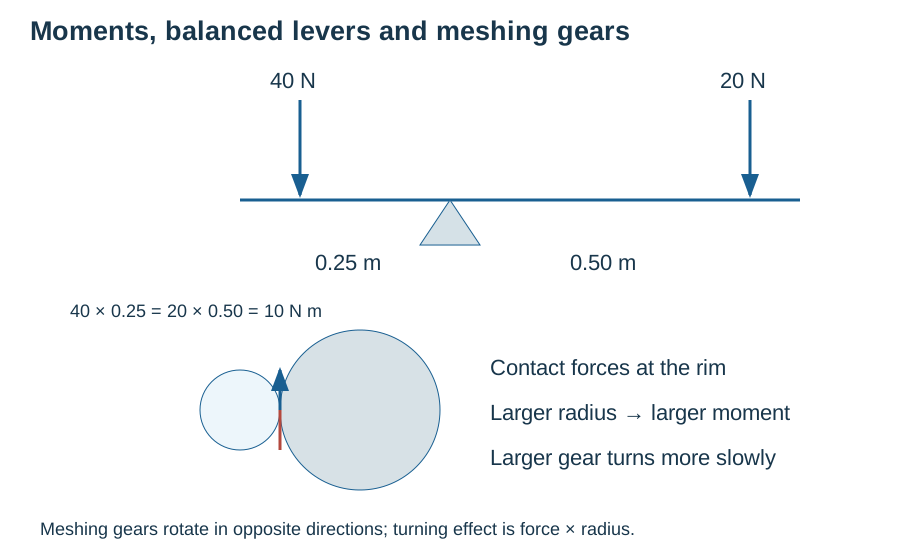
Meshing gears transmit a turning effect and adjacent gears rotate in opposite directions. The contact force on teeth gives a larger moment on the gear with larger radius. The larger gear turns more slowly. Gears exchange speed and turning effect; they do not create energy.
03
Choose the moment model before balancing
Scope: 8463 Physics only · Foundation and Higher
Draw the pivot and the line of each force. Measure the perpendicular distance to that line, rather than a sloping handle length. For a balanced lever, 40 N at 0.25 m and 20 N at 0.50 m each give 10 N m in opposite rotational directions. Rotational balance alone is not proof of zero resultant force; supports can provide the remaining force balance. Use the linked fluid guide for pressure and floating.
Read each belief, say what is wrong with it, then compare your correction.
Tempting idea: 20 N m.
Use instead: Perpendicular distance is zero. Moment = F × 0.
Tempting idea: It turns in the same direction at twice the speed.
Use instead: Adjacent meshing gears reverse rotation and the larger one turns more slowly.
Retrieval practice
Quick checks
Worked examples
See the method being built
Apply moments and equilibrium in the worked reasoning, then try the changed-context questions below.
Example 1 · Perpendicular lever force
Scope: 8463 Physics only · Foundation and Higher
A perpendicular 30 N force acts at 0.40 m from a pivot. Calculate its moment.
Identify the perpendicular distance.
Use moment = force × distance.
30 × 0.40 = 12.
Show the answer
12 N m.
Example 2 · Balance opposite moments
Scope: 8463 Physics only · Foundation and Higher
A 20 N force acts at 0.50 m. Find the opposite force at 0.25 m for balance.
Clockwise moment = 20 × 0.50 = 10 N m.
Anticlockwise moment must also be 10 N m.
F = 10/0.25.
Show the answer
40 N.
Example 3 · Larger driven gear
Scope: 8463 Physics only · Foundation and Higher
Explain the turning and speed effects when a small gear drives a larger meshing gear.
Adjacent gears turn in opposite directions.
The same contact force acts at a larger driven radius.
For the same tooth speed the larger gear rotates more slowly.
Show the answer
The larger gear turns oppositely and more slowly, with a larger turning effect from the contact force.
Exam precision
Use the physics precisely
Do this: Mark the pivot and each force line. Use perpendicular lever arms; for gears, connect contact force and radius to turning effect.
Independent practice
Exam-style questions
Write an answer before opening the marking guidance. Then edit the exact phrase or step that would gain the next mark.
1. A 15 N force acts perpendicular to a lever at 0.20 m from its pivot. Find its moment.
[3 marks]
Scope: 8463 Physics only · Foundation and Higher
Show marking guidance and model answer
Original PhysicsUK mark scheme: Point 1 (1 mark): Moment = Fdperpendicular. Point 2 (1 mark): Moment = 15 × 0.20. Point 3 (1 mark): Moment = 3.0 N m. Award each distinct point once. Accept equivalent scientifically correct wording. No half marks.
Moment = Fdperpendicular. (1 mark)
Moment = 15 × 0.20. (1 mark)
Moment = 3.0 N m. (1 mark)
Model answer: Moment = Fdperpendicular. Moment = 15 × 0.20. Moment = 3.0 N m.
Acceptable answers: Expected result: Moment = 3.0 N m. Accept the unrounded value or a correctly rounded equivalent to two or more significant figures; accept equivalent units if converted correctly. No additional measurement interval is implied.
Marking notes: Method marks remain available after an arithmetic error. Carry an earlier numerical error into a later valid step; award that method point if the unit conversion and physics are correct. A fully correct answer with unit earns all marks unless working is expressly requested.
2. Explain how a larger driven gear can produce a greater turning effect while rotating more slowly.
[3 marks]
Scope: 8463 Physics only · Foundation and Higher
Show marking guidance and model answer
Original PhysicsUK mark scheme: Point 1 (1 mark): Meshing teeth transmit a contact force at the rim. Point 2 (1 mark): The larger radius gives a greater moment for that contact force. Point 3 (1 mark): The larger gear turns more slowly and in the opposite direction to its neighbouring gear. Award each distinct point once. Accept equivalent scientifically correct wording. No half marks.
Meshing teeth transmit a contact force at the rim. (1 mark)
The larger radius gives a greater moment for that contact force. (1 mark)
The larger gear turns more slowly and in the opposite direction to its neighbouring gear. (1 mark)
Model answer: The contact force acts at a larger radius, increasing its moment. The larger gear rotates more slowly in the opposite direction; energy is not created.
Questions pupils ask
Moments, Levers and Gears FAQs
Why use perpendicular distance in a moment?
Only the perpendicular separation from the pivot to the force line produces the turning effect. A force through the pivot has zero moment.