Subsection scope: Momentum and qualitative conservation: both courses Higher. Collision calculations and force from momentum change: Physics Higher only.
Learn · practise · improve
Start here
The revision snapshot
Use a direction convention for momentum. Conservation concerns a system, while a stopping-time calculation gives an average interaction force.
By the end, you should be able to:
Higher: calculate momentum and explain conservation.
Physics Higher: solve a sticking collision.
Physics Higher: connect stopping time to average force.
Before you revise
Diagnostic question
Choose an answer from memory. Your result tells you what to watch for in the guide.
Core revision guide
Learn the model, then use it
Use a direction convention for momentum. Conservation concerns a system, while a stopping-time calculation gives an average interaction force.
01
Momentum and conservation
Scope: 8463 and 8464 · Higher only
Momentum p = mv is a vector in kg m/s. For a closed system with negligible external resultant, total momentum before equals total momentum after. Opposite velocities have opposite signs. Momentum may be conserved in a collision even when kinetic energy becomes thermal or deformation energy.
02
A sticking collision
Scope: 8463 Physics only · Higher only
For a 2 kg trolley at 3 m/s joining a stationary 1 kg trolley, initial momentum is 6 kg m/s. Final moving mass is 3 kg, so v = 6/3 = 2 m/s in the original direction. Include both bodies when identifying the closed system.
03
Average force in safety contexts
Scope: 8463 Physics only · Higher only
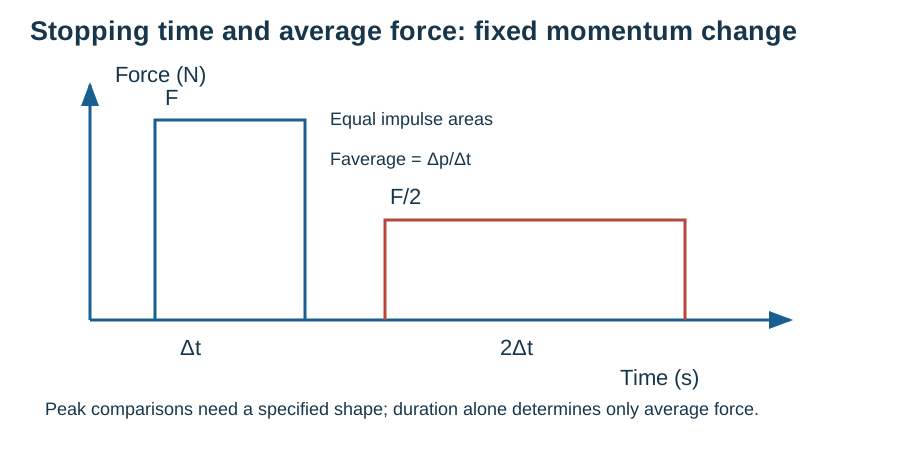
For a fixed change in momentum, Faverage = Δp/Δt. Airbags and crumple zones extend stopping time and lower the average force on the occupant. This equation does not guarantee a lower peak for every force–time shape; peak comparisons require comparable profiles. State the same initial/final velocity and mass when comparing safety designs.
A specified constant-force model illustrates average force. General peak claims need a force-time profile.Open the full-size exam diagram
Both courses Higher: momentump = mvkg m/s, kg, m/sPhysics Higher: average interaction forceFaverage = Δp/ΔtN, kg m/s, s
Misconception clinic
Replace the tempting answer
Read each belief, say what is wrong with it, then compare your correction.
Tempting idea: +4 kg m/s.
Use instead: Direction makes velocity negative. 0.50 × (−8) = −4.
Tempting idea: Every possible peak force must halve.
Use instead: Peak needs the force–time profile. Average force is Δp/Δt.
Retrieval practice
Quick checks
Explore the relationship
Momentum and safety model
Change momentum or collision time, then calculate average force using F = Δp ÷ Δt.
Model scope: 8463 Physics only · Higher only
What to notice: use the readout to describe how one variable changes when the other is controlled.
Worked examples
See the method being built
Apply momentum and conservation in the worked reasoning, then try the changed-context questions below.
Example 1 · Calculate momentum
Scope: 8463 and 8464 · Higher only
A 1200 kg car travels at 15 m/s. Find momentum.
Use p = mv.
Multiply 1200 × 15.
Give kg m/s.
Show the answer
p = 18 000 kg m/s.
Example 2 · Collision conservation
Scope: 8463 Physics only · Higher only
A 2.0 kg trolley at 3.0 m/s hits a stationary 1.0 kg trolley and sticks. Find final velocity.
Initial p = 2.0 × 3.0 = 6.0.
Combined mass = 3.0 kg.
v = 6.0 ÷ 3.0.
Show the answer
Final velocity = 2.0 m/s in the original direction.
Example 3 · Safety explanation
Scope: 8463 Physics only · Higher only
Explain how an airbag reduces injury.
Identify same momentum change.
State collision time increases.
Link to average force.
Show the answer
The airbag increases stopping time, so the same change in momentum happens with a smaller average force.
Exam precision
Use the physics precisely
Do this: Define the system and positive direction before balancing momentum. In safety explanations keep momentum change fixed when comparing average stopping forces.
Independent practice
Exam-style questions
Write an answer before opening the marking guidance. Then edit the exact phrase or step that would gain the next mark.
1. Higher: a 0.40 kg ball travels at 6.0 m/s to the right. Find its momentum.
[3 marks]
Scope: 8463 and 8464 · Higher only
Show marking guidance and model answer
Original PhysicsUK mark scheme: Point 1 (1 mark): p = mv. Point 2 (1 mark): p = 0.40 × 6.0. Point 3 (1 mark): p = 2.4 kg m/s to the right. Award each distinct point once. Accept equivalent scientifically correct wording. No half marks.
p = mv. (1 mark)
p = 0.40 × 6.0. (1 mark)
p = 2.4 kg m/s to the right. (1 mark)
Model answer: p = mv. p = 0.40 × 6.0. p = 2.4 kg m/s to the right.
Acceptable answers: Expected result: p = 2.4 kg m/s to the right. Accept the unrounded value or a correctly rounded equivalent to two or more significant figures; accept equivalent units if converted correctly. No additional measurement interval is implied.
Marking notes: Method marks remain available after an arithmetic error. Carry an earlier numerical error into a later valid step; award that method point if the unit conversion and physics are correct. A fully correct answer with unit earns all marks unless working is expressly requested.
2. Physics Higher: a person’s momentum decreases by 600 kg m/s in 0.30 s. Find the magnitude of average stopping force.
[3 marks]
Scope: 8463 Physics only · Higher only
Show marking guidance and model answer
Original PhysicsUK mark scheme: Point 1 (1 mark): |Faverage| = |Δp|/Δt. Point 2 (1 mark): |Faverage| = 600/0.30. Point 3 (1 mark): |Faverage| = 2000 N. Award each distinct point once. Accept equivalent scientifically correct wording. No half marks.
|Faverage| = |Δp|/Δt. (1 mark)
|Faverage| = 600/0.30. (1 mark)
|Faverage| = 2000 N. (1 mark)
Model answer: |Faverage| = |Δp|/Δt. |Faverage| = 600/0.30. |Faverage| = 2000 N.
Acceptable answers: Expected result: |Faverage| = 2000 N. Accept the unrounded value or a correctly rounded equivalent to two or more significant figures; accept equivalent units if converted correctly. No additional measurement interval is implied.
Marking notes: Method marks remain available after an arithmetic error. Carry an earlier numerical error into a later valid step; award that method point if the unit conversion and physics are correct. A fully correct answer with unit earns all marks unless working is expressly requested.
Questions pupils ask
Momentum, Conservation and Safety FAQs
Does a longer stop guarantee a smaller peak force?
It reduces average force for the same momentum change. A peak comparison also requires information about the force-time profile.