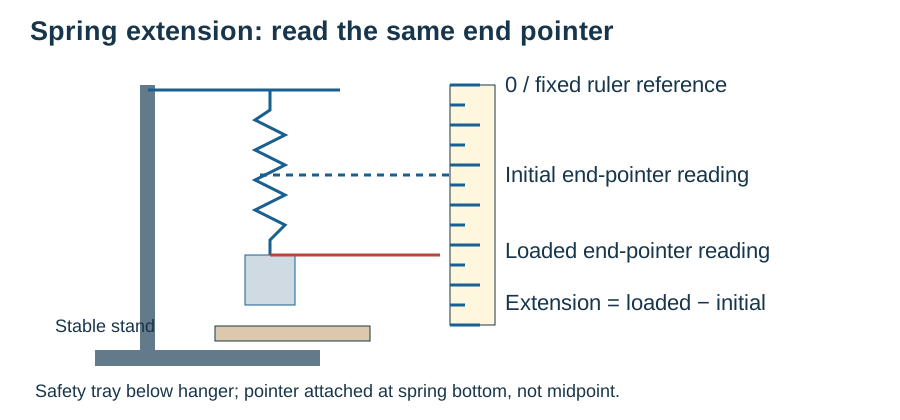
Read the bottom of the spring or hanger against a fixed ruler. Subtract its unloaded position from each loaded position to obtain extension.
By the end, you should be able to:
Measure spring extension from a fixed reference.
Plot force against extension and determine k.
Explain repeat measurements and overload control.
Before you revise
Diagnostic question
Choose an answer from memory. Your result tells you what to watch for in the guide.
Core revision guide
Learn the model, then use it
Read the bottom of the spring or hanger against a fixed ruler. Subtract its unloaded position from each loaded position to obtain extension.
01
Apparatus and reference position
Scope: 8463 and 8464 · Foundation and Higher
Clamp the spring to a stable stand, secure the stand and place a safety tray below the mass hanger. Fix a vertical ruler beside the spring. Attach a thin horizontal pointer to the bottom/hanger, not to a moving midpoint of the spring. Record the initial pointer reading with the stated unloaded condition; if a hanger is already present, treat that as the reference and state how added forces are defined.
02
Measurements and graph
Scope: 8463 and 8464 · Foundation and Higher
Add known masses in small increments. Calculate added force with F = mg using the supplied g. Wait until oscillations stop and read the pointer at eye level without touching it. Subtract the reference position, repeat each reading and plot added F (y) against e (x) in metres. Use the straight region’s gradient for k; departure from the linear trend identifies the limit of proportionality.
03
Quality and safety
Scope: 8463 and 8464 · Foundation and Higher
Keep the same spring, ruler and reference point. A pointer reduces ambiguity and eye-level reading reduces parallax. Remove masses gradually to check recovery of the reference length; do not overload the spring. Wear appropriate eye protection, keep feet clear of the tray and clamp the stand securely.
Read each belief, say what is wrong with it, then compare your correction.
Tempting idea: 168 mm.
Use instead: Total loaded position is not the change. 168 − 120 = 48 mm.
Tempting idea: At an arbitrary middle spring coil.
Use instead: A midpoint does not measure the complete spring’s end position. Its displacement gives the extension from a fixed reference.
Retrieval practice
Quick checks
Worked examples
See the method being built
Apply apparatus and reference position in the worked reasoning, then try the changed-context questions below.
Example 1 · Process readings
Scope: 8463 and 8464 · Foundation and Higher
Unloaded length is 120 mm; loaded length is 168 mm. Find extension.
Subtract unloaded length.
168 − 120.
State mm.
Show the answer
Extension = 48 mm.
Example 2 · Find force
Scope: 8463 and 8464 · Foundation and Higher
A 0.30 kg mass is added. Take g = 9.8 N/kg. Find force.
Use F = mg.
0.30 × 9.8.
Give N.
Show the answer
Force = 2.94 N.
Example 3 · Graph conclusion
Scope: 8463 and 8464 · Foundation and Higher
A graph is straight to 4 N then curves. State conclusion.
Identify straight region.
Identify first curve.
Name limit.
Show the answer
Extension is proportional to force up to about 4 N, the limit of proportionality.
Exam precision
Use the physics precisely
Do this: State the initial reference, successive loads and pointer readings. Describe how the linear gradient is found and how the safety tray controls falling masses.
Independent practice
Exam-style questions
Write an answer before opening the marking guidance. Then edit the exact phrase or step that would gain the next mark.
1. Describe how to find a spring constant from load and ruler readings.
[4 marks]
Scope: 8463 and 8464 · Foundation and Higher
Show marking guidance and model answer
Original PhysicsUK mark scheme: Point 1 (1 mark): Record an initial spring-end pointer position beside a fixed ruler. Point 2 (1 mark): Add known forces incrementally and record steady eye-level positions. Point 3 (1 mark): Subtract the initial position to obtain extension in metres. Point 4 (1 mark): Plot F against e; use gradient in the proportional region as k. Award each distinct point once. Accept equivalent scientifically correct wording. No half marks.
Record an initial spring-end pointer position beside a fixed ruler. (1 mark)
Add known forces incrementally and record steady eye-level positions. (1 mark)
Subtract the initial position to obtain extension in metres. (1 mark)
Plot F against e; use gradient in the proportional region as k. (1 mark)
Model answer: Read a pointer at the spring end before loading and at each known load. Subtract to obtain extension in metres and find the F–e line gradient in its proportional region.
2. A 0.20 kg added mass moves the pointer by 25 mm. With g = 10 N/kg, calculate k.
[3 marks]
Scope: 8463 and 8464 · Foundation and Higher
Show marking guidance and model answer
Original PhysicsUK mark scheme: Point 1 (1 mark): F = mg = 0.20 × 10 = 2.0 N. Point 2 (1 mark): e = 25 mm = 0.025 m; k = F/e. Point 3 (1 mark): k = 80 N/m. Award each distinct point once. Accept equivalent scientifically correct wording. No half marks.
F = mg = 0.20 × 10 = 2.0 N. (1 mark)
e = 25 mm = 0.025 m; k = F/e. (1 mark)
k = 80 N/m. (1 mark)
Model answer: F = 2.0 N and e = 0.025 m, so k = 80 N/m.
Marking notes: Carry an earlier force arithmetic error into a valid k = F/e calculation for the final method point; require conversion of extension to metres.
Questions pupils ask
Force and Extension Required Practical FAQs
Why measure extension rather than total loaded length?
Hooke’s law uses the change from the original length. The fixed ruler and moving end pointer allow that difference to be measured consistently.