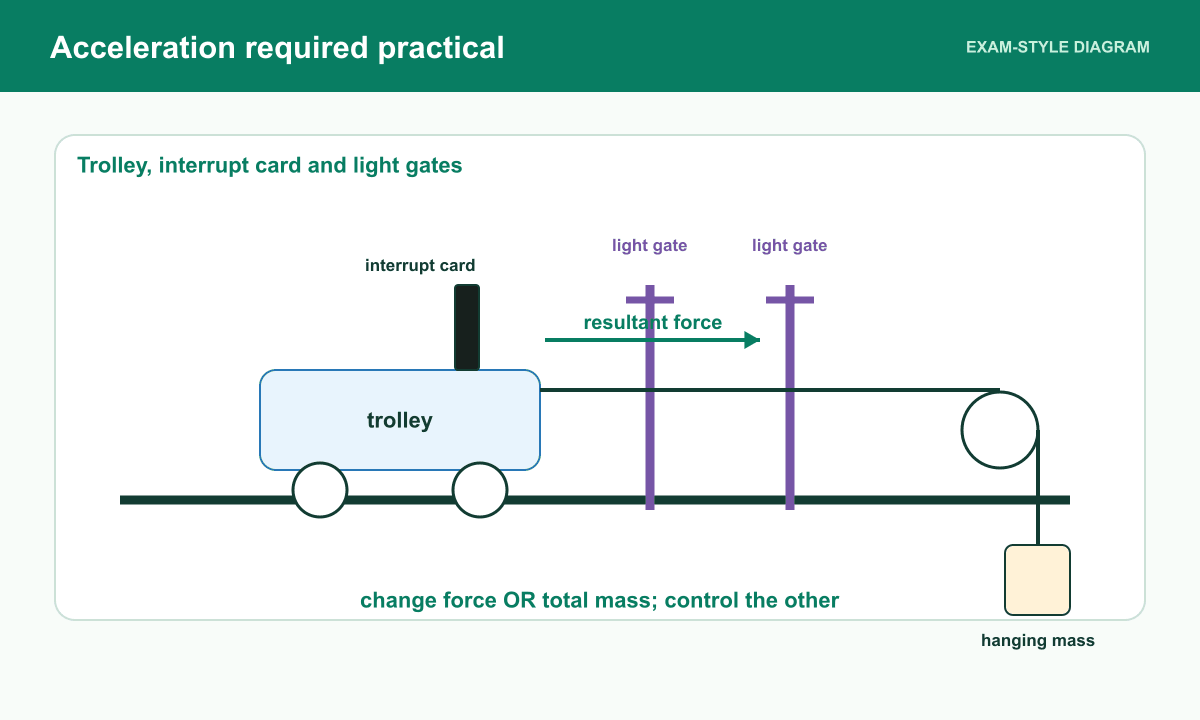
The accelerating system includes the trolley and hanging masses. Adding mass to the hanger alone changes both force and total mass, spoiling a force-only test.
The accelerating system includes the trolley and hanging masses. Adding mass to the hanger alone changes both force and total mass, spoiling a force-only test.
By the end, you should be able to:
Plan force and mass acceleration investigations.
Measure acceleration with gates or timed motion data.
Explain fixed total moving mass and friction controls.
Before you revise
Diagnostic question
Choose an answer from memory. Your result tells you what to watch for in the guide.
Core revision guide
Learn the model, then use it
The accelerating system includes the trolley and hanging masses. Adding mass to the hanger alone changes both force and total mass, spoiling a force-only test.
01
Whole-system force model
Scope: 8463 and 8464 · Foundation and Higher
Connect a trolley to a hanging mass over a low-friction pulley with a light string. For a nearly horizontal track, the hanging weight drives the combined moving mass; friction opposes motion. Approximately Fresultant = mhanger g − friction and Mtotal = mtrolley + mhanger + carried masses. String tension is internal to this combined system and is not generally equal to the hanging weight.
02
Two fair investigations
Scope: 8463 and 8464 · Foundation and Higher
For varying force at fixed total mass, transfer small masses from the trolley to the hanger. The system mass stays fixed while hanging weight changes. For varying total mass at fixed driving force, keep hanger mass fixed and add masses to the trolley. Use the same track, pulley, starting point and friction conditions. Release without a push and catch the trolley before the track end; use a tray below the hanger.
03
Measure acceleration and analyse
Scope: 8463 and 8464 · Foundation and Higher
Use a motion sensor or two light gates with an interrupt card of known length. Each gate measures speed from card length/blocking time; obtain the elapsed time between the corresponding speed measurements, then a = (v − u)/Δt. Repeat each run. Plot a against driving force at fixed M, or a against 1/M at fixed force. A non-zero force intercept can indicate friction. A slight slope may compensate friction only if checked and retained consistently.
State whether force or total mass is changed, measure acceleration electronically and control the other variable.Open the full-size exam diagram
Read each belief, say what is wrong with it, then compare your correction.
Tempting idea: Add extra masses to the hanger from outside the system.
Use instead: This also increases total mass. The same masses still move, but a larger share hangs.
Tempting idea: Total trolley-plus-hanger mass.
Use instead: Total mass is the independent variable. A fixed hanger gives the same driving weight.
Retrieval practice
Quick checks
Worked examples
See the method being built
Apply whole-system force model in the worked reasoning, then try the changed-context questions below.
Example 1 · Fixed-total-mass method
Scope: 8463 and 8464 · Foundation and Higher
How can hanger weight be increased while total accelerating mass remains unchanged?
Identify trolley, hanger and carried masses as one system.
Transfer small masses from trolley to hanger rather than adding new mass.
Use the same track and measure repeated accelerations.
Show the answer
Transferring masses changes the driving hanging weight while leaving total moving mass constant. Adding masses from outside changes both and is a confounded test.
Exam precision
Use the physics precisely
Do this: Choose the whole-system model, say which variable changes and which stays fixed, and connect the timing measurements to acceleration.
Independent practice
Exam-style questions
Write an answer before opening the marking guidance. Then edit the exact phrase or step that would gain the next mark.
1. Describe how to investigate force versus acceleration at constant total mass with a trolley and hanger.
[5 marks]
Scope: 8463 and 8464 · Foundation and Higher
Show marking guidance and model answer
Original PhysicsUK mark scheme: Point 1 (1 mark): Treat trolley, hanger and all moving masses as one system. Point 2 (1 mark): Transfer masses from trolley to hanger to increase driving weight with fixed total mass. Point 3 (1 mark): Measure acceleration electronically/from timed velocity changes. Point 4 (1 mark): Keep track/pulley/friction and release method fixed; repeat each force. Point 5 (1 mark): Plot mean acceleration against driving force and account for friction. Award each distinct point once. Accept equivalent scientifically correct wording. No half marks.
Treat trolley, hanger and all moving masses as one system. (1 mark)
Transfer masses from trolley to hanger to increase driving weight with fixed total mass. (1 mark)
Keep track/pulley/friction and release method fixed; repeat each force. (1 mark)
Plot mean acceleration against driving force and account for friction. (1 mark)
Model answer: Transfer masses from trolley to hanger while retaining all masses in the moving system. Measure acceleration for each force using motion data, repeat under fixed track and release conditions, and plot mean acceleration against force while accounting for friction.
2. A trolley changes from 0.20 m/s to 1.40 m/s in 0.60 s. Calculate acceleration.
[3 marks]
Scope: 8463 and 8464 · Foundation and Higher
Show marking guidance and model answer
Original PhysicsUK mark scheme: Point 1 (1 mark): a = (v − u)/t. Point 2 (1 mark): a = (1.40 − 0.20)/0.60. Point 3 (1 mark): a = 2.0 m/s². Award each distinct point once. Accept equivalent scientifically correct wording. No half marks.
a = (v − u)/t. (1 mark)
a = (1.40 − 0.20)/0.60. (1 mark)
a = 2.0 m/s². (1 mark)
Model answer: a = (v − u)/t. a = (1.40 − 0.20)/0.60. a = 2.0 m/s².
Acceptable answers: Expected result: a = 2.0 m/s². Accept the unrounded value or a correctly rounded equivalent to two or more significant figures; accept equivalent units if converted correctly. No additional measurement interval is implied.
Marking notes: Method marks remain available after an arithmetic error. Carry an earlier numerical error into a later valid step; award that method point if the unit conversion and physics are correct. A fully correct answer with unit earns all marks unless working is expressly requested.
Questions pupils ask
Acceleration Required Practical FAQs
Why transfer masses from trolley to hanger instead of adding masses?
Transferring changes the driving weight while preserving the whole moving-system mass, allowing acceleration to be compared at constant mass.