
Free worksheet and solutions · OCR A A Level · H556
Trigonometry and Vectors for Physics Worksheet
A-level physics trigonometry and vectors worksheet with answers. Resolve forces, draw vector triangles and calculate cable tensions and work on an inclined rail.
What is covered
Questions and skills covered
The worksheet contains 6 pages of printable questions. A separate 6-page solutions PDF makes it easy to mark, review or share answers after the activity.
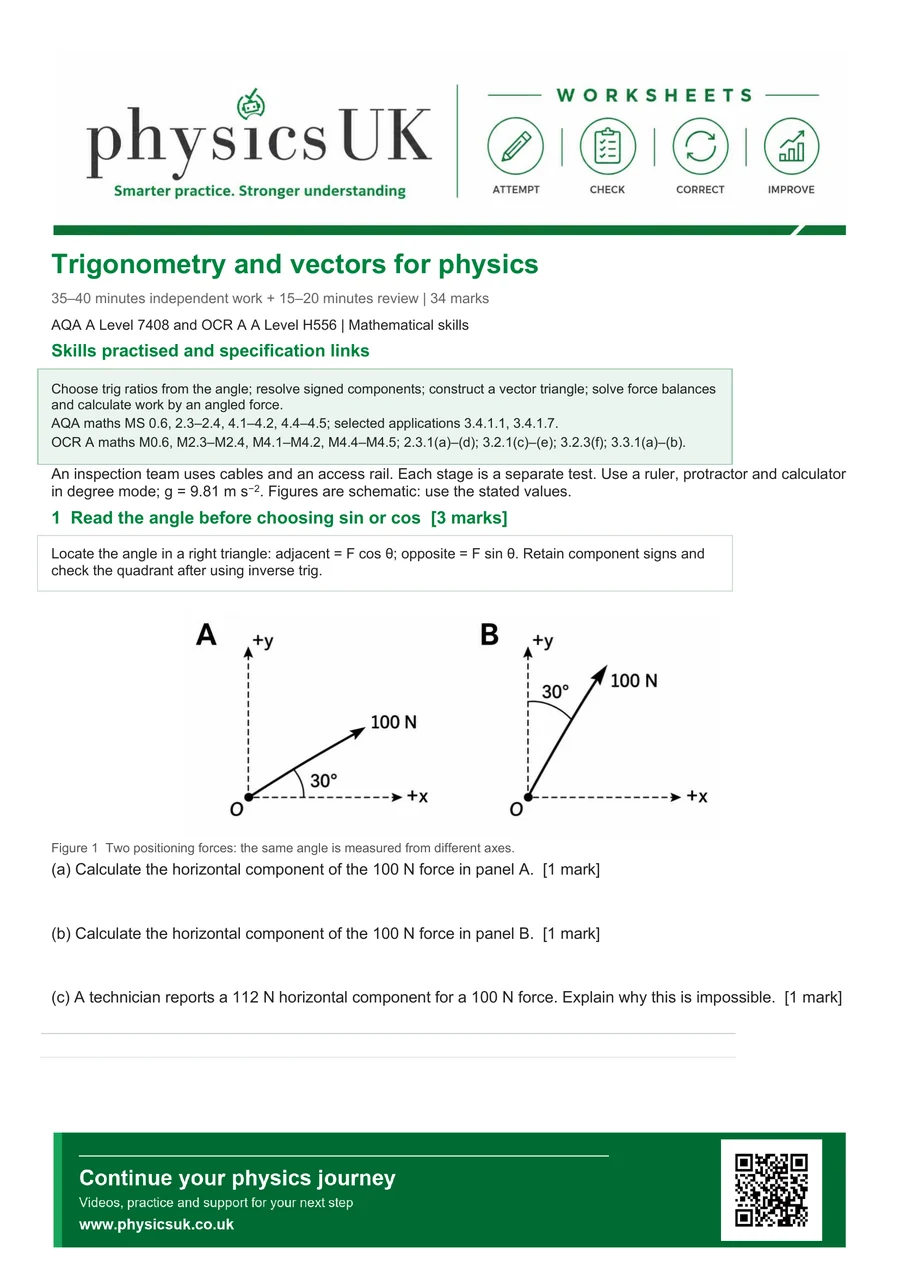
- Adjacent and opposite components for angles from different axes
- Signed components and kN-to-N conversion
- Free-body diagrams and inverse-trig angle recovery
- Pythagorean component identity
- Head-to-tail scale construction for oblique forces
- Magnitude and direction from two perpendicular components
- Three-force equilibrium with unequal cable angles
- Simultaneous component balances and checking both axes
- Cable working-tension selection
- Weight and pull components relative to an inclined rail
- Normal reaction reduced by an outward pull component
- Work by a force inclined to displacement
- Inverse-tangent quadrant checks
- Distinguishing a force from its components and scalar energy
About this activity
An inspection team positions a pod and a platform using support cables, and moves a separate carriage along an inclined access rail.
Before you start
Right-triangle trigonometry and inverse functions; Force, weight, translational equilibrium and work; Pythagoras, signed axes and basic equation rearrangement
Specification fit
This shared PDF includes the applicable boards’ references and a board-neutral footer. Choose an eligible course below and check the scope before assigning it.
- AQA A Level 7408 · Mathematical skills · 3.4.1.1, 3.4.1.7
- OCR A A Level H556 · Mathematical skills · 2.3.1(a), 2.3.1(b), 2.3.1(c), 2.3.1(d), 3.2.1(c), 3.2.1(d), 3.2.1(e), 3.2.3(f), 3.3.1(a), 3.3.1(b)
OCR A A Level Physics Worksheets
H556 · 2.3.1(a), 2.3.1(b), 2.3.1(c), 2.3.1(d), 3.2.1(c), 3.2.1(d), 3.2.1(e), 3.2.3(f), 3.3.1(a), 3.3.1(b)
Choose the correct pathway: Guided mathematical skills through separate inspection-team configurations. Signed components, angle choice, inverse trigonometry, pupil scale construction, three-force ring equilibrium and work by an angled pull. Oblique addition uses a scale drawing; the numerical resultant check starts from supplied perpendicular components, respecting the AQA calculation boundary. The platform load is transmitted as one force on the ring. Shared A-level pair only; no automatic AS/GCSE route, required-practical tag, two-dimensional collision, moment or complete mechanics-coverage claim.
Classroom use
Use the worksheet for class practice, homework, intervention, cover work or revision. Keep the PhysicsUK attribution intact when sharing copies with pupils.
Choose targeted follow-up practice
Use the diagnostic map to choose one or two worksheets. Keep your qualification and tier, and follow each PDF’s printed replacement instructions. The diagnostic score is not a grade prediction.