

Why does electric car range drop in winter?
A driver can charge an electric car to the same displayed percentage in summer and winter and still see a different estimated range. The car is not necessarily broken. It is using recent conditions to estimate how far the available energy might take it.
Cold weather changes both sides of that estimate: how much energy is needed for the journey, and how the battery performs while cold. Cabin heating, battery temperature control, tyres, air resistance and driving conditions can all contribute. Short trips repeatedly starting from cold can make heating especially noticeable.
Be careful with a headline promising a fixed winter loss. The US government fuel-economy guide cites a 2019 AAA study in which range fell by about 41% under a particular cold test with cabin heating. That is a result for the tested conditions and vehicles, not a prediction for every modern car.
The original study used five vehicles and compared controlled temperatures, including about -7 degrees Celsius and 24 degrees Celsius. Its results are useful evidence that heating and temperature matter. Differences in battery chemistry, heat pumps and control software mean they should not be used as a universal winter calculator.
Where does the battery energy go?
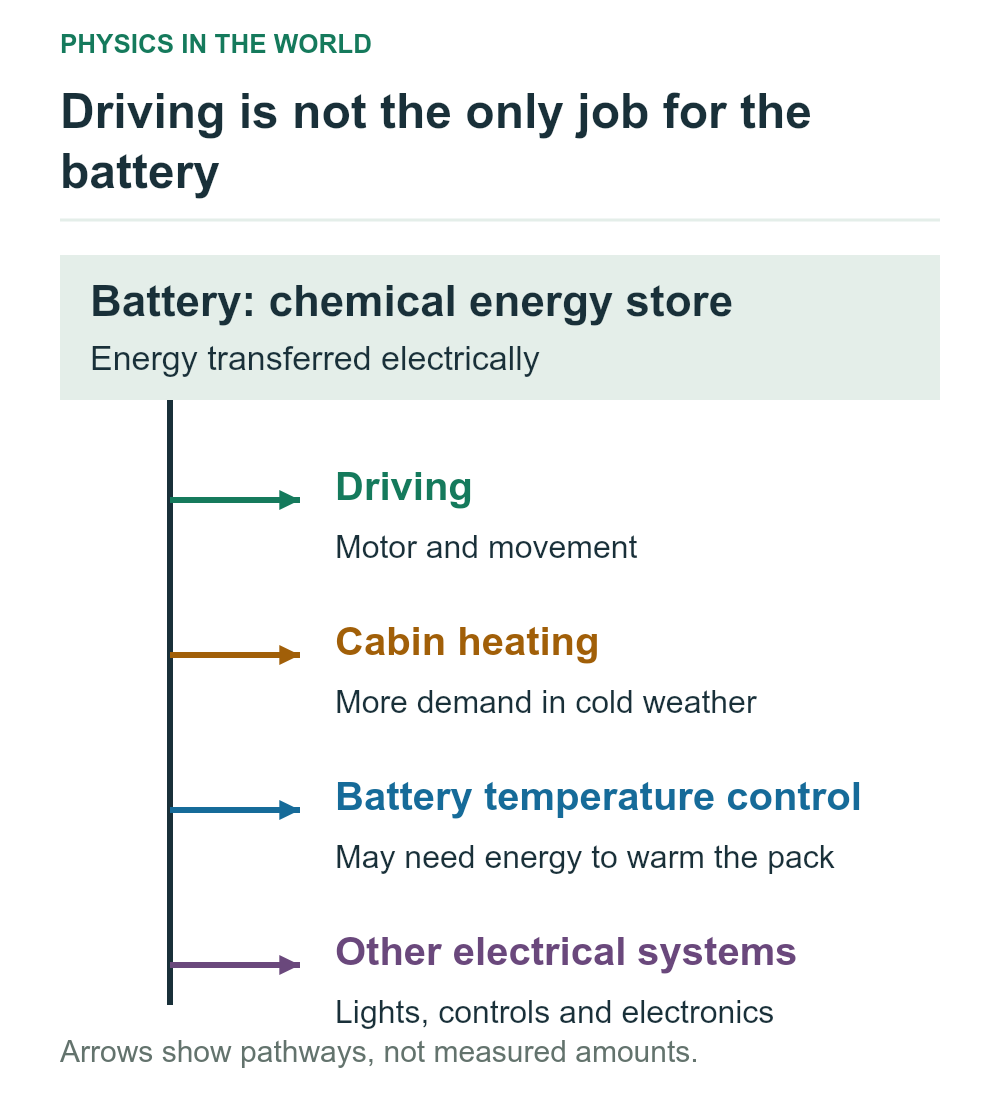
The battery stores energy chemically. While the car is operating, it supplies energy electrically to the motor and other systems. Driving is only one destination: lights, electronics, cabin heating and battery temperature management also need energy.
A combustion engine produces a large amount of waste heat that can help warm a cabin. An electric drive is more efficient and produces less waste heat, so a cold cabin often needs a separate heating input. There is no free heat just because the vehicle has a powerful motor.
A resistance heater transfers electrical energy to internal energy. A heat pump instead moves energy from one place to another using electrical work. It can deliver more heat to the cabin than the electrical energy it consumes because some of that heat comes from outside, not because it creates energy.
The battery itself also needs suitable operating conditions. At low temperature, processes that move charge inside a lithium-ion battery become less effective. Delivering energy and accepting charge can become harder, and the vehicle may warm the pack or limit power to protect it.
That is different from saying that the stored energy simply evaporates when the weather turns cold. Some reduced availability and performance can recover when the battery warms. Long-term battery health is a separate question, affected by chemistry, use and charging history as well as temperature.
What helps, and which claims need care?
Preconditioning means bringing the cabin or battery towards a useful temperature before you need it. When the car is plugged in, some of that energy can come from the external supply rather than the battery reserved for driving. It can help journey range, but it still uses electricity.
The Department of Energy recommends preheating while plugged in and notes that seat heating can warm occupants using less energy than heating the whole cabin. Follow the car's guidance: do not turn off necessary demisting or compromise visibility to save a small amount of energy.
A cold battery may accept charging power more slowly. It can also limit regenerative braking, which normally transfers some of the car's kinetic energy back into the battery. If the battery cannot accept that power, friction brakes may do more of the stopping and more energy ends up heating brake components.
A range display is an estimate, not a fixed physical property. A warm pack, a cold pack, motorway speed and a short urban trip can produce different estimates at the same displayed charge. Compare similar journeys before deciding that a sudden change means a battery fault.
For a longer winter journey, use the vehicle's current estimate, allow a sensible reserve and check charging arrangements. This article explains the physics; the manufacturer's instructions should guide charging and preconditioning for a specific car.
The GCSE physics behind winter range
Use energy stores and changes to follow the transfers. Energy leaves the battery's chemical store, supports motion and other functions, and eventually reaches the surroundings. A useful transfer today can still end as dispersed thermal energy later.
Our page on energy calculations and power explains why the length of time a heater runs matters. Power is the rate of energy transfer. A modest heating power maintained throughout a journey can use a substantial amount of energy; a kilowatt and a kilowatt-hour are not the same unit.
In efficiency and unwanted transfers, useful output depends on the purpose of the system. Heating the passenger compartment is useful for a comfortable, safe journey, even though it reduces the distance available from a charge. Do not call all heat wasted without saying what the system is meant to do.
An electrical engineer might design the drive electronics or battery controls. A mechanical engineer might work on thermal management and cabin heating. Improving winter performance needs those disciplines to work together, not just a larger battery.
A Level stretch: a cold battery is not a metal wire
An A Level circuit model represents a source using an electromotive force and an internal resistance. When current flows, some energy is transferred internally rather than delivered to the external circuit. A model with greater internal resistance predicts a larger voltage drop at the same current.
That model can help explain one aspect of reduced battery performance, but it is not the whole battery. Electrochemical transport, state of charge and temperature all affect real behaviour. A single resistance measured in one condition does not describe every charge and discharge situation.
Do not apply the temperature rule for a metal wire indiscriminately. A battery is an electrochemical system, not a length of copper. A metallic conductor becoming less resistive when cooled does not imply that a lithium-ion battery must deliver energy more easily when cooled.
The important habit is to state the assumptions behind a calculation. A fixed usable energy and constant drive power can make a useful classroom comparison of heater settings, but real range also depends on changing speed, hills, weather and battery management.
Key words
Quick pupil questions
Why do electric cars lose range in cold weather?
Heating uses additional energy, cold batteries can deliver and accept energy less effectively, and winter driving conditions can increase demand. The size of the change depends on the vehicle and journey.
How much range does an electric car lose in winter?
There is no single percentage for every car. Published test results must be read with their temperatures, heating settings and vehicle sample; your vehicle's current guidance and conditions matter.
Does preheating an electric car help winter range?
Preheating while plugged in can reduce the battery energy needed to warm the cabin at the start of the journey. The energy still comes from somewhere: preconditioning is not free electricity.
Why can regenerative braking be weaker with a cold battery?
The vehicle may limit how much charging power a cold battery can accept. Friction brakes then provide more of the braking, transferring energy to heat instead of returning as much to the battery.
Does a heat pump create extra energy?
No. It uses electrical work to move heat from another source. The delivered heat includes that external energy as well as the electrical input.