

Why talk about regenerative braking now?
European Mobility Week runs from 16 to 22 September, which makes this a useful moment to look at the physics of everyday transport. Regenerative braking is already in use: the interesting question is how a vehicle can put energy back while it slows down.
You may have felt an electric car decelerate when the driver lifts off the accelerator. Depending on its settings, the control system asks the motor for braking torque and recovers energy. The exact behaviour varies between vehicles, so this is an explanation of the physics rather than driving instructions.
How does regenerative braking charge a battery?
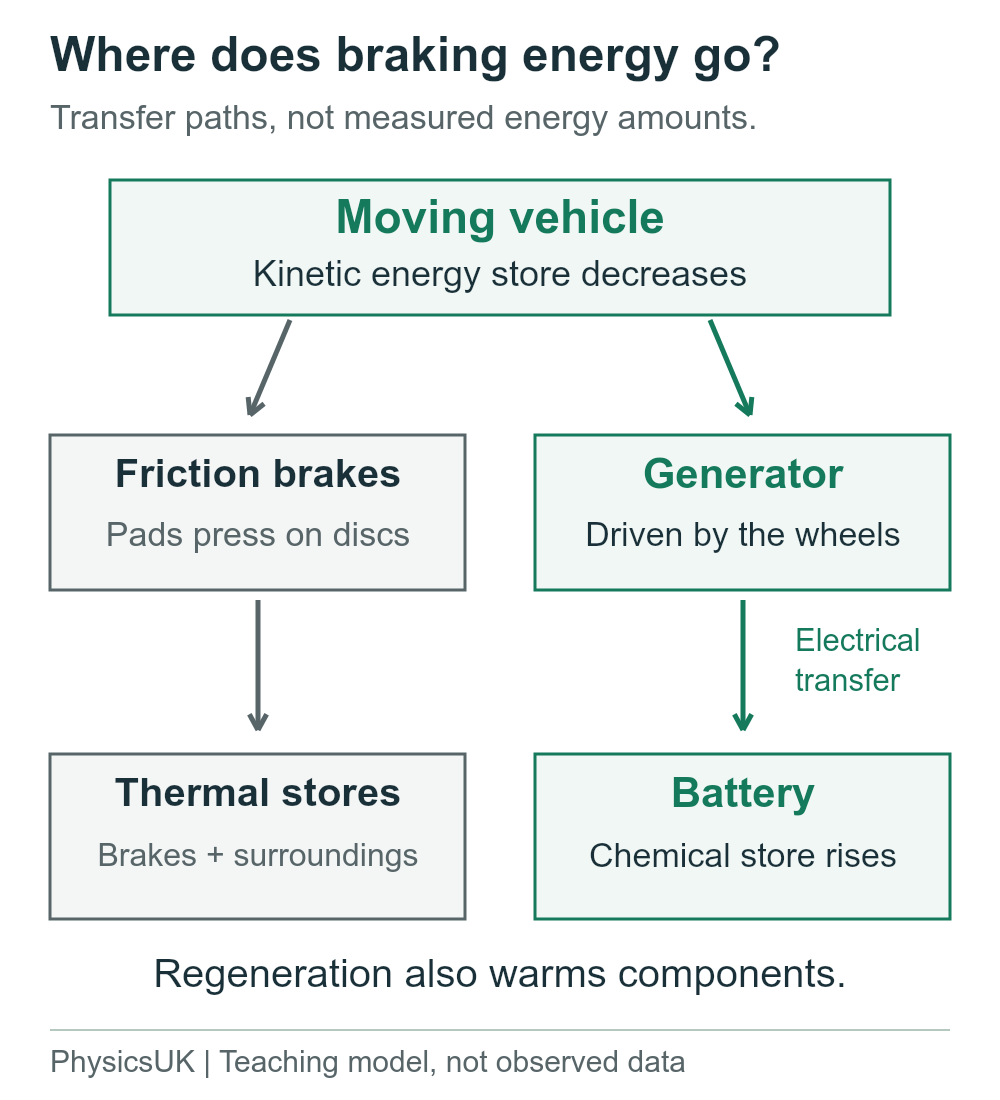
A moving car has a kinetic energy store. With conventional friction braking, pads press on rotating discs or drums. The car slows and the brakes get hotter. Energy has been transferred, not destroyed, but the dispersed thermal energy is difficult to use again for driving.
In regenerative braking, the wheels turn an electrical machine that acts as a generator. Movement relative to magnetic fields induces a voltage. When the control system allows current to flow, energy is transferred electrically towards the battery.
Inside the battery, charging increases its chemical energy store. Later, energy can leave that store, be transferred electrically to the motor and help accelerate the vehicle. Calling it an electricity store misses what is happening inside the battery.
The generator resists being turned while it supplies electrical energy. That resisting torque is useful here: it helps reduce the wheel speed. The system does not have to reverse the wheels or run the car backwards.
Some energy also warms the motor, power electronics and battery. Air resistance and tyre deformation take energy through other pathways. Regeneration captures a share of the energy available during slowing, not every joule associated with the journey.
What are the benefits and limits?
Repeatedly accelerating a heavy vehicle and then heating its brakes uses energy that must be supplied again at the next acceleration. Recovering part of the braking energy reduces that repeated demand. Stop-start routes give more opportunities for recovery than long stretches at constant speed.
A battery that is full has little room to accept more charge. Its temperature and charging-power limits can also constrain recovery. The vehicle must therefore coordinate the electrical system with its friction brakes; regeneration does not make conventional brakes unnecessary.
There is a difference between energy and power. A battery may have enough spare capacity for the total energy from a stop but be unable to accept it all in the few seconds available. The required charging power can be too high.
Trains can use the same generator principle without putting the recovered energy into a large onboard battery. Network Rail explains that modern trains on its third-rail network can return electricity to the conductor rail. Useful recovery depends on the supply system being able to receive or use it.
An electrical engineer works on the machine, power conversion and controls. A mechanical engineer considers torque, moving components and their loads. Braking is a good example of why real engineering rarely fits inside a single school topic.
The physics you meet at GCSE and A Level
Begin with energy stores and changes. A clear GCSE answer names the decreasing kinetic store, the increasing battery chemical store and the electrical transfer between them. It should also acknowledge energy dissipated to thermal stores.
The generator effect and electromagnetic induction is separate-physics Higher content in AQA GCSE. The key idea is a changing magnetic field through a coil, or motion of a conductor relative to a field, producing an induced potential difference. A complete conducting path allows a current.
At A Level, magnetic flux linkage gives a more precise way to describe the change. OCR A covers this in 6.3.3; AQA covers it in 3.7.5. The revision guide on electromagnetic induction and alternating currents connects the generator to Faraday's law and Lenz's law.
The induction simulation lets you change a field or motion and inspect the induced voltage. It represents a teaching model, not a complete electric-car controller, but it helps make the link between a changing field and an electrical output visible.
Science ideas to understand
Less waste is not new energy
The recovered energy was already in the moving vehicle, or came from descending a hill. The generator changes how energy is transferred.
One pedal does not mean one braking mechanism
A vehicle can coordinate regeneration, friction braking and a hold function. Behaviour depends on the model and settings.
A Level stretch: why generating electricity slows the wheels
Faraday's law links induced emf to the rate of change of magnetic flux linkage. Lenz's law gives the direction: the induced current produces a magnetic effect that opposes the change responsible for it.
For a generator feeding a load, that opposition appears as a torque resisting rotation. Mechanical work is needed to keep turning it. In a braking vehicle, the energy comes from the vehicle's motion instead of a person turning a handle.
Now imagine disconnecting the electrical load in an idealised generator. Rotation may still induce a voltage, but with no current there is no electrical power delivered to the load. An induced voltage alone is not evidence that useful energy is reaching a battery.
In a real vehicle, switching electronics regulate current and torque. A simple classroom coil is a useful model of induction, but the wheel speed, battery voltage and charging current are not connected by one unchanging resistance.
Regeneration also cannot create a self-charging car that drives indefinitely. Every cycle returns less useful energy than was supplied. On a downhill road, the extra source is the decreasing gravitational potential energy of the vehicle-Earth system.
Key words
Quick pupil questions
Does regenerative braking charge the battery?
Yes, when conditions allow. The wheels drive a generator and electrical energy is transferred into the battery, increasing its chemical store.
Why does regenerative braking work less when the battery is full?
A full battery cannot safely accept much additional charge. The control system limits regeneration and the vehicle uses other braking mechanisms as needed.
Do electric cars still need friction brakes?
Yes. Recovery is limited by charging power, battery condition, grip and the required braking force. Friction brakes remain part of the vehicle braking system.
Do trains use regenerative braking?
Many electric trains do. The traction motors act as generators and may return energy to the railway supply rather than storing it in an onboard battery.
Can regenerative braking recover 100% of the energy?
No. Some energy warms components or is dissipated through air resistance, rolling resistance and friction braking. Recovery also has practical power limits.