Induction requires a change, rather than simply the presence of a magnet. A microphone reverses the loudspeaker chain by turning motion into an electrical signal.
AQA 8463GCSE PhysicsHigher
Learn · practise · improve
Start here
The revision snapshot
Induction requires a change, rather than simply the presence of a magnet. A microphone reverses the loudspeaker chain by turning motion into an electrical signal.
By the end, you should be able to:
Explain induced p.d. from relative motion.
Compare alternator and dynamo output.
Explain the moving-coil microphone signal.
Before you revise
Diagnostic question
Choose an answer from memory. Your result tells you what to watch for in the guide.
Core revision guide
Learn the model, then use it
Induction requires a change, rather than simply the presence of a magnet. A microphone reverses the loudspeaker chain by turning motion into an electrical signal.
01
Induced potential difference
Scope: 8463 Physics only · Higher only
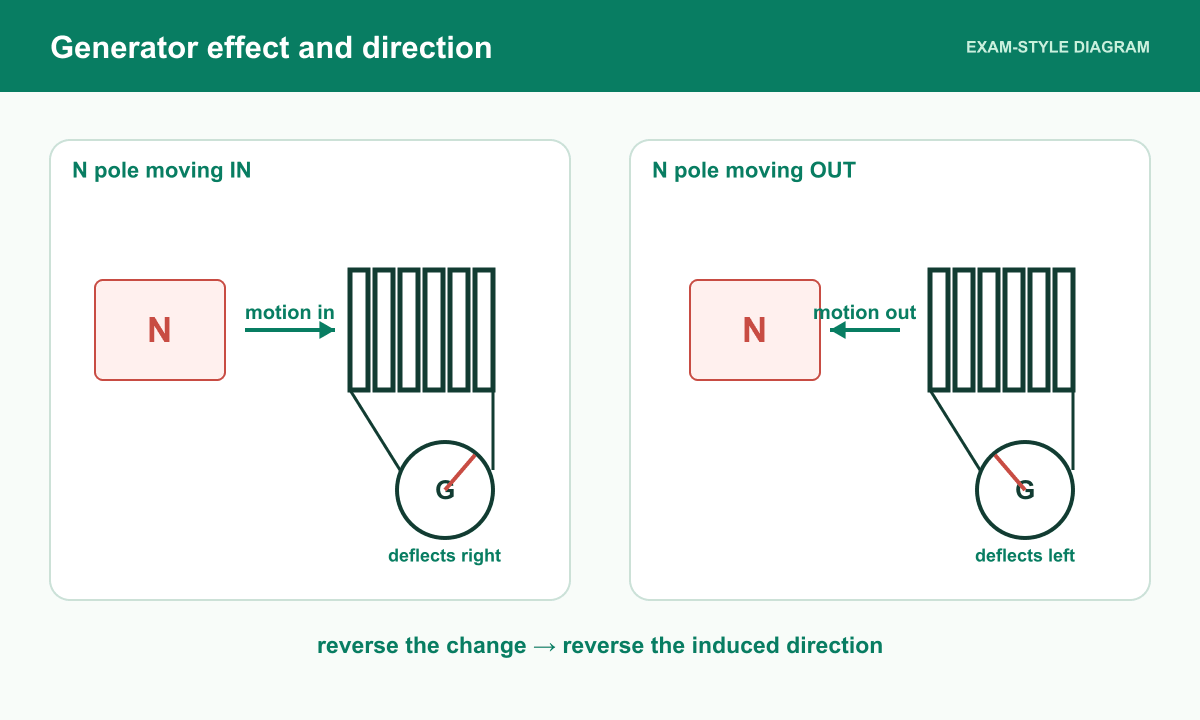
Relative motion of a conductor and magnetic field, or a change in field through a coil, induces a potential difference. Current flows only if there is a complete circuit. Faster change, stronger field and more coil turns increase the induced p.d. Reversing motion or field reverses its polarity. The induced current’s own magnetic effect opposes the change that produced it.
02
Alternator and dynamo
Scope: 8463 Physics only · Higher only
Rotating a coil in a field changes the field through it. Slip rings keep each coil end connected to one terminal, so output reverses each half-turn and is alternating. A split-ring arrangement reverses the external connection each half-turn, producing one-direction pulsing output in a simple dynamo. The mechanical input is transferred electrically, not created by the magnet.
03
Moving-coil microphone
Scope: 8463 Physics only · Higher only
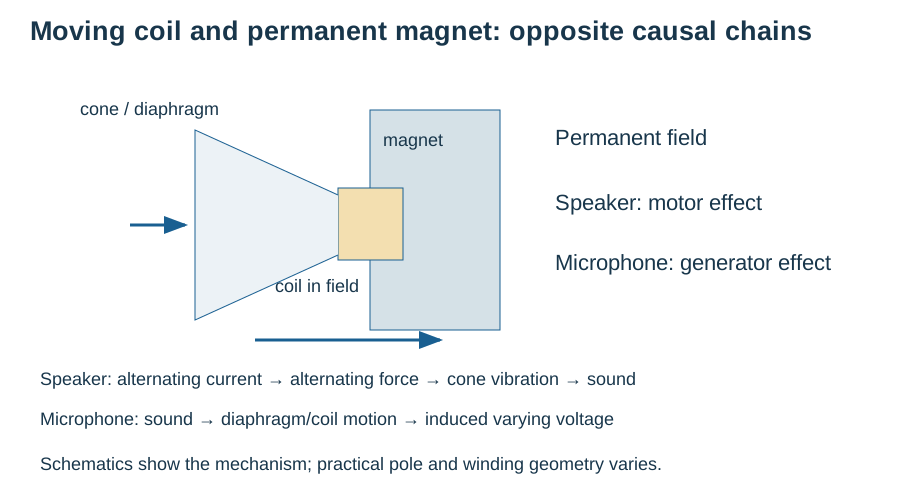
Sound pressure makes a diaphragm and its attached coil vibrate in a permanent magnetic field. The moving coil experiences changing field conditions, inducing a varying potential difference. Reversing coil motion reverses the signal; a connected circuit has a varying current. Frequency and amplitude of the electrical signal represent the sound. This is generator effect, whereas a loudspeaker uses motor effect.
A changing magnetic field induces potential difference; reversing the motion reverses the induced direction.Open the full-size exam diagram
Read each belief, say what is wrong with it, then compare your correction.
Tempting idea: A constant large induced voltage.
Use instead: Presence of field alone is insufficient. Induction depends on change.
Tempting idea: Current → force → cone motion → sound.
Use instead: That is the loudspeaker chain. Motion in the field gives generator output.
Retrieval practice
Quick checks
Explore the relationship
Induction and generator model
Change magnet speed or field strength. Their product is a relative induced p.d. index, not an absolute voltage.
Model scope: 8463 Physics only · Higher only
What to notice: use the readout to describe how one variable changes when the other is controlled.
Worked examples
See the method being built
Apply induced potential difference in the worked reasoning, then try the changed-context questions below.
Example 1 · Move a magnet
Scope: 8463 Physics only · Higher only
A magnet is pushed into a coil. Describe the meter reading.
Field through coil changes.
A p.d. is induced.
State reversal effect.
Show the answer
The meter deflects while the magnet moves; pulling it out reverses the induced current direction.
Example 2 · Increase output
Scope: 8463 Physics only · Higher only
Give two ways to increase induced p.d. in a generator.
Increase rate of change.
Name variables.
Avoid saying a stationary magnet induces continuously.
Show the answer
Move the magnet/coil faster, use a stronger magnet or increase turns on the coil.
Example 3 · AC generator
Scope: 8463 Physics only · Higher only
Explain why a rotating coil generator produces alternating p.d.
Coil sides cut field in changing directions.
Induced direction reverses each half-turn.
State alternating output.
Show the answer
The direction of induced p.d. reverses every half-turn, producing alternating current.
Exam precision
Use the physics precisely
Do this: State what changes the field linkage and what reverses. For a microphone connect sound, diaphragm/coil motion and induced signal in order.
Independent practice
Exam-style questions
Write an answer before opening the marking guidance. Then edit the exact phrase or step that would gain the next mark.
1. Explain why moving a magnet through a closed coil produces a current but leaving it still does not.
[3 marks]
Scope: 8463 Physics only · Higher only
Show marking guidance and model answer
Original PhysicsUK mark scheme: Point 1 (1 mark): Motion changes the magnetic field through the coil. Point 2 (1 mark): The change induces p.d., driving current in the closed circuit. Point 3 (1 mark): When still, the field is constant, so there is no continuous induced p.d. Award each distinct point once. Accept equivalent scientifically correct wording. No half marks.
Motion changes the magnetic field through the coil. (1 mark)
The change induces p.d., driving current in the closed circuit. (1 mark)
When still, the field is constant, so there is no continuous induced p.d. (1 mark)
Model answer: Motion changes the field through the coil and induces p.d. that drives current. At rest there is no continuing change and no continuing induced output.
2. Describe the operation of a moving-coil microphone.
[3 marks]
Scope: 8463 Physics only · Higher only
Show marking guidance and model answer
Original PhysicsUK mark scheme: Point 1 (1 mark): Sound pressure vibrates a diaphragm attached to a coil. Point 2 (1 mark): The coil moves in a permanent magnetic field. Point 3 (1 mark): This induces a varying p.d.; a closed circuit carries a varying current representing the sound. Award each distinct point once. Accept equivalent scientifically correct wording. No half marks.
Sound pressure vibrates a diaphragm attached to a coil. (1 mark)
The coil moves in a permanent magnetic field. (1 mark)
This induces a varying p.d.; a closed circuit carries a varying current representing the sound. (1 mark)
Model answer: Sound vibrates the diaphragm and coil. Coil motion in the magnet’s field induces a varying electrical signal that follows the sound.
Questions pupils ask
Generator Effect and Electromagnetic Induction FAQs
Why does a stationary microphone coil not produce the changing signal?
A changing induced voltage requires relative motion/change of magnetic flux. Sound moves the diaphragm and coil through the field.